
A self-contained “city within a city” of red-brick mills and workers’ terraces, built by Łódź’s greatest cotton baron — one of the most complete industrial landscapes in Europe.
At a glance
Księży Młyn is a near-complete nineteenth-century industrial quarter in the south of Łódź — the heart of Karol Scheibler’s cotton empire, the largest in the whole Kingdom of Poland. From the 1870s Scheibler built here not just a vast spinning mill but everything a workforce needed around it: long terraces of workers’ houses, a school, shops, two hospitals, a fire station, a club, even a railway siding. Modelled on English industrial settlements, it was a self-sufficient “city within a city”, and it survives largely intact — one of Europe’s most complete industrial landscapes, protected since 1971.
Key facts
- Location: Księży Młyn, south-central Łódź, Poland
- What it is: a 19th-century industrial settlement (mill and company town) of Karol Scheibler
- Built: from the 1870s (the area held mills from 1824)
- The mill: a castle-like cotton spinning works, the largest in Łódź (about 207 m long)
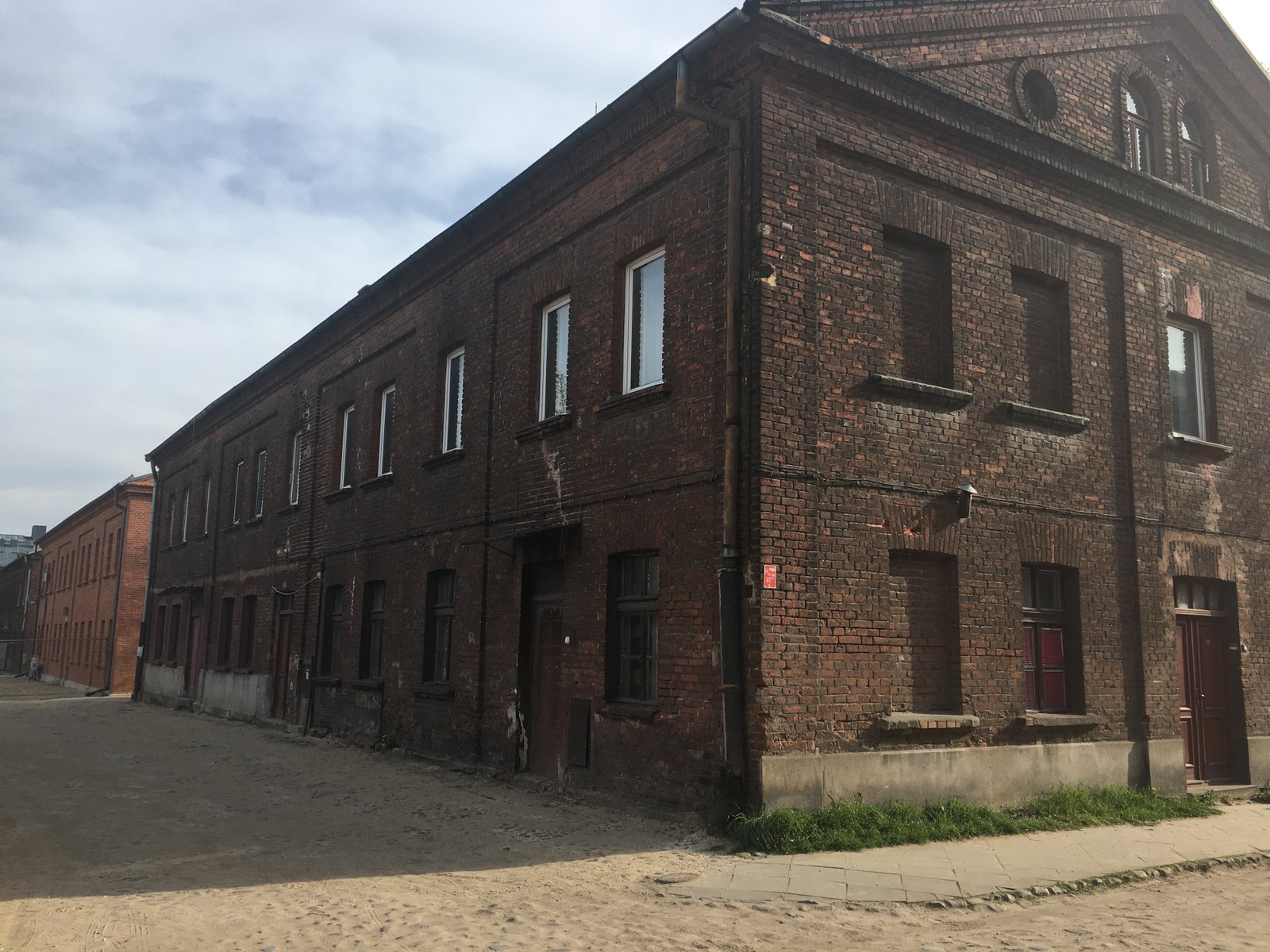
- Workers’ housing: the “famuły” — 18 two-storey brick houses in three rows, 1873–79
- Protected: industrial-architecture monument since 1971; part of Łódź’s “Monument of History”
History
The land at Księży Młyn — the “Priest’s Mill” — had carried watermills since the Middle Ages and cotton mills since 1824. It was Karol Scheibler who transformed it. From the 1870s the Cotton King assembled here the largest industrial complex in the Kingdom of Poland, centred on a spinning mill so long and crenellated it reads as a brick castle.
Around the factory Scheibler built a whole society. The famuły — eighteen two-storey brick workers’ houses in three rows, raised between 1873 and 1879 — stood beside the mill; nearby came a school, shops, two hospitals, a fire brigade, a workers’ club, gasworks and a railway siding, with the owners’ villas and a park completing the plan. The layout that Łódź made its own — factory, owner’s residence, workers’ estate, all together — was first and best realised here, on the model of the English industrial towns.
Most of it still stands. Recognised as an industrial-architecture monument in 1971 and later folded into Łódź’s “Monument of History” designation, Księży Młyn is now a heritage district: the mills converted to lofts and culture, the famuły still lived in, the whole reading as a textbook of how a nineteenth-century industrial city was built and housed.
What you see
The estate is best walked. The long red-brick spinning mill dominates, its towers and battlements giving it the look of a fortress; opposite run the famuły, plain two-storey terraces with the rhythm of a planned town. Between and around them lie the school, the shop, the hospital and the club, and the park with its pond.
Set into the same district are the owners’ houses — Karol Scheibler’s palace, now the Film Museum, and the Herbst villa, now part of the Museum of Art — so the whole social order of an industrial city, from mill floor to ballroom, can be read within a few hundred metres.
Practical information
- An open district, freely walkable; the museums and converted mills keep their own hours
- Best explored on foot, ideally as a loop taking in the mill, the famuły and the palaces
- Allow a half-day to see the area and one or two of its museums
- Cobbles and distances — comfortable shoes help
Getting there
Księży Młyn lies in the south-eastern part of central Łódź, off Przędzalniana Street, a short tram ride or a longer walk from Piotrkowska Street. Łódź is about 130 km south-west of Warsaw, with frequent trains to Łódź Fabryczna and Łódź Widzew.
Nearby
- Karol Scheibler’s Palace (the Film Museum)
- Herbst Palace (a branch of the Museum of Art)
- Piotrkowska Street and the Manufaktura complex
Sources
- Łódź city tourism (lodz.travel / visitlodz)
- Zabytek.pl — National Heritage Board of Poland (NID)
- City of Łódź — “Monument of History” designation
- Industrial-heritage registers
Find it on the map
See this place and what’s around it →📷 Become a Cultural Heritage Online photographer
Share your photos of places: they stay published under your name as the author. The more they're seen, the more you get noticed — and soon a contest will reward the most appreciated photos.
Log in or sign up free to add a photo