
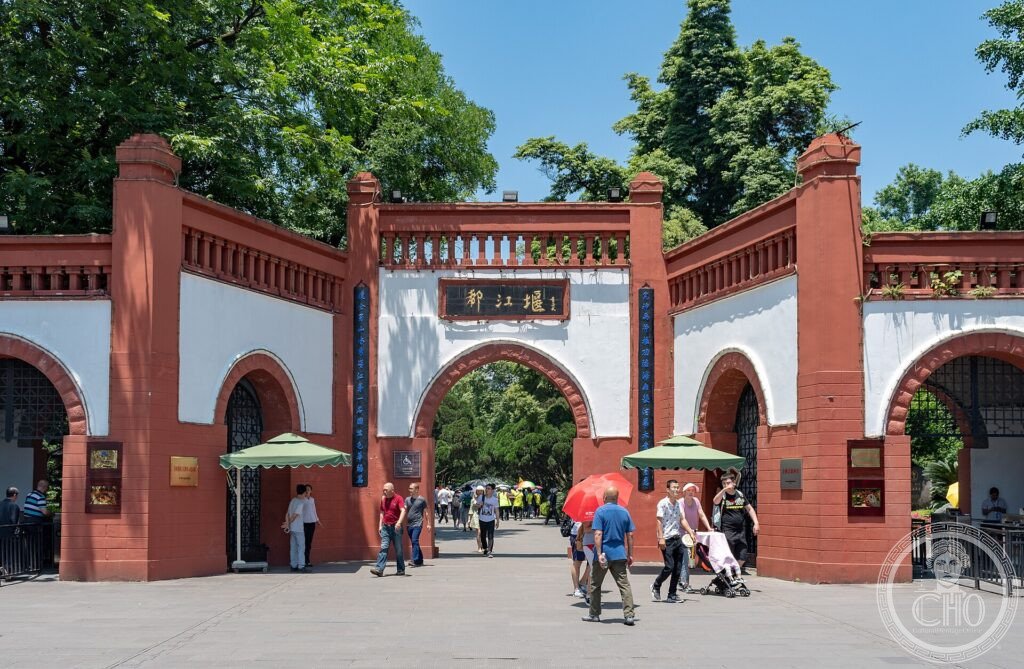
Oltre duemila anni fa l’ingegnere Li Bing domò il fiume Min senza dighe, con un sistema di canali e argini che ancora oggi irriga la pianura del Sichuan: è Dujiangyan, capolavoro dell’idraulica antica. Vicino si erge il Monte Qingcheng, una delle culle del taoismo, fra templi nascosti nei boschi.
At a glance
The UNESCO site near Chengdu unites two monuments of ancient China. The Dujiangyan irrigation system, begun around 256 BC by the engineer Li Bing, tamed the unruly Min River without a dam, using a dividing levee, a spillway and an intake to water the Chengdu plain — an engineering marvel still working after more than two thousand years. Nearby rises Mount Qingcheng, one of the cradles of Daoism, dotted with ancient temples in dense forest. They were inscribed together by UNESCO in 2000.
Key facts
- UNESCO: World Heritage since 2000 (Mount Qingcheng and the Dujiangyan Irrigation System)
- Dujiangyan: an irrigation system begun about 256 BC by Li Bing
- Damless engineering: divides and channels the Min River by levee and spillway
- Still working: it irrigates the Chengdu plain to this day
- Mount Qingcheng: one of the birthplaces of Daoism
- Daoist temples: ancient halls hidden in the mountain forest
History
In the 3rd century BC the engineer Li Bing, governor of the region, devised at Dujiangyan a way to control the flood-prone Min River and water the Chengdu plain without building a dam: a levee splits the river, a spillway sheds floodwater and sediment, and an intake channels water to the fields. The system transformed Sichuan into one of China’s most fertile regions and has been maintained ever since — the oldest such waterworks still in use.
Close by, Mount Qingcheng was, by tradition, where the Daoist master Zhang Daoling founded one of the earliest organised Daoist communities in the 2nd century AD. Temples and pavilions were built among its forests, making the mountain a centre of Daoism to this day.
What you see
At Dujiangyan, paths and bridges cross the works of the irrigation system — the fish-mouth levee, the spillway and the intake — with temples and a suspension bridge overlooking the rushing Min. On Mount Qingcheng, forest trails climb past Daoist temples, gates and pavilions to the summit, in an atmosphere of green seclusion.
Together the engineering and the sacred mountain show the Chinese ideal of harmony between human work and nature.
Practical information
- Sites: Dujiangyan town and Mount Qingcheng are a short distance apart
- Time needed: a day for both
- Note: an easy day trip from Chengdu
- Setting: on the edge of the Chengdu plain
Getting there
Dujiangyan and Mount Qingcheng are about 50 km north-west of Chengdu, the capital of Sichuan, China, reached by frequent trains and road. GPS: 31.00° N, 103.60° E.
Nearby
- Chengdu — the provincial capital and giant-panda base
- Mount Qingcheng — the Daoist mountain, part of the site
- Sichuan plain — the fertile farmland the system waters
Sources
- UNESCO World Heritage Centre — “Mount Qingcheng and the Dujiangyan Irrigation System” (ref. 1001)
- Dujiangyan administration — official body
- Encyclopaedia Britannica — Dujiangyan; Daoism
Find it on the map
See this place and what’s around it →📷 Become a Cultural Heritage Online photographer
Share your photos of places: they stay published under your name as the author. The more they're seen, the more you get noticed — and soon a contest will reward the most appreciated photos.
Log in or sign up free to add a photo