
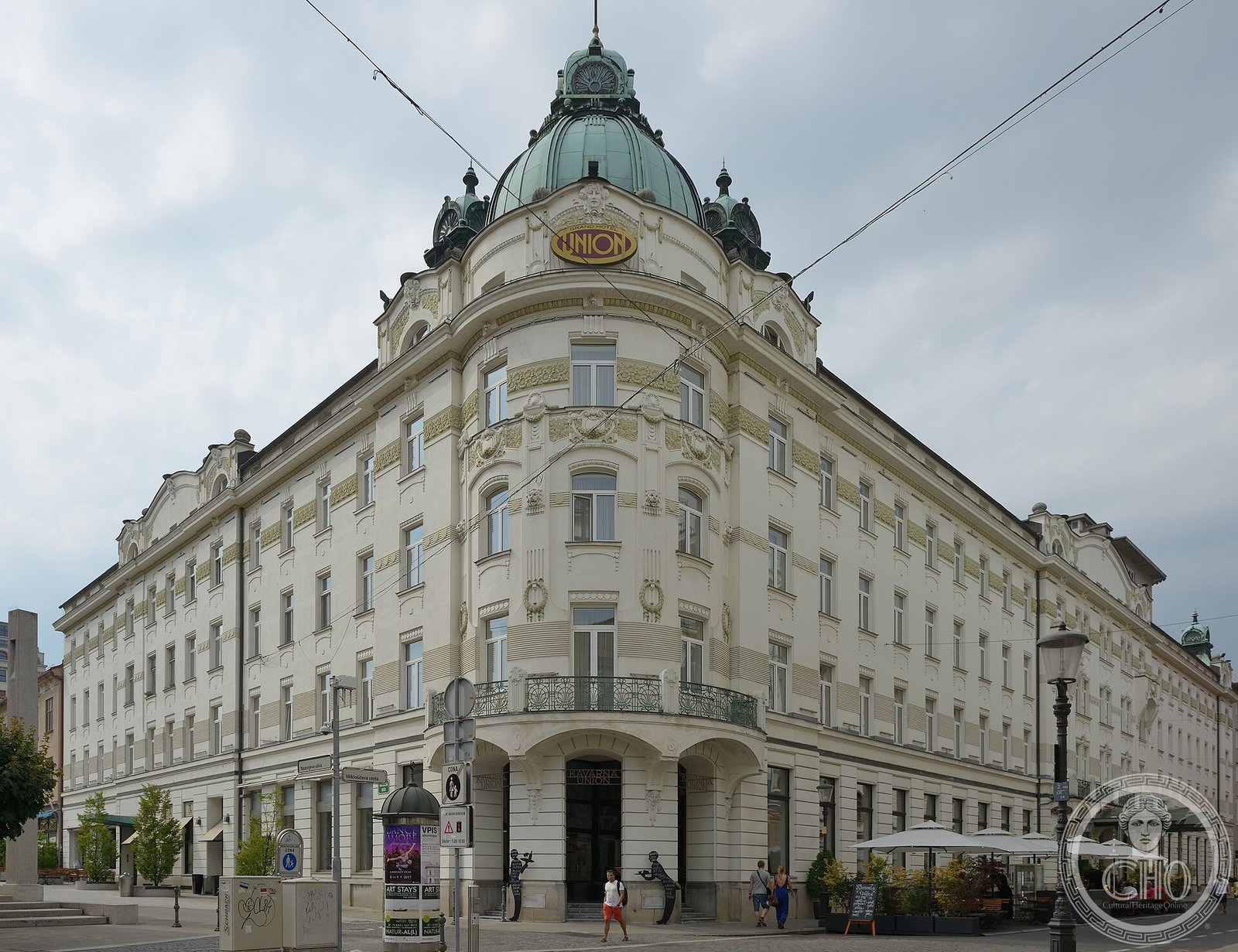
Ljubljana's first modern hotel, opened in 1905 to designs by architect Josip Vančaš, is one of the finest Vienna Secession buildings in the city and a landmark of its post-earthquake rebirth.
At a glance
The Grand Hotel Union stands at Miklošičeva cesta 1 in central Ljubljana, where the street it helped define opens toward the heart of the old town. Designed by the architect Josip Vančaš (1859–1932), a connoisseur of the Viennese Secession, and built by Viljem Treo's firm in just eighteen months, it opened on 28 October 1905 with a celebration that lasted seven days. It was the first modern hotel in Ljubljana and, for several years, the largest building in the city. With its roughly 100-metre Art Nouveau façade, domed corner tower, and a grand concert hall that was among the largest in the region, the Union was conceived not merely as lodging but as a declaration of modernity, complete with electric lighting, central heating, a lift, and a telephone.
Key facts
- Designed by architect Josip Vančaš (1859–1932), an expert in the Viennese Secession style; built by Viljem Treo
- Opened on 28 October 1905; construction took just 18 months and the opening celebration lasted seven days
- Built in the Vienna Secession / Art Nouveau style, with a façade about 100 metres long and a complex iron roof considered a great technical achievement
- The first modern hotel in Ljubljana and, at the time, one of the biggest and finest hotels in the Austro-Hungarian Monarchy
- Among the first buildings in the city with electric lighting, central heating, a lift, and a telephone
- Features a rounded, domed corner tower that still serves as the southern entrance to the building
- Home to a grand concert hall (today's Union Hall), historically among the largest in the region
History
The Grand Hotel Union belongs to the wave of ambitious building that transformed Ljubljana after the devastating 1895 earthquake, when the city set out to remake itself as a modern Central European capital. The project was driven by the Slovene doctor, businessman and politician Vinko Gregorič; construction began in 1903–1904 and the hotel was raised in roughly eighteen months by the firm of Viljem Treo, reportedly consuming millions of bricks and dozens of wagonloads of iron girders. To design it, the investors turned to Josip Vančaš (1859–1932), an architect deeply familiar with the contemporary architectural developments of Vienna and a connoisseur of its Secession trends. The hotel opened on 28 October 1905 with festivities that ran for seven days, and the newspapers of the day hailed it as one of the largest, most modern and most elegant hotels in southeastern Europe.
From the outset the building was a stage for the cultural, political and social life of the city. Its grand concert hall (today's Union Hall) hosted concerts by famous orchestras and conductors, congresses, state celebrations, rallies and lectures, as well as the famed Black and White Masquerades between the two world wars. Over more than a century the Union has remained at the centre of public life in the capital. The hall was completely renovated in 2002 and restored to its original glamour, while a broader renovation of the property was completed in 2010; today the hotel operates as Grand Hotel Union Eurostars and still preserves the original Art Nouveau character in the Union Hall and main lobby.
What you see
From the street, the eye is drawn to the long Secession façade — close to 100 metres — animated with ornamental garlands, heads of female figures and cartouches, and crowned by a rounded, domed corner tower that still marks the southern entrance. The three-storey building presents itself as a self-confident urban palace at the head of Miklošičeva cesta. Inside, the showpiece is the grand concert hall, today's Union Hall, historically counted among the largest in the region; together with the main lobby it preserves the original Art Nouveau character, with undulating lines, lavish furnishings and stucco work restored to their early-20th-century glamour.
Practical information
- Now operating as Grand Hotel Union Eurostars, a working hotel; the lobby, café and Union Hall carry the historic Secession atmosphere
- The domed corner tower marks the southern entrance, historically leading to the Union Café
- The Union Hall regularly hosts concerts, congresses and cultural events (around 700 events a year)
- Best appreciated from the street to take in the full length of the Art Nouveau façade and the corner dome
Getting there
The hotel sits at Miklošičeva cesta 1 in the very centre of Ljubljana, a few minutes' walk north of Prešeren Square and the Triple Bridge, and an easy walk from the Ljubljana railway and bus stations just up the same street. The historic core is pedestrian-friendly, so the building is best reached on foot.
Nearby
- Cooperative Business Bank Building (Vurnik House), the boldly coloured 1921 landmark by Ivan and Helena Vurnik on Miklošičeva cesta — roughly 150–250 m along the same street
- Dragon Bridge (Zmajski most), the celebrated 1901 Art Nouveau bridge with its four dragon statues — about 300–400 m to the east
- The Secession buildings lining Miklošičeva cesta, part of Ljubljana's post-1895 Art Nouveau reconstruction — immediately along the street
Sources
- Grand Hotel Union — History, Union Hotels official (https://www.union-hotels.eu/en/grand-hotel-union/about-hotel/history/)
- Grand Hotel Union: remarkable, glamorous, historical — Visit Ljubljana (https://www.visitljubljana.com/en/meetings/why-ljubljana/of-tales-and-secrets/grand-hotel-union-remarkable-glamorous-historical)
- Grand Hotel Union Hall — Culture.si (https://www.culture.si/en/Grand_Hotel_Union_Hall)
- The Grand (hi)story of the Grand Hotel Union — Kongres Magazine (https://kongres-magazine.eu/2018/10/the-grand-history-of-the-grand-hotel-union/)
Find it on the map
See this place and what’s around it →📷 Become a Cultural Heritage Online photographer
Share your photos of places: they stay published under your name as the author. The more they're seen, the more you get noticed — and soon a contest will reward the most appreciated photos.
Log in or sign up free to add a photoIs this page about you?
This page is read by travellers and heritage enthusiasts who find it on Google. Tell us how you are connected to this place and we will take it from there.