
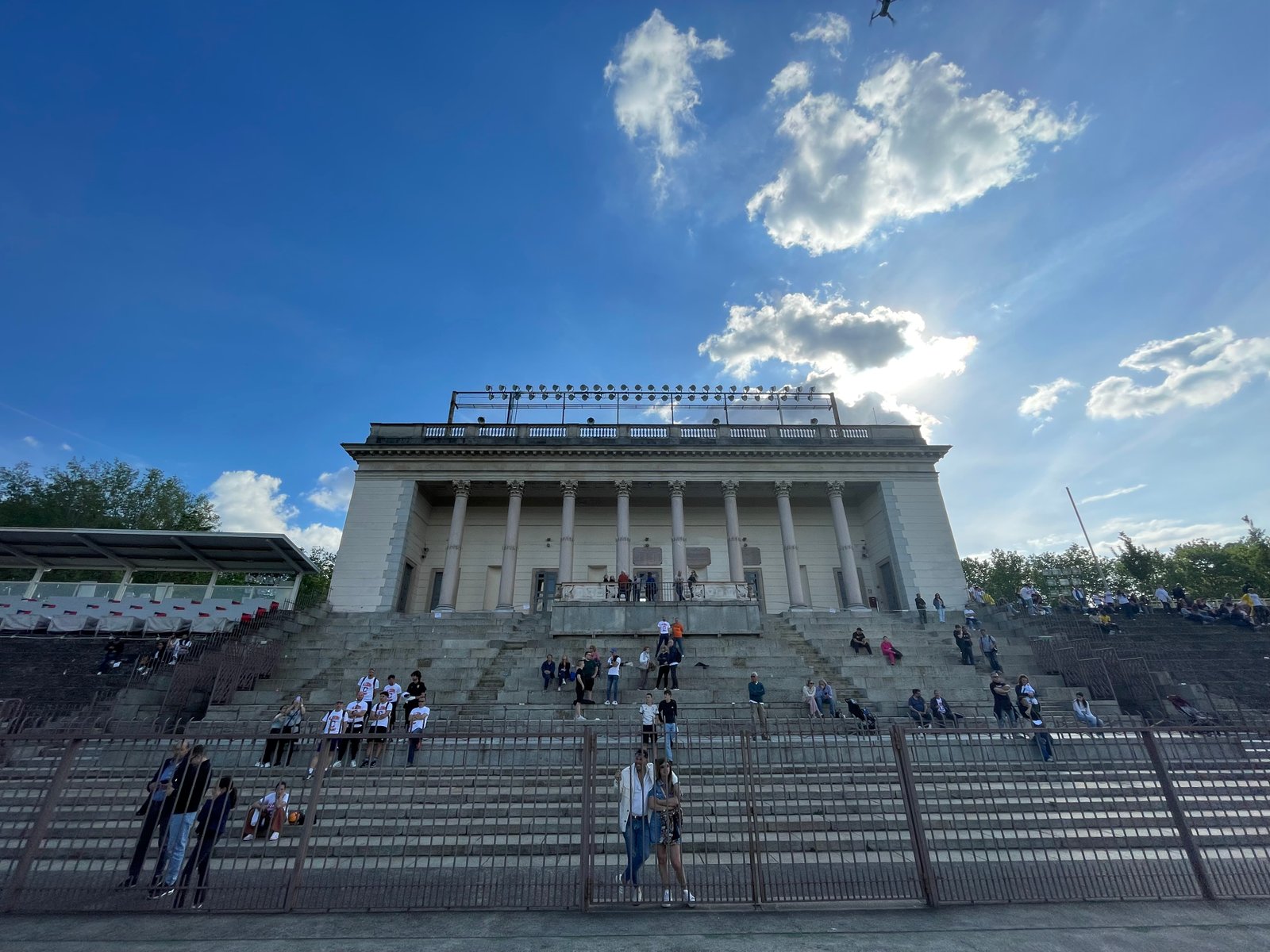
The royal box of Milan’s Arena Civica: a neoclassical pavilion of pink-granite columns, finished in 1813 to seat Napoleon’s family above the games.
At a glance
The Palazzina Appiani stands on the rim of the Arena Civica, on the Parco Sempione side of Milan. Luigi Canonica designed it as part of the Arena he raised from 1807 on the model of a Roman amphitheatre. Completed in 1813, the building was the pulvinare — the box of honour — meant to seat Napoleon and his family above the spectacles below. A loggia of eight pink-granite Corinthian columns faces the arena; inside, a Hall of Honour carries a long frieze of triumphal processions. The building takes its name from the painter Andrea Appiani. The FAI cared for it for a decade; in 2025 it returned to the city.
Key facts
- Location: Viale Byron 2, Parco Sempione, Milan, Lombardy
- Architect: Luigi Canonica
- Completed: 1813 (the Arena begun 1807)
- Function: pulvinare — royal box of the Arena Civica, for Napoleon’s family
- Loggia: eight monolithic Corinthian columns in pink granite
- Named after: the neoclassical painter Andrea Appiani
- Managed by: the FAI until January 2025; now the Comune di Milano
History
When Napoleon took Milan in 1796, the city became a capital of his Italian state, and his administration drew up ambitious plans to remake it. Few were built. The Arena Civica, laid out by the Ticinese architect Luigi Canonica from 1807, was one that was — a vast oval for games, races and staged naval battles, modelled on the amphitheatres of Rome.
The Palazzina Appiani completed the design. Finished in 1813 and reached through a triumphal gate, the pulvinare gave the ruling family a box of honour facing the track. Eight monolithic columns of pink granite form its loggia toward the arena; behind them, the Hall of Honour was lined with marble and crystal and wrapped in a continuous frieze of triumphal processions, painted in the manner of Andrea Appiani, the leading neoclassical painter of Napoleonic Milan, whose name the building still carries.
For most of its life the pavilion stood quietly at the park’s edge. The Fondo Ambiente Italiano took it under a ten-year management agreement, opening it for guided visits and events; when that agreement ended in January 2025, care returned to the Comune di Milano. It remains one of the clearest surviving fragments of Napoleon’s unbuilt Milan.
What you see
From inside the Arena the Palazzina reads as a temple front: eight Corinthian columns of pink granite, single shafts, carrying a plain entablature. The pink stone against the green of Parco Sempione is the first thing most visitors notice.
The interior is the reason to go in. The Hall of Honour keeps its Napoleonic dress — marble surfaces, crystal, and a frieze that runs the room like a Roman triumph unrolled along the wall. The scale is domestic next to the Arena outside, but the ambition is imperial.
Practical information
- Opening varies; the building hosts events and guided tours — check the current operator before visiting
- Set inside Parco Sempione, beside the Arena Civica Gianni Brera
- Easy to combine with the park, the Castello Sforzesco and the Arco della Pace
- Allow about 30 minutes
Getting there
The Palazzina sits in Parco Sempione, at the Arena Civica on Viale Byron. The nearest Metro stops are Lanza and Moscova on line M2, each a short walk away; the Castello Sforzesco and Cadorna are also close. Several tram lines pass along the edge of the park.
Nearby
- Arena Civica Gianni Brera
- Arco della Pace
- Castello Sforzesco and Parco Sempione
- Cimitero Monumentale
Sources
- Fondo Ambiente Italiano (FAI) — property page
- WikiMilano
- Lombardia Beni Culturali — Regione Lombardia
- Comune di Milano / YesMilano
Find it on the map
See this place and what’s around it →📷 Become a Cultural Heritage Online photographer
Share your photos of places: they stay published under your name as the author. The more they're seen, the more you get noticed — and soon a contest will reward the most appreciated photos.
Log in or sign up free to add a photoIs this page about you?
This page is read by travellers and heritage enthusiasts who find it on Google. Tell us how you are connected to this place and we will take it from there.