
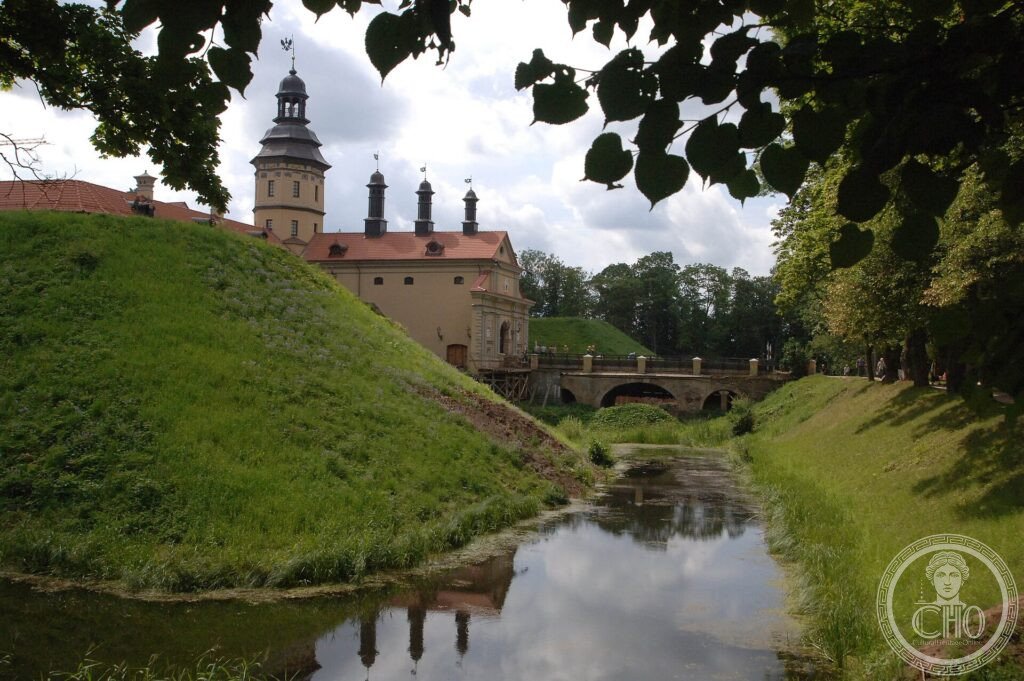
Per oltre quattro secoli i Radziwiłł, una delle più potenti famiglie d’Europa orientale, ressero la loro corte a Nesvizh. Il loro palazzo-fortezza e la chiesa del Corpus Domini — la prima chiesa barocca a pianta cruciforme dell’Europa centro-orientale — diffusero da qui modelli artistici per tutta la regione.
At a glance
Nesvizh was the seat of the Radziwiłł family, among the most powerful dynasties of the Polish-Lithuanian Commonwealth, who held it from the 16th to the 20th century. Their residence, a fortified palace surrounded by ramparts and a moat, grew over the centuries from Renaissance into Baroque. Beside it, the Corpus Christi Church, built in the 1580s–1590s, was the first cross-domed Baroque (Jesuit-plan) church in Eastern Europe and a model widely copied. The complex was inscribed by UNESCO in 2005.
Key facts
- UNESCO: World Heritage since 2005 (Radziwiłł Family Complex at Nesvizh)
- The Radziwiłłs: seat of the magnate dynasty from the 16th to 20th century
- Corpus Christi Church: the first cross-domed Baroque church in Eastern Europe
- Architect: the Italian Giovanni Maria Bernardoni for the church
- Palace: a fortified residence with ramparts, moat and park
- Mausoleum: the church crypt holds the Radziwiłł family tombs
History
The Radziwiłłs made Nesvizh their chief seat in the 16th century, when Mikołaj Krzysztof Radziwiłł “the Orphan” transformed the wooden castle into a modern fortified palace and brought the Italian architect Giovanni Maria Bernardoni to build the Corpus Christi Church. Completed in the 1590s, the church introduced the Jesuit cross-domed Baroque plan to the region, where it was widely imitated.
From Nesvizh the family patronised printing, theatre and the arts, and their court radiated influence across the Commonwealth and beyond. The palace was rebuilt after wars and remodelled into the 18th and 19th centuries; restored after the upheavals of the 20th century, it and the church preserve the legacy of one of Eastern Europe’s great dynasties.
What you see
The palace stands behind grassy ramparts and a moat, a long range of buildings around an arcaded courtyard, its rooms restored as a museum of the Radziwiłłs. Avenues and ponds of the surrounding park lead the eye out from the residence.
In the town, the Corpus Christi Church presents a serene early-Baroque facade; within, frescoes and the family crypt recall four centuries of the dynasty.
Practical information
- Palace: a museum; interiors visited by ticket
- Church: the Corpus Christi Church and crypt in the town
- Time needed: 2–3 hours; combine with Mir Castle
- Setting: palace, park and town church a short walk apart
Getting there
Nesvizh is in the Minsk region of central Belarus, about 120 km south-west of Minsk and near Mir. It is reached by road or bus from Minsk. GPS: 53.2225° N, 26.6914° E.
Nearby
- Mir Castle — the other Radziwiłł UNESCO site, about 30 km away
- Minsk — the Belarusian capital
- Belarusian countryside — lakes, forests and small towns
Sources
- UNESCO World Heritage Centre — “Architectural, Residential and Cultural Complex of the Radziwill Family at Nesvizh” (ref. 1196)
- National Historical and Cultural Museum-Reserve “Nesvizh” — official body
- Encyclopaedia Britannica — Radziwiłł family
Find it on the map
See this place and what’s around it →📷 Become a Cultural Heritage Online photographer
Share your photos of places: they stay published under your name as the author. The more they're seen, the more you get noticed — and soon a contest will reward the most appreciated photos.
Log in or sign up free to add a photoIs this page about you?
This page is read by travellers and heritage enthusiasts who find it on Google. Tell us how you are connected to this place and we will take it from there.