
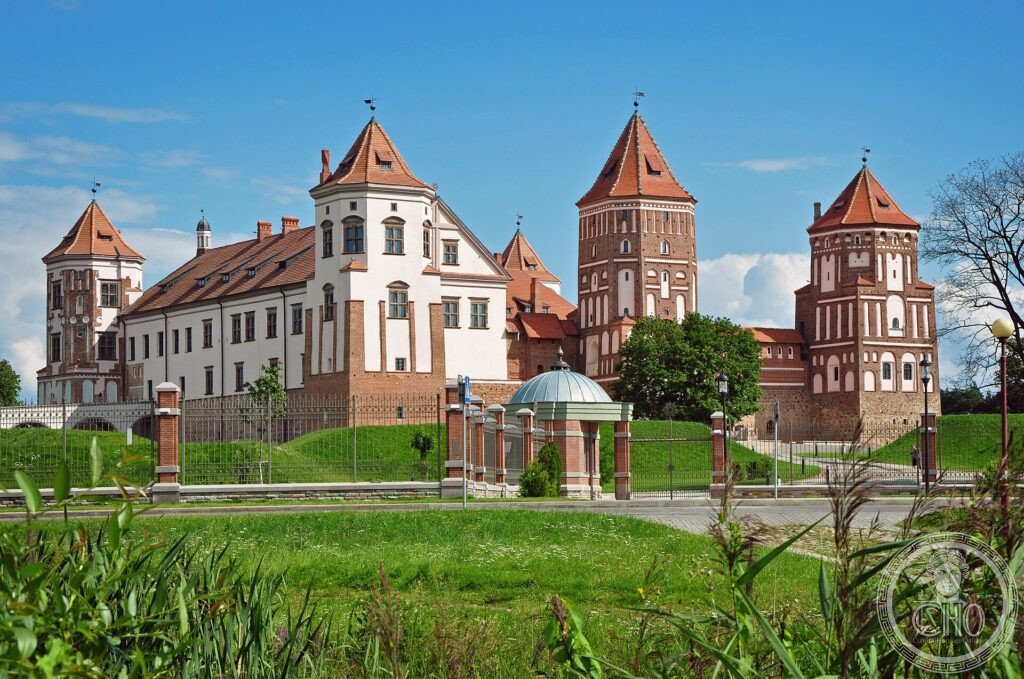
Sorta sui confini contesi dell’Europa, la fortezza di Mir riassume nei suoi muri le ondate di stili che hanno attraversato la Bielorussia: il gotico delle torri, il Rinascimento dei cortili, il barocco delle aggiunte. Un castello di mattoni rossi e merli, a lungo dimora della grande famiglia Radziwiłł.
At a glance
Mir Castle, in central Belarus, is an outstanding example of Central European castle-building in which Gothic, Renaissance and Baroque all leave their mark. Begun around the start of the 16th century in the late Gothic style, with tall brick towers, it passed to the powerful Radziwiłł family, who added Renaissance and Baroque elements and a landscaped setting. Standing on the historic borderlands between Catholic and Orthodox, Western and Eastern Europe, it was inscribed by UNESCO in 2000.
Key facts
- UNESCO: World Heritage since 2000 (Mir Castle Complex)
- Begun: early 16th century, in the late Gothic style
- Three styles: Gothic towers, Renaissance courtyard, Baroque additions
- The Radziwiłłs: long held by the great Lithuanian-Polish noble family
- Borderland: on the historic frontier of cultures and faiths
- Setting: beside a chapel-mausoleum and a landscaped pond
History
The castle was begun around 1500 by the Illinich family in the late Gothic manner, with four corner towers and a gate-tower of red brick. It soon passed to the Radziwiłłs, among the wealthiest magnates of the Polish-Lithuanian Commonwealth, who turned the fortress into a residence, adding a Renaissance palace wing within the walls and, later, Baroque touches.
Damaged in successive wars, including the Napoleonic campaign, the castle declined, then was partly restored under later owners who laid out a park and built a family mausoleum. Carefully conserved after the 20th century, it stands as a record of the layered cultural history of the Belarusian lands.
What you see
The castle presents a square of high walls with five towers, the brick patterned in white plaster decoration, its Gothic mass softened by Renaissance and Baroque detail. Within the courtyard rises the palace wing; the rooms now hold a museum of the castle’s history and the Radziwiłł family.
Outside, a landscaped pond mirrors the towers, and a small Orthodox chapel-mausoleum stands among the trees.
Practical information
- Castle: a museum; interiors and towers are visited by ticket
- Time needed: 2–3 hours
- Note: easily combined with Nesvizh, the other Radziwiłł residence
- Setting: in the small town of Mir
Getting there
Mir is in the Grodno region of central Belarus, about 85 km south-west of Minsk. It is reached by road or bus from Minsk. GPS: 53.4514° N, 26.4731° E.
Nearby
- Nesvizh — the other great Radziwiłł residence, also UNESCO-listed
- Minsk — the Belarusian capital, about 85 km north-east
- Navahrudak — a historic town with castle ruins nearby
Sources
- UNESCO World Heritage Centre — “Mir Castle Complex” (ref. 625)
- National Historical and Cultural Museum-Reserve “Nesvizh” — official body
- Encyclopaedia Britannica — Belarus (architecture)
Find it on the map
See this place and what’s around it →📷 Become a Cultural Heritage Online photographer
Share your photos of places: they stay published under your name as the author. The more they're seen, the more you get noticed — and soon a contest will reward the most appreciated photos.
Log in or sign up free to add a photoIs this page about you?
This page is read by travellers and heritage enthusiasts who find it on Google. Tell us how you are connected to this place and we will take it from there.