


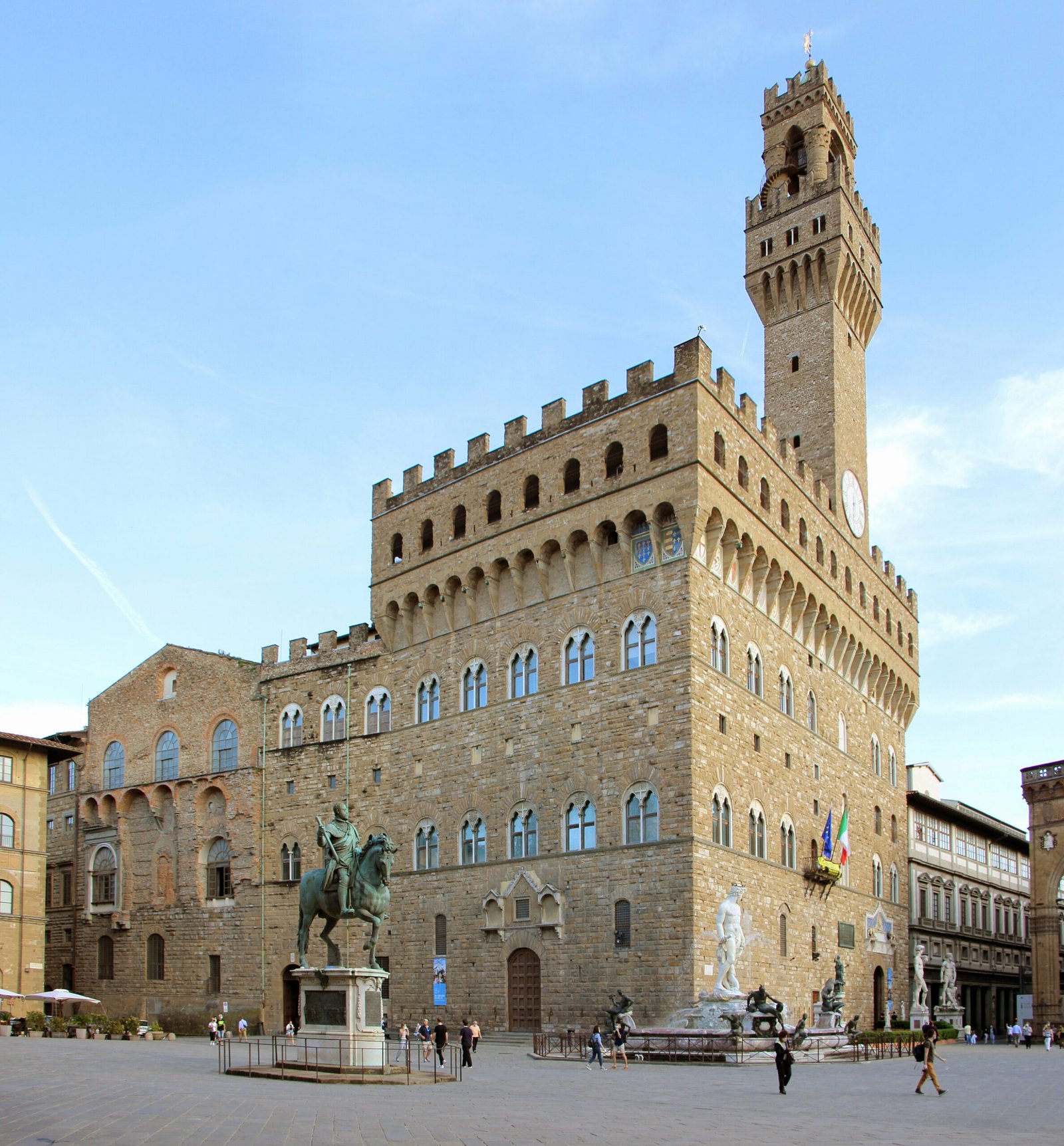
Florence’s most iconic civic palace, Palazzo Vecchio dominates Piazza della Signoria as the seat of the Municipality and one of the world’s finest examples of fourteenth-century civil architecture.
At a glance
This fortress-like palace stands as the symbolic heart of Florence’s political life. Originally the seat of the city’s republican government, it later served as the residence of Duke Cosimo I de’ Medici before becoming the city’s municipal headquarters. Today it functions as both administrative centre and museum, showcasing masterworks by Renaissance masters.
History
Built as “Palazzo dei Priori” to house Florence’s ruling magistrates, the building acquired the name “Palazzo della Signoria” in the fifteenth century, reflecting the republic’s governing body. When Duke Cosimo I de’ Medici established his residence here in 1540, it became “Palazzo Ducale.” The epithet “Vecchio” (Old) arrived after 1565, when the ducal court relocated to the newly favoured Palazzo Pitti. From 1865 to 1871, Palazzo Vecchio served as seat of the Parliament of the Kingdom of Italy during Florence’s role in the newly unified nation.
What you see
The palace exemplifies the robust, crenellated style of Florentine civic architecture, with its distinctive tower rising prominently above the piazza. The interior preserves magnificent chambers decorated and frescoed by Renaissance luminaries including Agnolo Bronzino, Domenico Ghirlandaio, and Giorgio Vasari. These rooms display works by Michelangelo, Donatello, and Verrocchio, creating an unparalleled survey of Florentine artistic achievement.
Cultural significance
Palazzo Vecchio represents the apogee of fourteenth-century Florentine republican ideals made stone. Its architecture and interior decoration embody the city’s transition from medieval commune to Renaissance power. The palace’s role as both political nerve centre and artistic patron—employing and commissioning the era’s greatest artists—made it instrumental in Florence’s cultural dominance during this transformative period.
Key facts
- Address: Piazza della Signoria, 2, 50122 Florence
- Coordinates: 43.769922, 11.256761
- Phone: 055 276 8224
- Official website: https://cultura.comune.fi.it/pagina/musei-civici-fiorentini
Practical information
Palazzo Vecchio functions as both the municipal seat and a museum open to the public. Hours and admission fees are available through the official website. The building’s historical significance and artistic collections make it one of Florence’s principal attractions.
Getting there
The palace stands in the heart of Florence’s historic centre, directly fronting Piazza della Signoria. Public transport connections are excellent; the piazza is walkable from Florence’s main railway station in approximately fifteen minutes. Parking nearby can be challenging; public transport or walking are recommended.
Sources & resources
Gallery
Find it on the map
See this place and what’s around it →📷 Become a Cultural Heritage Online photographer
Share your photos of places: they stay published under your name as the author. The more they're seen, the more you get noticed — and soon a contest will reward the most appreciated photos.
Log in or sign up free to add a photoIs this page about you?
This page is read by travellers and heritage enthusiasts who find it on Google. Tell us how you are connected to this place and we will take it from there.