
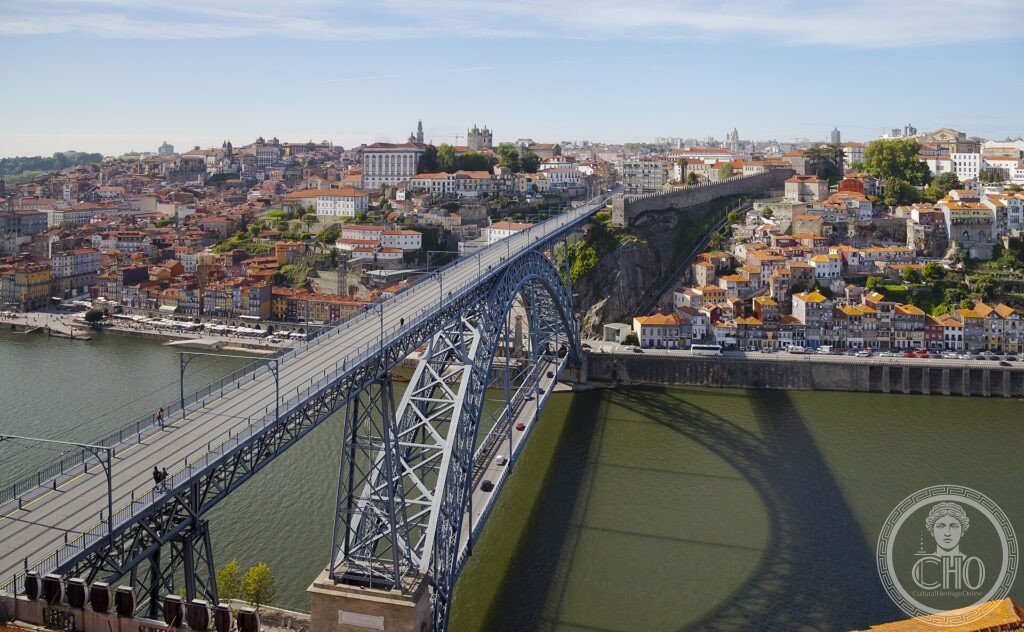
Aggrappata alle colline sopra il Douro, Porto guarda dall’alto i suoi magazzini di vino e il grande ponte di ferro di Dom Luís I. Città di mercanti e di lavoro, ha dato il nome al Portogallo e al suo vino più famoso. Il centro storico, un labirinto di vicoli che scende fino alla Ribeira, è Patrimonio dell’Umanità.
At a glance
Porto is the second city of Portugal, built on granite hills above the deep gorge of the river Douro. Its dense historic centre, the Ribeira, tumbles down to the water in a maze of medieval streets, beneath the cathedral and the great iron arch of the Dom Luís I Bridge. Across the river, the lodges of Vila Nova de Gaia age the port wine to which the city gave its name. A trading city for a thousand years, its old town and bridge were inscribed by UNESCO in 1996.
Key facts
- UNESCO: World Heritage since 1996 (extended 2016 to the bridge and Serra do Pilar)
- The Douro: the old town climbs the north bank of the river gorge
- Dom Luís I Bridge: a double-deck iron arch of 1886, by the Seyrig studio (Eiffel’s circle)
- Port wine: aged across the river in the lodges of Vila Nova de Gaia
- Landmarks: the Romanesque Cathedral (Sé), the Clérigos Tower, São Bento station’s azulejos
- Origins: Roman Portus Cale, which gave Portugal its name
History
Porto grew from the Roman settlement of Portus Cale at the mouth of the Douro, a name that later spread to the whole nation. Through the Middle Ages it prospered as a merchant city, fiercely independent, its people nicknamed tripeiros for the tripe they ate after giving their meat to Henry the Navigator’s ships. The Ribeira quarter on the river became the commercial heart.
From the 17th century the trade in port wine, shipped down the Douro in flat-bottomed boats and aged in Vila Nova de Gaia, brought wealth and an English merchant community. The 19th century added grand iron structures, above all the Dom Luís I Bridge of 1886, whose double deck became the city’s emblem.
What you see
From the upper town the streets drop steeply to the Ribeira, where tall coloured houses crowd the quay beneath the bridge. The Sé cathedral and the Clérigos Tower mark the skyline; São Bento railway station dazzles with blue-and-white azulejo tiles, and the Livraria Lello is among the most beautiful bookshops in the world.
Crossing the upper deck of the Dom Luís I Bridge gives a sweeping view of the gorge, the port lodges opposite and the river curving toward the sea.
Practical information
- Old town: freely walkable, but steep — comfortable shoes help
- Port lodges: tours and tastings across the river in Vila Nova de Gaia
- Time needed: two days for the old town, river and port lodges
- Note: the funicular and bridge link the upper and lower town
Getting there
Porto is in northern Portugal. It has an international airport and fast trains from Lisbon (about 3 hours) to Campanhã and São Bento stations, both near the old town. The metro links the airport to the centre. GPS: 41.1408° N, 8.6116° W.
Nearby
- Vila Nova de Gaia — the port-wine lodges across the river
- Alto Douro — the terraced wine country up the river valley
- Guimarães — the “cradle of Portugal”, also UNESCO-listed, to the east
Sources
- UNESCO World Heritage Centre — “Historic Centre of Oporto, Luiz I Bridge and Monastery of Serra do Pilar” (ref. 755)
- Câmara Municipal do Porto — official city authority
- Encyclopaedia Britannica — Porto
Find it on the map
See this place and what’s around it →📷 Become a Cultural Heritage Online photographer
Share your photos of places: they stay published under your name as the author. The more they're seen, the more you get noticed — and soon a contest will reward the most appreciated photos.
Log in or sign up free to add a photo