

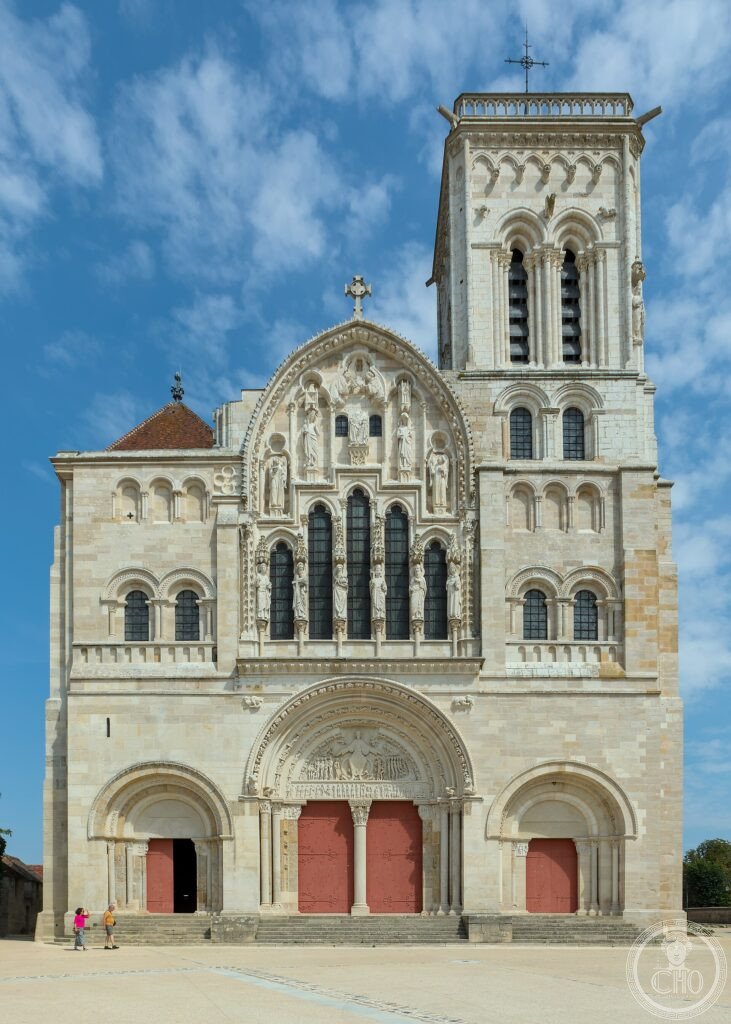
On the «eternal hill» of Burgundy, a church holds the relics of Mary Magdalene and, on its inner portal, one of the greatest sculptures of the Middle Ages: Christ sending out the apostles, with the winds breathed upon all the peoples of the earth. From here Saint Bernard preached the Second Crusade, and Richard the Lionheart set out on the Third.
At a glance
The basilica of Sainte-Marie-Madeleine crowns the hill of Vézelay in northern Burgundy, a masterpiece of 12th-century Romanesque art and one of the great pilgrimage churches of the Middle Ages. The Benedictine abbey, founded in the 9th century, claimed the relics of Mary Magdalene, drawing pilgrims from across Europe and becoming a gathering-point on the roads to Santiago de Compostela. The church, built between about 1120 and 1150, is famous above all for the sculpted tympanum of its inner portal — Christ sending out the apostles — and for the carved capitals of its luminous nave. UNESCO inscribed “Vézelay, Church and Hill” in 1979.
Key facts
- UNESCO: World Heritage since 1979 (“Vézelay, Church and Hill”)
- Relics: the abbey claimed the relics of St Mary Magdalene, making Vézelay one of the chief pilgrimage sites of the medieval West and a departure point on the way to Santiago de Compostela
- The great tympanum: over the inner doorway of the narthex, the Romanesque masterpiece of the “Mission of the Apostles” (Pentecost), c. 1120–30 — Christ in glory sending the apostles to convert the nations
- The nave: built c. 1120–40, with banded two-colour arches and a celebrated series of carved capitals (among them the Mystic Mill)
- Crusades: St Bernard of Clairvaux preached the Second Crusade here in 1146 before Louis VII and Eleanor of Aquitaine; in 1190 Richard the Lionheart and Philip Augustus mustered here for the Third Crusade
- Restoration: near ruin by the 19th century, the basilica was rescued and restored from 1840 by the young Eugène Viollet-le-Duc
History
The hill of Vézelay was settled by Benedictine monks in the 9th century; the cult of Mary Magdalene, whose relics the abbey claimed to hold, turned it into one of the busiest shrines of Christendom by the 11th and 12th centuries. The wealth of pilgrimage paid for the great church, begun after a fire in 1120 and built in two generations. Its sculpture — the apocalyptic tympanum, the inventive capitals — made Vézelay a fountainhead of Romanesque art.
The hill was also a stage of European history: St Bernard preached the Second Crusade from it in 1146, and kings gathered here for the Third. When a rival claim to the Magdalene relics arose at Saint-Maximin in Provence in the 13th century, Vézelay’s pilgrimage declined; the Wars of Religion and the Revolution left the basilica half-derelict, until Prosper Mérimée sent the 27-year-old Viollet-le-Duc to save it in 1840.
What you see
You enter through the narthex, a great vaulted porch, and look up at the inner portal: Christ enthroned in a mandorla, rays from his hands reaching the apostles, and around them the strange peoples of the world the apostles were sent to convert — a Romanesque vision of Pentecost carved with astonishing energy. Beyond, the nave opens long and bright, its transverse arches banded in pale and dark stone, its capitals carved with biblical scenes, labours and monsters — the famous “Mystic Mill” among them.
The choir, rebuilt in early Gothic, is lighter still; the crypt below holds the reliquary of the Magdalene. From the terrace behind the church the view runs over the vineyards and woods of the Morvan — the reason the place is called the eternal hill.
Practical information
- Visiting: the basilica is a working church (a Monastic Fraternities of Jerusalem community) and free to enter
- Light: at the summer solstice, a line of light from the south windows falls along the nave axis — a celebrated effect
- Time needed: 1 hour for the church, more for the medieval town below
Getting there
Vézelay is in the Yonne, in northern Burgundy. By train to Sermizelles-Vézelay (Paris–Auxerre line) then a short bus/taxi; by car via the A6 (exit Avallon). GPS: 47.4663° N, 3.7485° E.
Nearby
- Avallon — the fortified town on its granite spur, 15 km south-east
- Parc naturel régional du Morvan — the wooded hills and lakes around Vézelay
- Fontenay & Chablis — the Cistercian abbey to the east and the white-wine vineyards to the north
Sources
- UNESCO World Heritage Centre — “Vézelay, Church and Hill” (ref. 84)
- Burgundy Tourism — Basilique Sainte-Marie-Madeleine de Vézelay
- Centre des monuments nationaux / Encyclopaedia Britannica
Find it on the map
See this place and what’s around it →📷 Become a Cultural Heritage Online photographer
Share your photos of places: they stay published under your name as the author. The more they're seen, the more you get noticed — and soon a contest will reward the most appreciated photos.
Log in or sign up free to add a photoIs this page about you?
This page is read by travellers and heritage enthusiasts who find it on Google. Tell us how you are connected to this place and we will take it from there.