
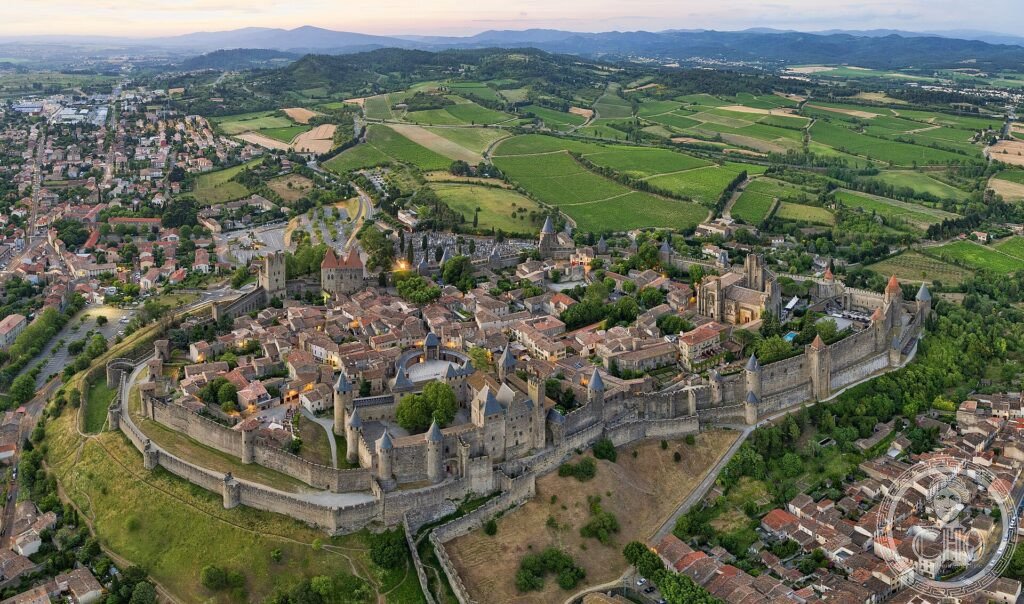
Cité de Carcassonne: la città murata medievale dalla doppia cinta e dalle 52 torri
Tre chilometri di mura, due cinte concentriche, cinquantadue torri: vista dalla pianura dell’Aude, la Cité di Carcassonne sembra uscita da un libro di fiabe. Lo è in parte: rifugio dei catari, presa nella crociata albigese, poi quasi in rovina, fu il restauro ottocentesco di Viollet-le-Duc a darle i tetti a punta che la rendono inconfondibile.
At a glance
The Cité de Carcassonne, on a hill above the river Aude in Occitania, is one of the most complete medieval fortified towns in Europe. A double ring of walls about 3 km long, studded with 52 towers, encloses a small town, the Château Comtal and the basilica of Saints-Nazaire-et-Celse. The site has some 2,500 years of history — Gallo-Roman, Visigothic, then the stronghold of the Trencavel viscounts and a refuge of the Occitan Cathars — before its dramatic capture in the Albigensian Crusade and annexation to the French crown. Half-ruined by the 19th century, it was famously restored by Eugène Viollet-le-Duc, and inscribed by UNESCO in 1997.
Key facts
- UNESCO: World Heritage since 1997 (Historic Fortified City of Carcassonne)
- Defences: two concentric walls about 3 km long with 52 towers; the inner line incorporates Gallo-Roman and Visigothic work, the outer added in the 13th century
- Cathar wars: the Trencavel viscounts made it a power; in 1209 the Albigensian Crusade under Simon de Montfort took the city, and Viscount Raymond-Roger de Trencavel died in captivity
- Royal fortress: annexed to France in 1247; Louis IX and his successors built the outer wall, making the Cité an impregnable frontier stronghold against Aragon
- Decline & revival: the 1659 Treaty of the Pyrenées moved the border south and the fortress lost its purpose; by the 1800s it was a slum facing demolition
- Viollet-le-Duc: the architect restored the Cité from 1853; his pointed slate roofs — northern rather than local — remain debated but saved the monument
History
A hill-fort since the Iron Age, Carcassonne was walled by the Romans and held in turn by Visigoths and Franks. Under the Trencavel viscounts in the 12th century it grew rich and built the Château Comtal. When the Albigensian Crusade swept the Languedoc to stamp out the Cathar heresy, Carcassonne — crowded with refugees — fell to Simon de Montfort in 1209 after a short siege; its young viscount died a prisoner. The crown took the Cité in 1247, and the kings of France girded it with the second, outer wall, turning it into the most formidable fortress of the southern frontier.
The Treaty of the Pyrenées in 1659 pushed the border to the Pyrenees and stripped Carcassonne of its strategic value. The walls decayed; in 1849 the government even ordered their demolition. Local protest and the antiquarian Jean-Pierre Cros-Mayrevieille won a reprieve, and from 1853 Eugène Viollet-le-Duc began the great restoration that, for all its controversies, preserved the medieval city.
What you see
You enter through the Porte Narbonnaise, between two great towers, into the lists (lices) — the open corridor between the two walls, where you can walk almost the full circuit and read the difference between the older inner rampart and the 13th-century outer one. Within, the Château Comtal, itself walled and moated, guards the heart of the Cité and houses the site museum; ramparts walks run from it along the walls.
The basilica of Saints-Nazaire-et-Celse combines a Romanesque nave with a luminous Gothic choir and transept, glowing with some of the finest medieval stained glass in the Midi. Beyond the walls, the cone-roofed towers that so define the skyline are Viollet-le-Duc’s most visible — and most argued-over — contribution.
Practical information
- Visiting: the walled town and its streets are free to enter; the Château Comtal and ramparts walk are ticketed (Centre des monuments nationaux)
- When: very busy in summer; the Bastille Day (14 July) fireworks over the Cité are spectacular
- Time needed: half a day for the walls, château and basilica
Getting there
Carcassonne is on the Toulouse–Narbonne rail line (Toulouse about 50 minutes); from the station it is a 25-minute walk across the Aude and up to the Cité, or a short bus/taxi. By car it is on the A61 motorway. GPS: 43.2063° N, 2.3640° E.
Nearby
- Canal du Midi — Pierre-Paul Riquet’s 17th-century canal (UNESCO) passes through the lower town of Carcassonne
- Cathar castles — the mountain fortresses of Lézignan, Lastours and (further) Montsegur and Peyrepertuse
- Abbaye de Lagrasse — a fine medieval abbey in the Corbières hills to the south-east
Sources
- UNESCO World Heritage Centre — “Historic Fortified City of Carcassonne” (ref. 345)
- Centre des monuments nationaux — Château et remparts de la Cité de Carcassonne
- Visit Occitanie / Aude Tourisme — La Cité de Carcassonne
Find it on the map
See this place and what’s around it →📷 Diventa un fotografo di Cultural Heritage Online
Condividi le tue foto dei luoghi: restano pubblicate con la tua firma come autore. Più vengono viste, più ti fai conoscere — e presto un concorso premierà le foto più apprezzate.
Accedi o registrati gratis per aggiungere una foto