
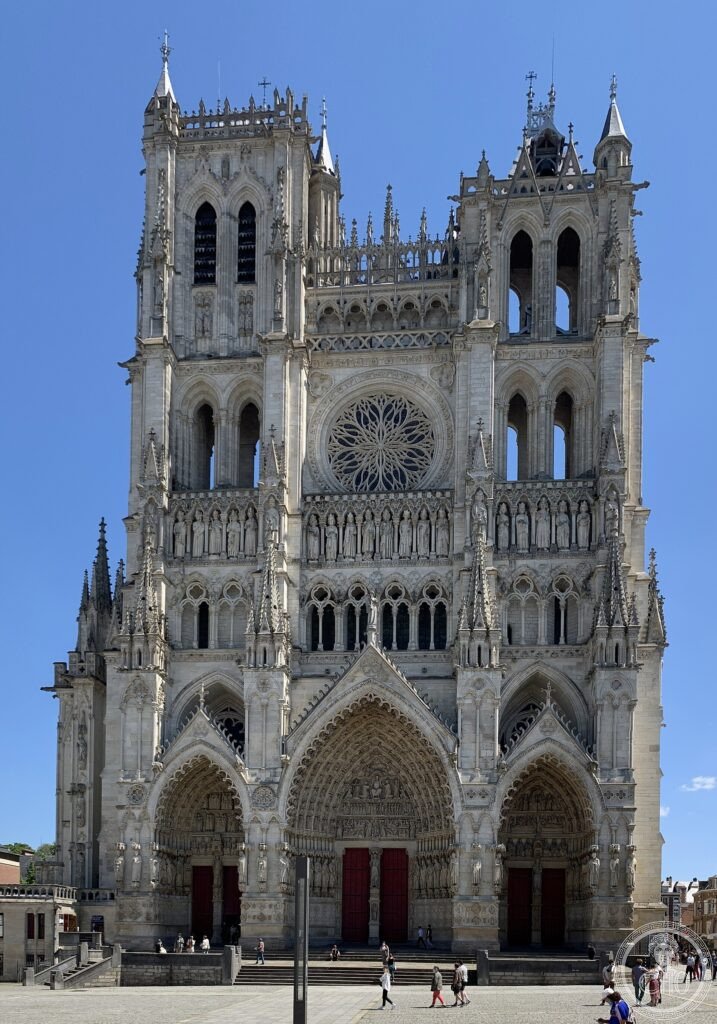
È la più vasta cattedrale di Francia — il doppio di Notre-Dame di Parigi — eppure fu costruita in appena cinquant’anni, e per questo ha un’unità di stile che nessun’altra possiede. Le sue settecentocinquanta statue erano un tempo dipinte: oggi, di notte, la luce le riaccende dei colori del Duecento.
At a glance
Amiens Cathedral, in Picardy 120 km north of Paris, is the largest church in France by volume — about 200,000 cubic metres, more than twice Notre-Dame de Paris. Begun in 1220 after a fire destroyed the Romanesque cathedral, it was built almost entirely between 1220 and around 1270, an unusually short span that gives it a rare unity of design. Its nave soars to 42.3 m, its sculpted west front carries more than seven hundred statues, and its 13th-century stonework was once brightly painted — a polychromy rediscovered by laser study and now recreated in light shows. Inscribed by UNESCO in 1981, it is one of the supreme achievements of High Gothic architecture.
Key facts
- UNESCO: World Heritage since 1981
- Largest in France: about 200,000 m³ in volume; nave vault 42.3 m high, only 14.6 m wide — a vertiginous 3:1 ratio
- Built 1220–c.1270: begun by Bishop Evrard de Fouilloy; architects Robert de Luzarches, then Thomas and Renaud de Cormont — hence its stylistic unity
- Sculpture: over 750 statues on the west front, including the “Beau Dieu” of the central portal and the calendar quatrefoils; the labyrinth (1288) names the cathedral’s architects
- Polychromy: traces of the original 13th-century colours, found during 1990s laser cleaning, are projected back onto the facade at night
- Relic: the cathedral has long claimed to hold the head of St John the Baptist, brought from Constantinople after the Fourth Crusade (1206)
History
When fire destroyed the earlier cathedral in 1218, Bishop Evrard de Fouilloy seized the moment to build on a colossal scale. The arrival of the relic of John the Baptist in 1206 had made Amiens a wealthy pilgrimage city, and the wool and woad trade of Picardy paid for the work. Robert de Luzarches drew the plan; the Cormont family carried it up. Because the building rose so fast — nave, choir and transepts essentially complete by about 1270 — it escaped the patchwork of styles that marks most Gothic cathedrals.
Amiens survived the centuries, the Revolution and two World Wars (the city around it was devastated in 1918 and 1940, but the cathedral stood). Its sculptural programme, studied since the 19th century as a “Bible in stone,” and the rediscovery of its lost colours have made it a touchstone of medieval art history.
What you see
The west front is the overture: three deep portals crowded with figures — the Last Judgment at the centre beneath the serene “Beau Dieu,” the calendar and zodiac in quatrefoils at eye level — below the gallery of kings and the rose. Inside, the nave runs straight and impossibly tall, the three-storey elevation drawn upward by slender shafts to vaults 42 m overhead. On the floor of the nave, the octagonal labyrinth (a 19th-century replacement of the 1288 original) records the names of the builders.
In the ambulatory behind the high altar stands the marble “Weeping Angel” (l’Ange pleureur) carved by Nicolas Blasset in 1636 — obscure for centuries until First World War soldiers made it famous on postcards home. The choir stalls, the polychrome reliefs of the saints’ lives, and the great windows complete the visit.
Practical information
- Visiting: the cathedral is free (a working church); tower climbs are ticketed
- Colours in light: the “Chroma” sound-and-light show projects the medieval polychromy onto the facade on summer evenings and around Christmas
- Time needed: about an hour, more with the towers
Getting there
Direct trains run from Paris-Nord to Amiens in about 1h10; the cathedral is a short walk from the station, above the canals of the Saint-Leu quarter. GPS: 49.8946° N, 2.3020° E.
Nearby
- Quartier Saint-Leu & the hortillonnages — the canal district and the floating market gardens of Amiens
- Maison de Jules Verne — the writer’s house; Verne lived and died in Amiens
- Beffrois of Belgium and France — the Amiens belfry is part of a separate UNESCO listing
Sources
- UNESCO World Heritage Centre — “Amiens Cathedral” (ref. 162)
- Encyclopaedia Britannica — Amiens Cathedral
- Cathédrale Notre-Dame d’Amiens / Centre des monuments nationaux
Find it on the map
See this place and what’s around it →
📷 Become a Cultural Heritage Online photographer
Share your photos of places: they stay published under your name as the author. The more they're seen, the more you get noticed — and soon a contest will reward the most appreciated photos.
Log in or sign up free to add a photoIs this page about you?
This page is read by travellers and heritage enthusiasts who find it on Google. Tell us how you are connected to this place and we will take it from there.