

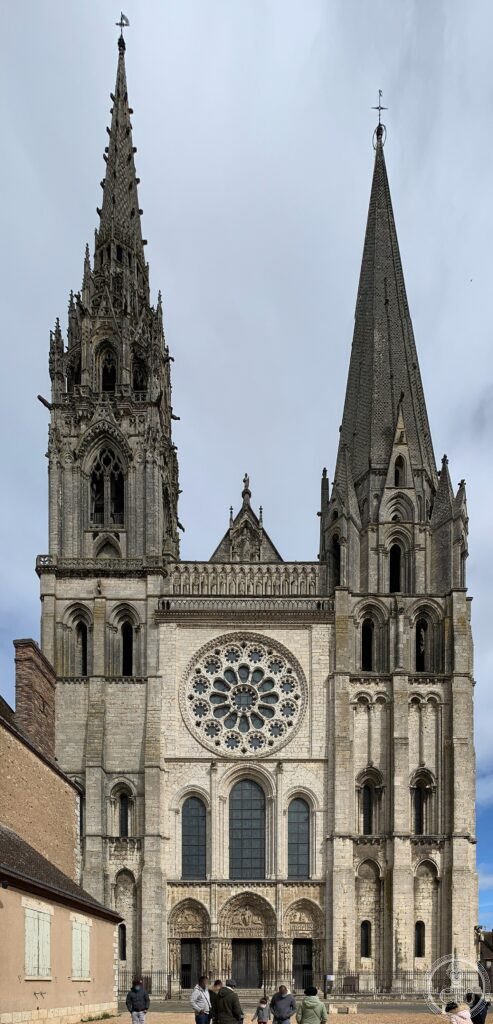
It burned in 1194, and out of the ashes — when the relic of the Virgin’s veil was found intact — the town rebuilt it in a single generation. That is why Chartres is the most coherent Gothic there is: 176 thirteenth-century windows alight with that blue no one has since been able to reproduce, a labyrinth in the floor, two spires from two different centuries.
At a glance
Chartres Cathedral, in the Eure-et-Loir some 90 km south-west of Paris, is widely regarded as the high point of French Gothic art. After a fire destroyed the earlier Romanesque cathedral in 1194 — sparing the relic of the Virgin’s veil, the Sancta Camisia — the city rebuilt the church with extraordinary speed, largely between 1194 and 1220. That single, rapid campaign gave Chartres a coherence rare among Gothic cathedrals: architecture, the sculpture of the portals and the vast glazing programme all belong to the same moment. It keeps the most complete set of medieval stained glass in the world, famous for its deep “Chartres blue,” and was inscribed by UNESCO in 1979.
Key facts
- UNESCO: World Heritage since 1979; called by UNESCO “the high point of French Gothic art”
- Rebuilt 1194–1220: after the fire of 1194, in a single coherent High Gothic campaign
- Royal Portal (west front, c. 1145–55): survived the fire; a masterpiece of Early Gothic sculpture, with its famous column-statues of kings and queens
- Stained glass: about 176 windows of the early-to-mid 13th century — the largest surviving medieval ensemble — and the celebrated bleu de Chartres
- Sancta Camisia: the relic of the Virgin’s veil, given to the cathedral by Charles the Bald in 876; its survival of the 1194 fire was read as a sign to rebuild
- Two unmatched spires & the labyrinth: a plain Romanesque tower (c. 1140s) and a Flamboyant Gothic spire by Jehan de Beauce (after a 1506 lightning strike); the nave labyrinth dates to around 1200
History
Chartres was an ancient Marian pilgrimage town long before the present church: the relic of the Virgin’s veil, given by Charles the Bald in 876, made it one of the great Marian shrines of the West, and its cathedral school was a centre of 12th-century learning. When fire swept the Romanesque cathedral in 1194, the discovery that the relic had survived was taken as the Virgin’s wish that a greater church be built. Money poured in from across France, and tradition recalls the “cult of the carts,” in which the faithful themselves hauled stone to the site.
The new cathedral rose in barely a quarter-century and was consecrated in 1260. It came through the Revolution and both World Wars largely intact — the windows were dismantled and hidden for safety in 1914–18 and again in 1939–45 — and is today both a working cathedral and a place of pilgrimage and study.
What you see
The west front carries the Royal Portal, its slender column-statues among the first great works of Gothic sculpture, beneath two utterly different towers — one a sober Romanesque pyramid, the other a lace of Flamboyant stone. Inside, the nave is the widest in France, and the walls dissolve into glass: three great rose windows, the deep-blue “Notre-Dame de la Belle-Verrière,” the Tree of Jesse, and rank upon rank of 13th-century lancets in which the Chartres blue glows even on a grey day.
On the floor of the nave runs the famous labyrinth, a single winding path once walked as a symbolic pilgrimage; around the choir, the carved stone screen (the tour du chœur, 16th–18th c.) tells the lives of Christ and the Virgin in some forty scenes.
Practical information
- Visiting: the cathedral is a working church and free to enter; guided climbs of the towers and visits to the crypt are ticketed
- Light: the glass is best in strong daylight; in summer the “Chartres en Lumières” festival illuminates the city and the cathedral at night
- Time needed: 1.5–2 hours, more for the towers and crypt
Getting there
SNCF trains run from Paris-Montparnasse to Chartres in about an hour; the cathedral is a short walk uphill from the station. By car, Chartres is on the A11 motorway south-west of Paris. GPS: 48.4478° N, 1.4879° E.
Nearby
- Old town of Chartres — the Centre international du vitrail (stained-glass centre) and the stepped streets down to the Eure
- Maison Picassiette — a house covered entirely in mosaic of broken china, on the edge of the city
- Château de Maintenon — Madame de Maintenon’s château and Vauban’s unfinished aqueduct, to the north-east
Sources
- UNESCO World Heritage Centre — “Chartres Cathedral” (ref. 81)
- Cathédrale de Chartres / Centre des monuments nationaux
- Encyclopaedia Britannica — Chartres Cathedral
Find it on the map
See this place and what’s around it →📷 Become a Cultural Heritage Online photographer
Share your photos of places: they stay published under your name as the author. The more they're seen, the more you get noticed — and soon a contest will reward the most appreciated photos.
Log in or sign up free to add a photoIs this page about you?
This page is read by travellers and heritage enthusiasts who find it on Google. Tell us how you are connected to this place and we will take it from there.