
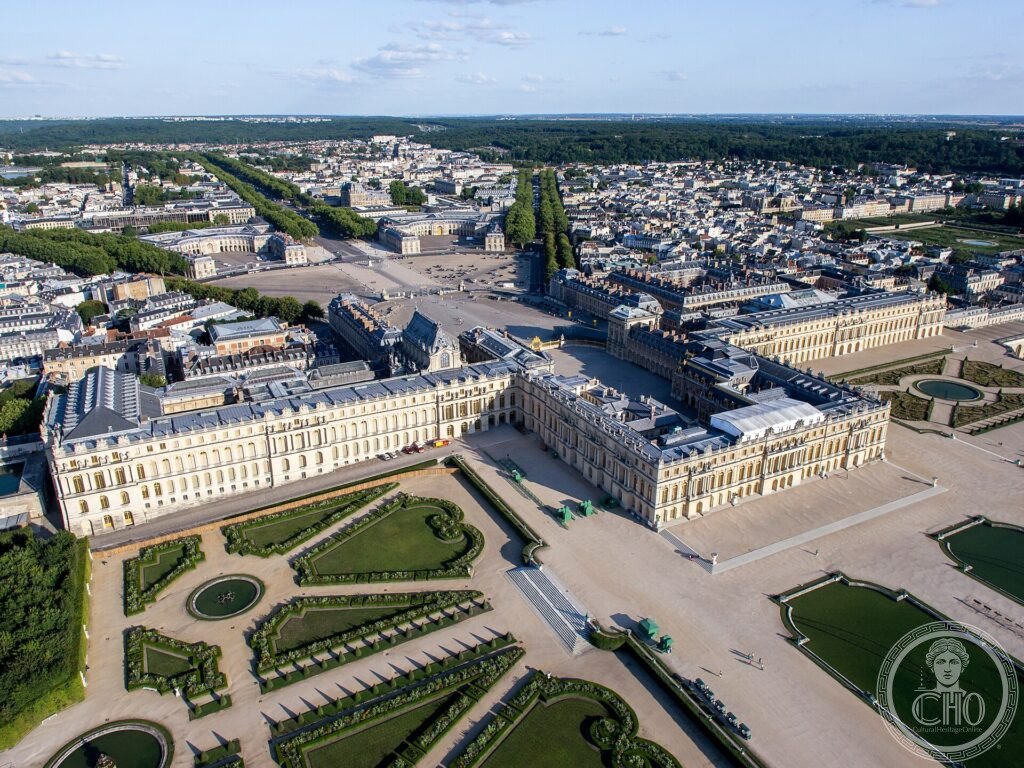
Da padiglione di caccia di Luigi XIII a centro del potere assoluto: nel 1682 Luigi XIV vi trasferì la corte e il governo di Francia. Versailles è la Galleria degli Specchi che incendia il tramonto su settecento metri di giardini disegnati al millimetro da Le Nôtre — la macchina scenica della monarchia, copiata da ogni corte d’Europa.
At a glance
The Palace of Versailles, some 20 km south-west of Paris, was the seat of the French court and government from 1682 until the Revolution of 1789. What began as Louis XIII’s brick-and-stone hunting lodge of 1623 was transformed by his son Louis XIV into the largest royal residence in Europe — a total work of art uniting architecture, painting, sculpture and landscape in the service of absolute monarchy. The architects Louis Le Vau and Jules Hardouin-Mansart, the painter Charles Le Brun and the garden designer André Le Nôtre created a model of palace-and-park imitated by courts across the continent. Inscribed by UNESCO in 1979, the palace and its park draw more than seven million visitors a year.
Key facts
- UNESCO: World Heritage since 1979 (Palace and Park of Versailles)
- From lodge to capital: Louis XIII’s hunting lodge (1623) became the seat of court and state when Louis XIV moved here in 1682
- Architects: Louis Le Vau (from 1661) then Jules Hardouin-Mansart (from 1678), who gave the palace its colossal, sober garden front
- Hall of Mirrors (Galerie des Glaces, 1678–89): about 73 m long, 17 mirror-clad arches facing 17 garden windows, beneath a painted vault by Charles Le Brun glorifying Louis XIV
- Gardens: the grandest French formal garden, by André Le Nôtre — the Grand Canal, parterres, groves and fountains fed by a vast hydraulic system
- History made here: the German Empire was proclaimed in the Hall of Mirrors in 1871; the Treaty of Versailles was signed there in 1919
History
Louis XIV built in campaigns: Le Vau’s “envelope” wrapped the old lodge after 1661; from 1678 Hardouin-Mansart doubled the palace, raised the Hall of Mirrors and, by 1710, the Royal Chapel. Around the king revolved a court of thousands, its every gesture choreographed as political theatre. Louis XV added the Royal Opera and the Petit Trianon; Louis XVI and Marie-Antoinette the rustic Hameau. In October 1789 the women’s march on Versailles forced the royal family back to Paris and ended the palace’s century as the centre of France.
Stripped at the Revolution, Versailles was saved in the 1830s when Louis-Philippe turned it into a museum “to all the glories of France.” Its later history is European: the new German Empire was proclaimed in the Hall of Mirrors in 1871, and the treaty that ended the First World War was signed in the same room in 1919.
What you see
Through the gilded gate and the Cour d’Honneur, the visit climbs through the State Apartments of the King and Queen — rooms named for the planet-gods, hung with marble and bronze — to the Hall of Mirrors, where seventeen arcades of mirror throw the garden and the western light back across the gallery. The Royal Chapel and the Royal Opera show the same union of architecture and decoration carried to its height.
Outside, Le Nôtre’s gardens unfold along a single axis: the parterres, the Latona and Apollo fountains, the groves, and the Grand Canal stretching to the horizon. Beyond lie the Grand and Petit Trianon and Marie-Antoinette’s Hameau, the queen’s model hamlet.
Practical information
- Visiting: run by the Établissement public du château de Versailles; ticketed (palace, Trianon estate, gardens); the Musical Fountains and Gardens shows run on set days
- Busy: one of the most-visited sites in the world — book a timed entry and arrive early
- Time needed: a full day for palace, gardens and Trianon
Getting there
From Paris, the RER C reaches Versailles Château–Rive Gauche (about 40 minutes); SNCF trains run from Paris Montparnasse (to Versailles-Chantiers) and Saint-Lazare (to Versailles Rive Droite). GPS: 48.8044° N, 2.1203° E.
Nearby
- Town of Versailles — the planned royal town, the cathedral of Saint-Louis and the Notre-Dame quarter
- Saint-Germain-en-Laye — the earlier royal château and the national archaeology museum
- Paris — 20 km north-east
Sources
- UNESCO World Heritage Centre — “Palace and Park of Versailles” (ref. 83)
- Château de Versailles — official site (chateauversailles.fr)
- Encyclopaedia Britannica — Palace of Versailles
Find it on the map
See this place and what’s around it →📷 Become a Cultural Heritage Online photographer
Share your photos of places: they stay published under your name as the author. The more they're seen, the more you get noticed — and soon a contest will reward the most appreciated photos.
Log in or sign up free to add a photoIs this page about you?
This page is read by travellers and heritage enthusiasts who find it on Google. Tell us how you are connected to this place and we will take it from there.