
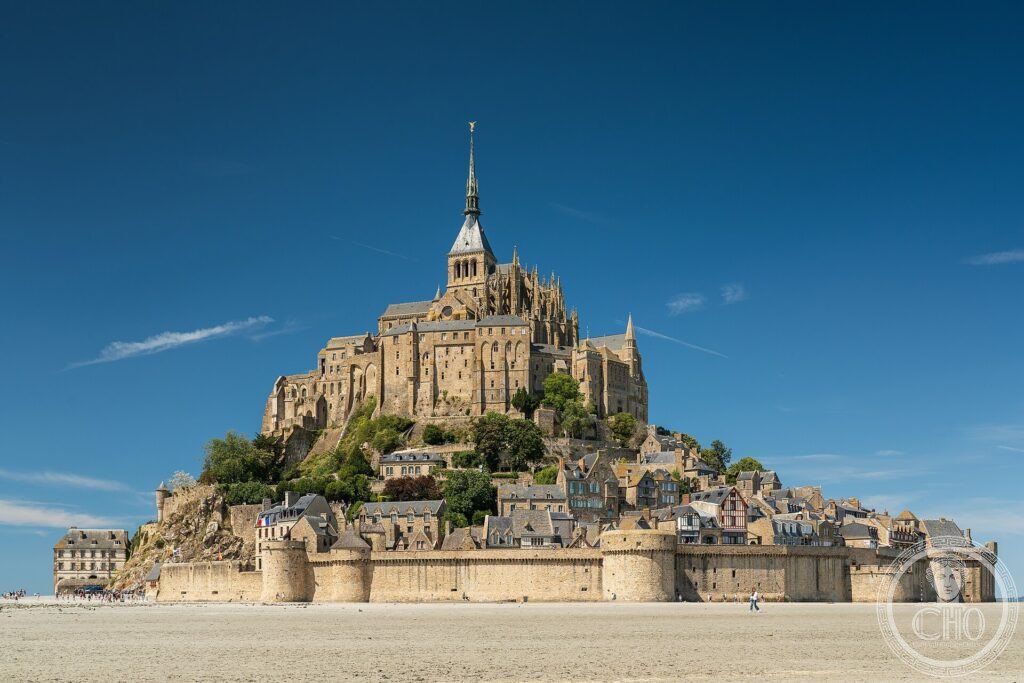
Mont-Saint-Michel (708): l’abbazia sull’isola delle maree tra Normandia e Bretagna
Due volte al giorno il mare si ritira per chilometri e poi torna, isolando la rocca conica che dal 708 porta in cima un’abbazia. Mont-Saint-Michel — la «meraviglia dell’Occidente» — è romanica alla base e gotica in cima, e da tredici secoli è il faro dei pellegrini del Nord.
At a glance
Mont-Saint-Michel rises from a rocky tidal islet in the bay between Normandy and Brittany, where some of the strongest tides in continental Europe uncover and flood vast sandbanks twice a day. By tradition the archangel Michael appeared to Aubert, bishop of Avranches, in 708, asking him to raise a sanctuary on the rock; a Benedictine community settled in 966, and from the early 11th century a Romanesque abbey church crowned the summit. Over the centuries the abbey, the village clinging to its slopes and the ramparts that held off the English through the Hundred Years’ War grew into one of the most astonishing built sites in Europe. Inscribed by UNESCO in 1979, it is the most-visited monument in France outside Paris.
Key facts
- UNESCO: World Heritage since 1979 (Mont-Saint-Michel and its Bay)
- Origin: a sanctuary founded in 708 after the archangel Michael appeared to Aubert, bishop of Avranches; Benedictine abbey from 966
- Romanesque church: begun in the early 11th century on the very tip of the rock, carried on a ring of crypts that turn the summit into a level platform
- La Merveille: the Gothic monastic buildings (13th c.), funded after Philip II Augustus annexed Normandy — two three-storey ranges crowned by the cloister and the refectory
- Hundred Years’ War: the fortified Mount never fell to the English; the Romanesque choir collapsed in 1421 and was rebuilt in Flamboyant Gothic in the early 16th century
- Tides & access: among the highest in Europe; a stilted bridge (2014) replaced the old causeway to give the rock back its island character
History
The legend of 708 — the archangel pressing his finger to the bishop’s skull until he obeyed — launched a cult of St Michael that drew pilgrims from across the Christian West. The Benedictines who arrived in 966 built first the Romanesque abbey, an audacious act of engineering that balanced a full church on the narrow summit. Royal patronage, above all after Philip II Augustus brought Normandy into the French crown in 1204, paid for the Gothic Merveille, whose cloister and refectory are among the masterpieces of 13th-century architecture.
Fortified against the English, the Mount resisted every siege of the Hundred Years’ War. After the Revolution the abbey was closed and turned into a prison — the “Bastille of the seas” — until 1863; declared a historic monument in 1874, it was gradually restored, and a monastic community returned in the 20th century. Today it is at once a working sanctuary, a major monument of the Centre des monuments nationaux, and the magnet for some three million visitors a year.
What you see
From the mainland the silhouette is unmistakable: the pyramid of ramparts, houses and abbey climbing to the gilded statue of St Michael on the spire. The single street, the Grande Rue, winds up past medieval houses to the great stair and the abbey platform. The abbey church mixes a Romanesque nave with a luminous Flamboyant Gothic choir; below and beside it, La Merveille stacks the almonry, the guests’ hall, the knights’ hall and, at the top, the cloister — a double row of slender pink columns set off-beat — and the refectory, lit by tall windows hidden in its walls.
The crypts that support the choir, the great wheel that once hauled supplies, the ramparts and the gardens all reward the climb; and from the terraces the bay opens in every direction, the tide drawing its silver lines across the sand.
Practical information
- Visiting: the abbey is run by the Centre des monuments nationaux (ticketed); the village and ramparts are free; check tide times before crossing the bay
- Bay walks: only with a licensed guide — the sands and fast tide are dangerous alone
- Time needed: half a day for the abbey and village
Getting there
Mont-Saint-Michel is in the Manche department of Normandy, near Pontorson. From the mainland car park, free shuttles (or a walk) cross the 2014 bridge to the rock. Nearest stations: Pontorson, or Dol-de-Bretagne / Rennes with bus links. GPS: 48.6360° N, 1.5115° W.
Nearby
- Avranches — the Scriptorial museum, home to the medieval manuscripts of the abbey
- Saint-Malo & Cancale — the corsair city and the oyster port of the Brittany coast
- Bayeux — the 11th-century Tapestry and the Normandy landing beaches, to the north-east
Sources
- UNESCO World Heritage Centre — “Mont-Saint-Michel and its Bay” (ref. 80)
- Centre des monuments nationaux — Abbaye du Mont-Saint-Michel (abbaye-mont-saint-michel.fr)
- Office de tourisme du Mont-Saint-Michel
Find it on the map
See this place and what’s around it →📷 Diventa un fotografo di Cultural Heritage Online
Condividi le tue foto dei luoghi: restano pubblicate con la tua firma come autore. Più vengono viste, più ti fai conoscere — e presto un concorso premierà le foto più apprezzate.
Accedi o registrati gratis per aggiungere una foto