
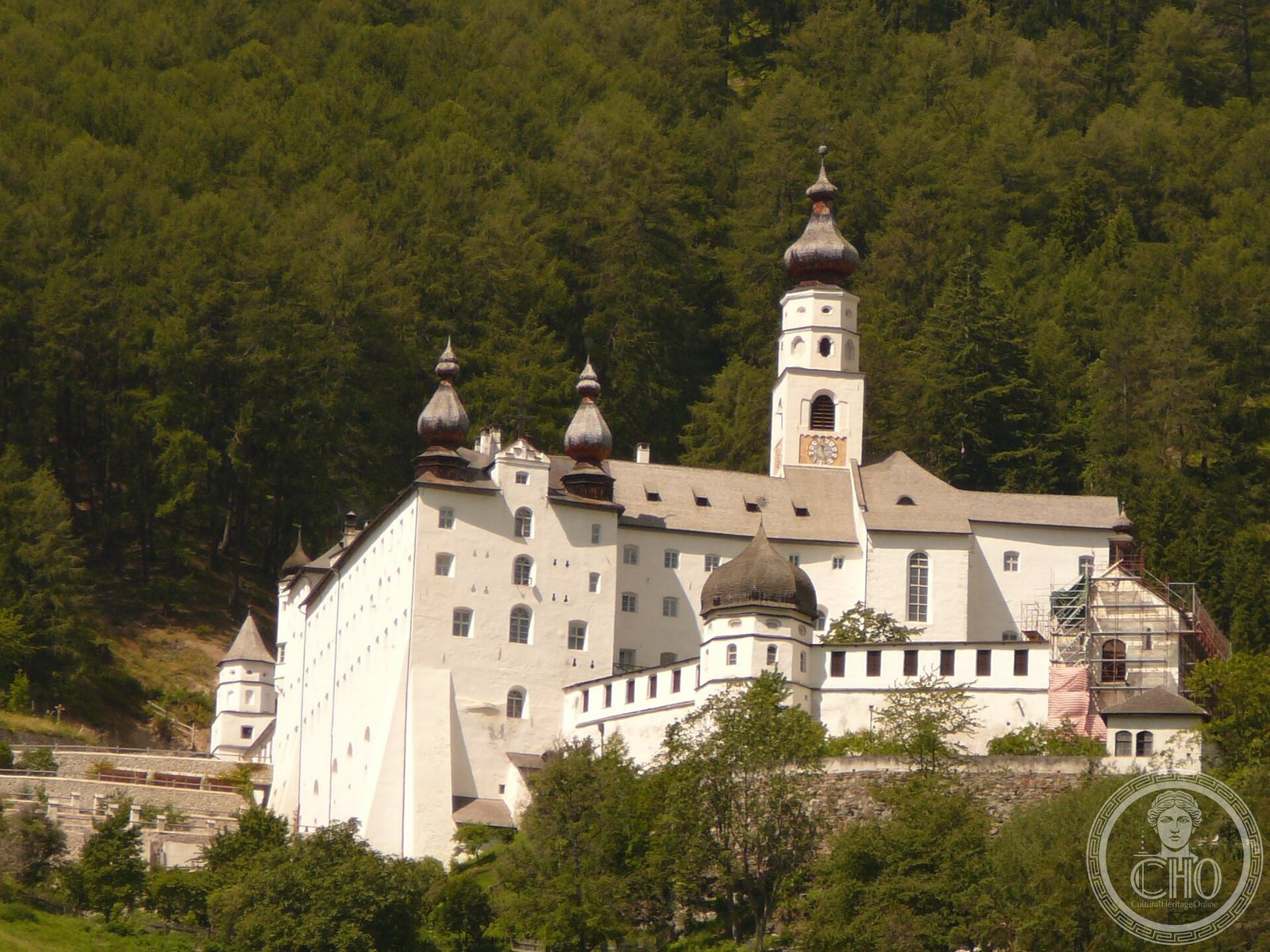
A Benedictine monastery in Val Venosta, transformed into Baroque grandeur after medieval devastation, now home to a museum and one of the region’s most distinctive ecclesiastical structures.
At a glance
Founded around 1150 by the Tarasp nobles on the site of an earlier chapel, this monastery rose from repeated hardship to become a centre of religious, intellectual and educational life in the Tyrol. Today it belongs to the Benedictine Congregation of Switzerland and welcomes visitors to its church and museum.
History
The Tarasp nobles established the abbey in the 12th century, transferring a monastic community from Scuol-Schuls in the Engadine to this Alpine location. In the 14th century, the monk Goswin documented the monastery’s history in his Registrum monasterii Montis sancti Marie while also reorganising the archive—a legacy that preserves rich medieval records to the present day.
Two fires and the Black Plague of 1348 nearly destroyed the community, reducing the monks to just four. Survival came through support from the Duke of Tyrol and papal intervention. Recovery accelerated under Abbot Matthias Lang (1615–1640), who arrived from Weingarten abbey in Württemberg and presided over a period of renewal.
In 1647, the complex underwent comprehensive Baroque renovation. The monks opened a gymnasium and boarding school near Merano in 1724, educating generations including the orientalist Pius Zingerle and Frankfurt Parliament delegate Albert Jäger. Napoleonic suppression in 1807 and subsequent Austrian restoration under Abbot Carl Mayr (1816–1855) tested the community’s resilience. The gymnasium closed under Fascism but a middle school operated at the monastery from 1946 to 1986.
What you see
The Baroque church, rebuilt in 1647, stands as Val Venosta’s only example of a three-naved basilica with colonnades. Its architectural expression embodies the monastery’s recovery and renewed confidence after centuries of struggle. The monastic complex integrates residential, communal and sacred spaces characteristic of Benedictine communities.
Cultural significance
Monte Maria represents both spiritual continuity and Alpine resilience. As a centre of learning, it shaped regional intellectual life through its gymnasium and the scholarly achievements of its alumni. The monastery’s archive preserves exceptional medieval documentation, while its architectural transformation mirrors broader stylistic shifts in Central European religious life.
Key facts
- Address: Schlinig 1, 39024 Malles Venosta
- Coordinates: 46.70596182206708, 10.52039623260498
- Website: https://www.marienberg.it
- Phone: 0473 843980
- Founded: c. 1150
- Order: Benedictine Congregation of Switzerland
Practical information
The abbey operates a museum and gift shop. Opening hours and admission fees are available on the official website. Visitors should check ahead for group visits or guided tours. The monastery is an active religious community; please be respectful of monastic life during your visit.
Getting there
The abbey is located in Malles Venosta in the Val Venosta (Vinschgau) valley in South Tyrol. Check the official website or contact the monastery directly for directions, public transport options and parking information.
See the place
Sources & resources
Find it on the map
See this place and what’s around it →📷 Become a Cultural Heritage Online photographer
Share your photos of places: they stay published under your name as the author. The more they're seen, the more you get noticed — and soon a contest will reward the most appreciated photos.
Log in or sign up free to add a photoIs this page about you?
This page is read by travellers and heritage enthusiasts who find it on Google. Tell us how you are connected to this place and we will take it from there.