
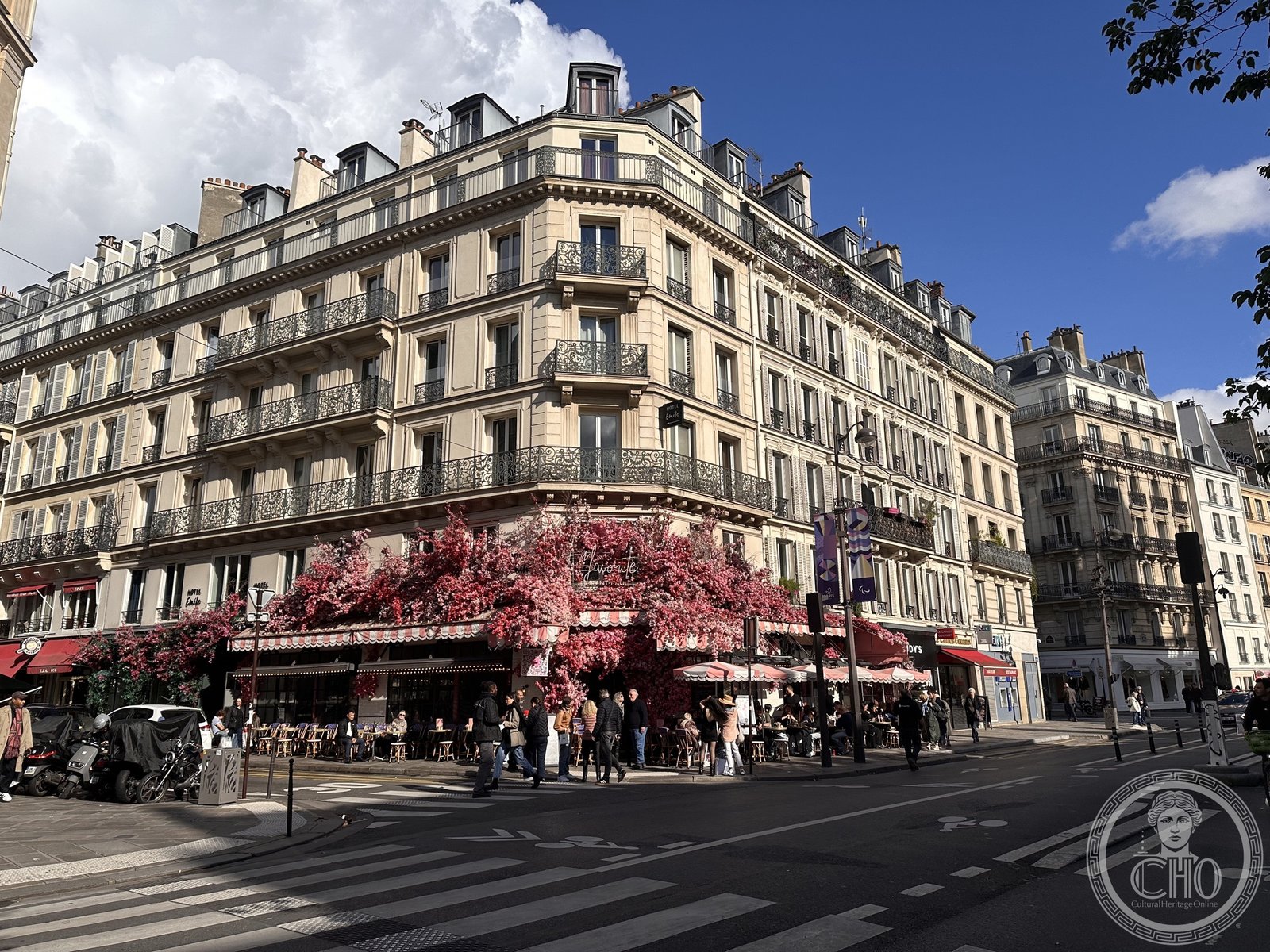
On rue Pavée in the Marais, steps from Hector Guimard’s 1913 synagogue, a Belle Époque residential building preserves a complete Art Nouveau facade — sinuous ironwork balconies, organic floral reliefs in stone, and the vertical rhythm that Parisian architects applied to the city’s apartment houses between 1895 and 1914.
At a glance
The Marais quarter (4th arrondissement) retains one of the highest densities of pre-Haussmann and Belle Époque residential fabric in Paris. Rue Pavée runs north from the Rue des Francs-Bourgeois through the historic Jewish quarter, where two Hector Guimard commissions survive intact within 100 metres of each other: the Synagogue Agoudas Hakehilos (1913) and several apartment house facades. The Art Nouveau residential building photographed here represents the domestic expression of the same formal language — organic stone carving, wrought-iron balcony railings with whiplash curves, and the elongated window proportions that Parisian building regulations of the period encouraged.
Key facts
- Location: Rue Pavée, 4e arrondissement, Marais, Paris
- Period: c. 1900–1910, Belle Époque / Art Nouveau
- Style: Paris residential Art Nouveau — organic stone relief, wrought-iron balconies
- Near landmark: Guimard Synagogue Agoudas Hakehilos (1913), 100 metres
- District: Le Marais heritage conservation area (secteur sauvegardé since 1962)
- Current use: Residential with ground-floor commercial premises
History
The Marais was the fashionable residential district of Paris from the late 16th to the early 18th century, before the aristocracy migrated west to the Faubourg Saint-Germain. By the mid-19th century it had become a dense working-class and artisan quarter, its 17th-century hôtels particuliers subdivided into workshops and tenements. The Belle Époque construction wave that transformed much of Paris bypassed the Marais’s medieval street pattern for the most part — but on wider streets like rue Pavée, developers built the five- and six-storey apartment houses typical of the period throughout Paris.
The Art Nouveau elements visible on rue Pavée facades — the carved sunflower rosettes, the intertwined stems in the ironwork, the ceramic tile bands at ground-floor level — belong to the middle register of the style: neither the signed commissions of Guimard or Lavirotte, nor the bare utilitarian facades of the cheaper housing stock. They represent the broad commercial diffusion of Art Nouveau ornament through Parisian building practice between approximately 1900 and 1910, produced by anonymous craftsmen working from pattern books rather than named architects.
The Marais was saved from comprehensive redevelopment by André Malraux’s 1962 legislation creating the first secteur sauvegardé in France, which froze demolitions and mandated restoration of the surviving historic fabric. The Belle Époque apartment houses of rue Pavée were included in the protected zone, preserving facades that would otherwise have been regularised or rebuilt.
What you see
The facade composition follows the standard Paris apartment-house format of the period: a commercial ground floor with wide glazed openings, four or five upper residential floors with paired windows, and a sloped zinc roof with dormer windows. The Art Nouveau ornamental programme concentrates at the balcony level and around the window openings: carved stone panels with floral and foliate motifs occupy the spandrels between floors, and the wrought-iron balcony railings describe the whiplash curves that are the movement’s most recognisable signature. The ironwork is galvanised and painted dark green or black, as was standard practice.
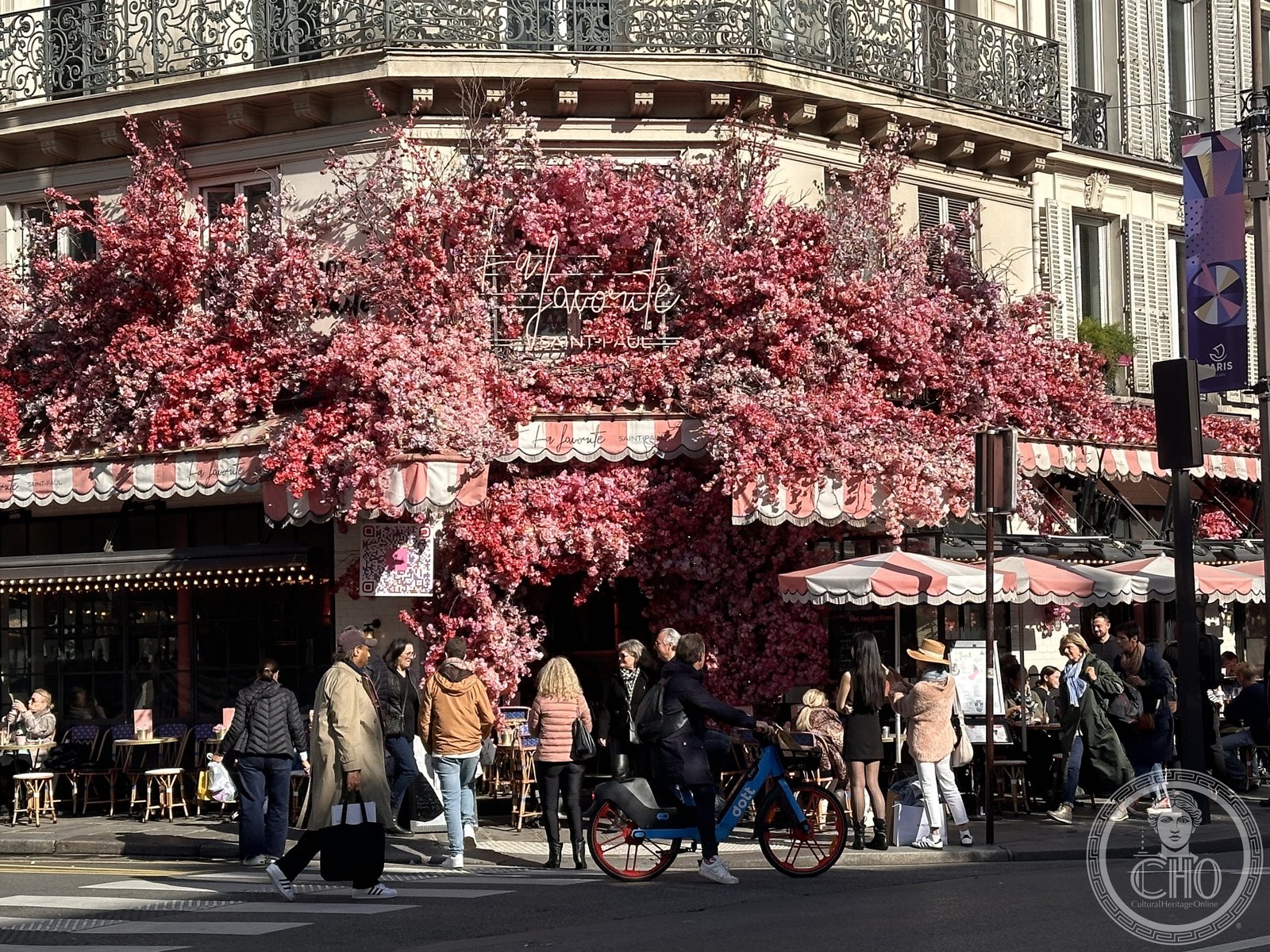
The ground-floor commercial tenant — a tailor’s workshop or small boutique — occupies the original vitrine opening, maintaining the mixed-use character that rue Pavée has had since the 17th century. The signage, hand-painted on the glass or mounted as individual letters, continues a commercial lettering tradition that predates the Art Nouveau building by at least a century.
Practical information
- Public facade — visible from the street, no entry fee
- Best viewed: morning light (east-facing facades on rue Pavée)
- Combine with: Guimard Synagogue (100m), Place des Vosges (500m), Musée Picasso (400m)
- Ground-floor commercial premises: hours vary by tenant
Getting there
Métro 1 Saint-Paul (exit rue de Rivoli, 5 minutes walk north via rue Pavée). Métro 1 or 11 Hôtel de Ville (10 minutes walk east). The Marais is best explored on foot; the entire quarter between rue de Rivoli and boulevard du Temple is compact and walkable in a single afternoon.
Nearby
- Guimard Synagogue Agoudas Hakehilos — 100 metres north on rue Pavée
- Musée National Picasso-Paris — 400 metres, Hôtel Salé
- Place des Vosges — 500 metres south-east, the oldest planned square in Paris
- Musée Carnavalet (History of Paris) — 300 metres west
Sources
- Fierro, Annick. “The Glass State: The Technology of the Spectacle, Paris, 1981–1998.” MIT Press, 2003.
- Loyer, François. “Paris XIXe Siècle: l’immeuble et la rue.” Hazan, 1987.
- Ministère de la Culture. “Le Marais — Secteur sauvegardé.” culturecommunication.gouv.fr.
- Archives de Paris. “Permis de construire 4e arrondissement, 1895–1914.”
Gallery
Photographs by Luigi De Marchi.
Find it on the map
See this place and what’s around it →📷 Become a Cultural Heritage Online photographer
Share your photos of places: they stay published under your name as the author. The more they're seen, the more you get noticed — and soon a contest will reward the most appreciated photos.
Log in or sign up free to add a photoIs this page about you?
This page is read by travellers and heritage enthusiasts who find it on Google. Tell us how you are connected to this place and we will take it from there.