
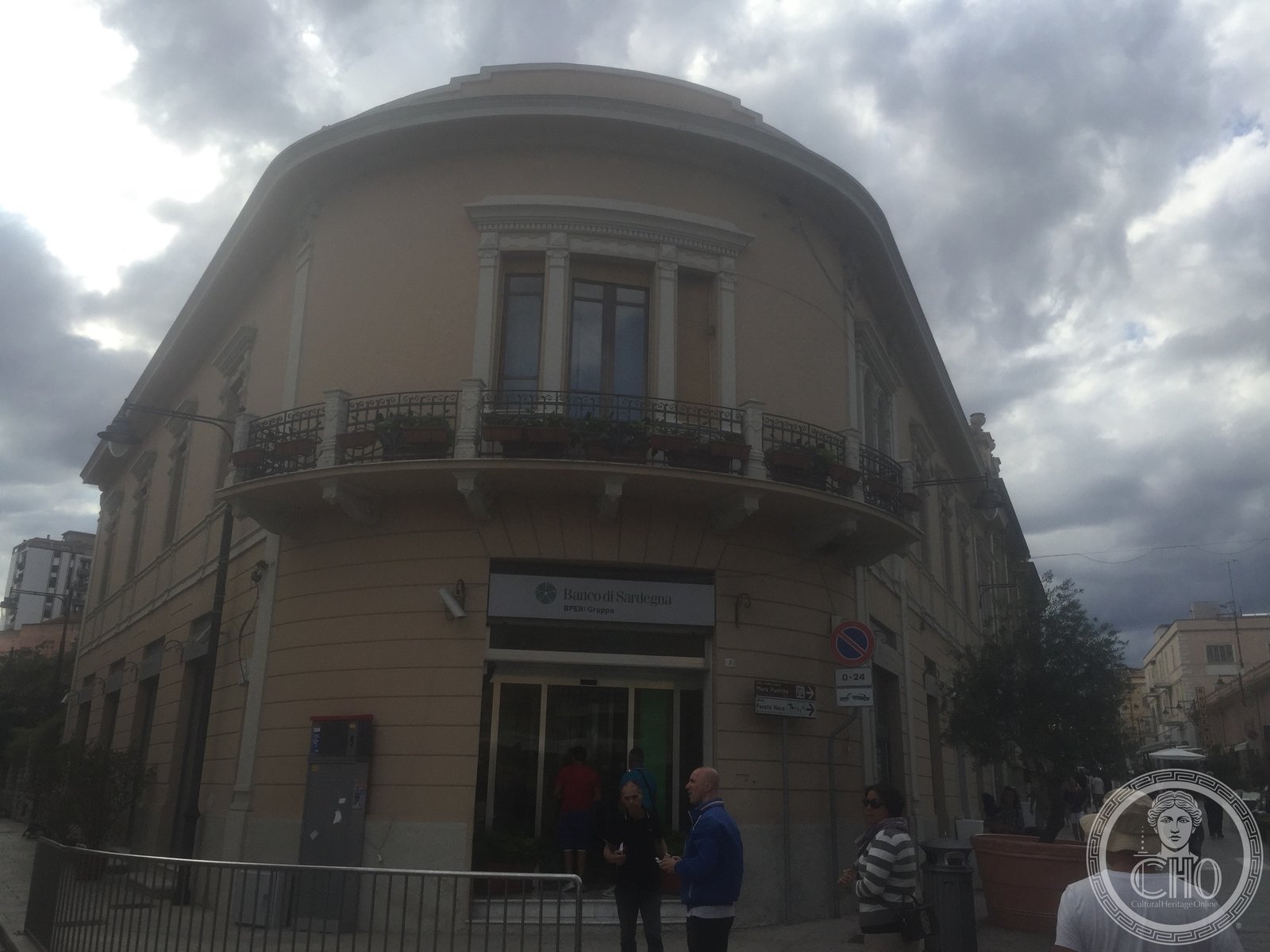
The 1930s left a coherent layer of rationalist and stripped-classical buildings across Italian provincial cities, and Olbia is no exception. The buildings constructed under the regime's civic programme are now part of the city's architectural stratification, sitting between the 19th-century Umbertine blocks and the postwar expansion.
At a glance
Italian Rationalism of the 1930s was the architectural expression of the Fascist period's ambitions: monumental but stripped of historical ornament, drawing on modernist principles while insisting on classical proportion and symmetry. In provincial cities like Olbia, the buildings from this period were typically public or institutional — post offices, schools, tax offices, barracks — and they were built to project authority and permanence at the regional scale. The result, 80 years later, is an architectural layer that reads as distinctly mid-century Italian, recognizable from Bolzano to Palermo, and visible in Olbia's town centre among the earlier and later building phases.
Key facts
- Location: Central Olbia, near Piazza Matteotti
- Coordinates: 40.9234° N, 9.5049° E
- Period: 1930s (Italian Fascist-era civic construction)
- Style: Rationalism / stripped classicism
- Characteristic features: Regular fenestration, horizontal banding, minimal ornament, travertine or plaster cladding
History
The Fascist regime's public works programme (1925–1943) produced a generation of buildings across Italy's provincial cities, many of which remain standing as the most architecturally coherent layer of 20th-century civic construction in their respective cities. In Sardinia, this programme was amplified by the regime's interest in the island as a strategic and demographic resource: new towns were founded (Carbonia, Fertilia, Arborea), existing cities received public buildings, and regional architecture was pressed into service as propaganda.
The Olbian examples from this period are not the most celebrated in Sardinia — Carbonia and Fertilia attract most architectural attention — but they form part of a legible urban sequence visible on foot through the city centre.
What you see
The building presents the characteristic rationalist syntax: a symmetrical or near-symmetrical façade, windows arranged in regular vertical or horizontal bands, minimal classical detail reduced to cornices and string courses, and a ground-floor arcade or recessed entrance in some variants. The material is typically plaster over masonry, often in a warm off-white or ochre tone. The scale is urban but not monumental at the Olbian examples: these are buildings designed to fit into a provincial street rather than to dominate a piazza.
Reading this building alongside the nearby Municipio (late 19th century) and the contemporary street art makes legible the successive layers of political and aesthetic intention deposited on Olbia's centre over 150 years.
Practical information
- Exterior freely visible from the public street; no admission charge
- Central Olbia; accessible on foot from all transit connections
- Best seen as part of a walking tour of Olbia's historic centre (allow 1.5 hours for the full centre)
Getting there
In the centre of Olbia, a 10-minute walk from the train station (Trenitalia Sardegna) or ferry terminal. Olbia Costa Smeralda Airport (OLB) is 3 km from the centre.
Nearby
- Palazzo del Municipio di Olbia (30 m) — late 19th-century civic building on Piazza Matteotti
- National Archaeological Museum of Olbia (200 m) — from Phoenician Olbia to the Roman and medieval city
- Street Art — Olbia Old Town (200 m) — contemporary murals on the old town walls
Sources & resources
Find it on the map
See this place and what’s around it →📷 Become a Cultural Heritage Online photographer
Share your photos of places: they stay published under your name as the author. The more they're seen, the more you get noticed — and soon a contest will reward the most appreciated photos.
Log in or sign up free to add a photoIs this page about you?
This page is read by travellers and heritage enthusiasts who find it on Google. Tell us how you are connected to this place and we will take it from there.