
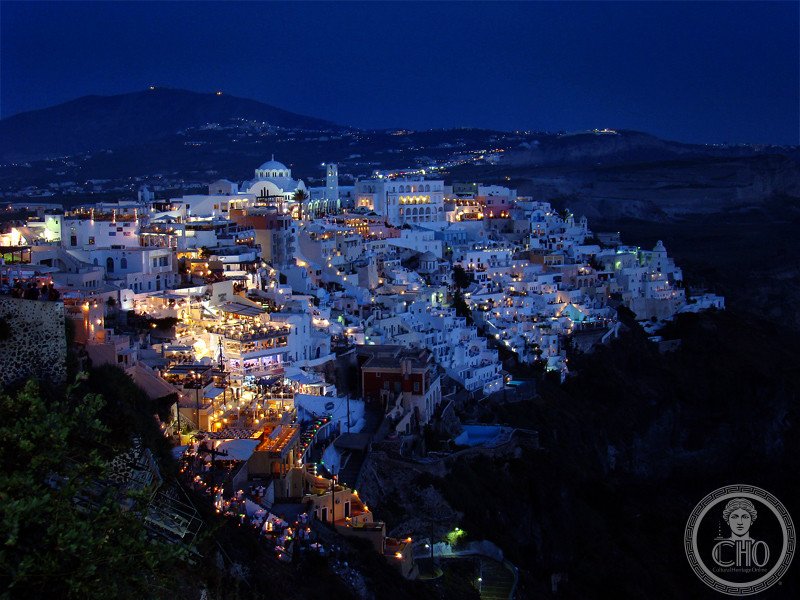

Fira is Santorini's capital, perched at 400 metres on the caldera's western rim. The Archaeological Museum, the Museum of Prehistoric Thera with its Akrotiri frescoes, and the cable car from the port below all converge here.
At a glance
Fira (also spelled Thira or Phira) occupies the central section of Santorini's caldera rim, stretching along the cliff edge above the port of Skala Fira. The town serves as the island's administrative and commercial hub, with ferries and cruise ships arriving at the port below. A cable car (1979) and a stepped path serviced by donkeys connect the port to the upper town. Fira was substantially rebuilt after the 1956 Amorgos earthquake; its current character — whitewashed architecture, Orthodox churches, and caldera-view terraces — reflects the post-earthquake reconstruction that became the model for Santorini's visual identity.
Key facts
- Location: Central caldera rim, Santorini, Cyclades, Greece
- Coordinates: 36.4149° N, 25.4325° E
- Elevation: Approximately 400 m above sea level
- Population: 1,516 (2021 census)
- Key museums: Archaeological Museum of Thera; Museum of Prehistoric Thera (Akrotiri frescoes)
- Port connection: Cable car from Skala Fira (1979); 588 donkey steps
- Rebuilt after: 1956 Amorgos earthquake
History
The island of Santorini takes its formal Greek name Thira from the ancient city of the same name, founded by Dorian colonists on the inland peak of Mesa Vouno in the 9th century BC. The modern capital Fira occupies a different location — the caldera rim — and developed in the post-medieval period as a trading and administrative town. The island's name Santorini derives from the Venetian Santa Irini (Saint Irene), patron saint of Thira.
The 1956 earthquake measuring 7.8 on the Richter scale destroyed most of Fira and Oia. The reconstruction produced the current aesthetic: a consciously designed vernacular architecture that has become one of the most replicated visual styles in modern tourism.
What you see
The Orthodox Cathedral of Ypapanti (Candlemas), rebuilt after 1956 and decorated with painted murals, anchors the upper town. Below it, a web of pedestrian lanes connects hotels, restaurants, and shops built into the caldera cliff. The Three Bells of Fira — a campanile composition of three arched bell towers against the caldera — is among the most-photographed architectural details on the island.
The Museum of Prehistoric Thera houses the best collection of Akrotiri frescoes, including the Boxing Children and the Minoan gold collection. This is the essential complement to a visit to the archaeological site, 12 km south.
Practical information
- Cable car runs 6:30 am to 11 pm; short queue in peak season
- Museum of Prehistoric Thera: closed Tuesdays; check seasonal hours
- Archaeological Museum: adjacent; shared ticket available
- Town centre is pedestrianised; cars park outside
- Sunset is best viewed from Oia (11 km); Fira sunsets are also notable
Getting there
Santorini airport (JTR) is 5 km southeast of Fira; taxi or bus connects in 15 minutes. The ferry port of Athinios is 12 km south; bus or taxi to Fira takes 20 minutes. Cruise ship tenders dock at Skala Fira directly below the town.
Nearby
- Oia (11 km north) — the caldera village iconic for its sunset
- Akrotiri (12 km south) — Minoan Bronze Age city preserved by volcanic ash
- Nea Kameni — active volcano island at caldera centre; boat from Fira port
Sources & resources
Find it on the map
See this place and what’s around it →📷 Become a Cultural Heritage Online photographer
Share your photos of places: they stay published under your name as the author. The more they're seen, the more you get noticed — and soon a contest will reward the most appreciated photos.
Log in or sign up free to add a photo