
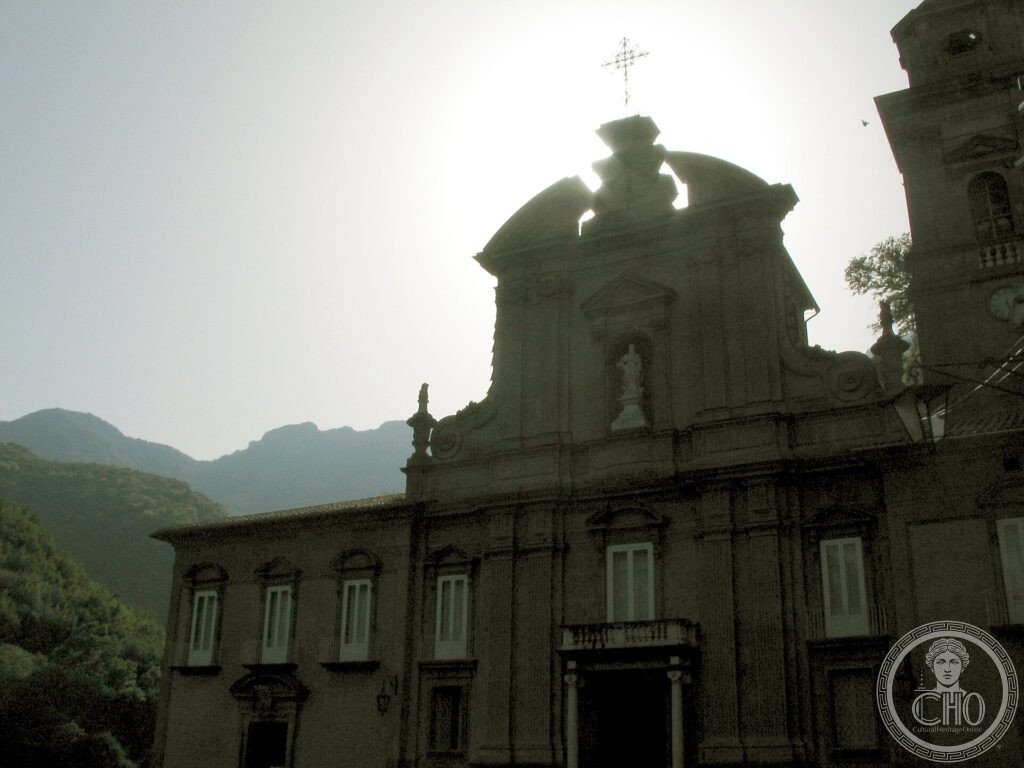
Founded in 1011 by Saint Alferius in the gorge above Cava de’ Tirreni, the abbey of the Holy Trinity was the Benedictine mother house of the Norman South: the Norman kings deposited their wills here, received the papal blessing here, and built here the three-apsed churches that defined the sacred architecture of medieval Campania.
At a glance
The abbey of the Most Holy Trinity of Cava (Abbazia della Santissima Trinità della Cava) stands in a narrow valley above the town of Cava de’ Tirreni, 10 km north of Salerno in Campania. Founded in 1011 by the hermit Alferius (who had been a courtier of Guaimar III of Salerno before becoming a monk at Cluny and then a hermit), it grew rapidly under the patronage of the Norman rulers of southern Italy — Robert Guiscard, Roger Borsa, Roger II of Sicily — to become the most important Benedictine house in the Kingdom of Sicily. The archive, preserved largely intact, contains over 15,000 documents from the 9th to the 18th century, including Norman royal diplomas, papal privileges, and the original texts of charters that are otherwise lost to history. The church, extensively rebuilt in the 18th century in Baroque style, retains a Romanesque crypt with columns of late antique capitals. The abbey is still inhabited by a Benedictine community.
Key facts
- Founded: 1011 by Saint Alferius of Cava (950–1050); former courtier of Guaimar III, monk of Cluny; hermit in the gorge above Cava before founding the community
- Norman patronage: Robert Guiscard (deathbed rites administered here 1085), Roger Borsa, Roger II of Sicily — all Norman rulers of southern Italy patronised the abbey; it was the burial place of Guaimar IV of Salerno
- Archive: the Archivio della Cava contains over 15,000 original documents from the 9th to 18th century — one of the richest medieval archives in southern Italy; includes documents relating to the Norman kingdom not preserved elsewhere
- Architecture: the church was rebuilt in Baroque style in the 17th-18th century; the Romanesque crypt (11th century) with late antique spoliated columns survives; the cloister is 12th century
- Canonisation: Saint Alferius was canonised in 1893; the community has produced 4 popes (Blessed Victor IV, Alexander II, Urban II, Paschal II are all associated with the Cluniac-Cava connection), a generous but debated claim
- Today: active Benedictine community; church open daily; archive and museum by appointment; the library contains over 50,000 volumes
History
Alferius’s foundation grew with extraordinary speed because it was patronised from its earliest years by the most powerful dynasty in southern Italy. Robert Guiscard, the Norman adventurer who conquered Apulia and Calabria from the Byzantines and founded the Norman state in southern Italy, placed his trust in the monks of Cava; when he was struck down by fever during the siege of Dyrrachion in 1085, he received the last rites from a monk of Cava, and his will was deposited in the abbey archive. Successive Norman rulers continued the tradition: Roger II of Sicily, who unified southern Italy and Sicily under a single crown in 1130, issued dozens of diplomas to Cava, confirming and expanding its landholdings from Calabria to Apulia.
The abbey’s importance went beyond royal patronage. It was a major centre of Benedictine scholarship in the Norman kingdom, producing monks who became bishops throughout southern Italy and providing the ecclesiastical infrastructure of the new Norman dioceses. The archive that accumulated over these centuries is one of the most important sources for the social and economic history of medieval southern Italy: the charters record land transactions, boundary disputes, feudal arrangements, and legal traditions of extraordinary variety, reflecting the multilingual, multicultural society of the Norman kingdom (Latin, Greek, Arabic, and Romance vernacular documents all survive).
What you see
The abbey is reached by a road that climbs into the gorge above Cava de’ Tirreni — a landscape of limestone cliffs, chestnut woods, and the narrow valley of the Bonea stream. The approach is dramatic: the abbey buildings pile up on the hillside, the 18th-century church facade reading at the top of a long flight of steps. The interior of the church is elegant Baroque, with side chapels and an imposing main altar; the most historically important space is the Romanesque crypt, where antique columns with diverse capitals — some clearly taken from earlier buildings (spoliation was the norm in early medieval southern Italy) — support the low vaults of the oldest surviving part of the complex.
The monastic museum, when open, gives access to a selection of the archival treasures: illuminated manuscripts, royal diplomas with their wax seals and silk threads, papal bulls, and objects from the treasury. The library, still in use by the monks, is one of the largest monastic libraries in Campania.
Practical information
- Church: open daily 09:00–12:00 and 15:00–18:00; free
- Museum and archive: by appointment; contact the monastery (abbaziadelacava.it)
- Dress code: appropriate for an active monastery
- Time needed: 45 minutes for church and crypt; longer if museum visit arranged
Getting there
By car from Salerno (10 km north): A3 motorway exit Cava de’ Tirreni, then SP road into the valley above the town. By train: Salerno–Cava de’ Tirreni (Trenitalia, 15 minutes), then taxi or local bus up the valley. GPS: 40.6812° N, 14.8074° E.
Nearby
- Cava de’ Tirreni — the medieval porticoed town below, with its arcaded corso Umberto I, 2 km south
- Salerno — the Norman city with the Duomo di San Matteo (Norman, 11th century) and Museo Diocesano, 10 km south
- Costiera Amalfitana — the Amalfi Coast UNESCO site begins at Vietri sul Mare, 8 km south-west of Salerno
Sources
- Wikipedia — “Holy Trinity of Cava Abbey” (en.wikipedia.org/wiki/Holy_Trinity_of_Cava_Abbey)
- Graham Loud, The Latin Church in Norman Italy, Cambridge University Press, 2007
- Cava Abbey — official website (abbaziadelacava.it)
- Archivio della Badia di Cava — digitised documents (archivio.abbaziadelacava.it)
Find it on the map
See this place and what’s around it →📷 Become a Cultural Heritage Online photographer
Share your photos of places: they stay published under your name as the author. The more they're seen, the more you get noticed — and soon a contest will reward the most appreciated photos.
Log in or sign up free to add a photoIs this page about you?
This page is read by travellers and heritage enthusiasts who find it on Google. Tell us how you are connected to this place and we will take it from there.