
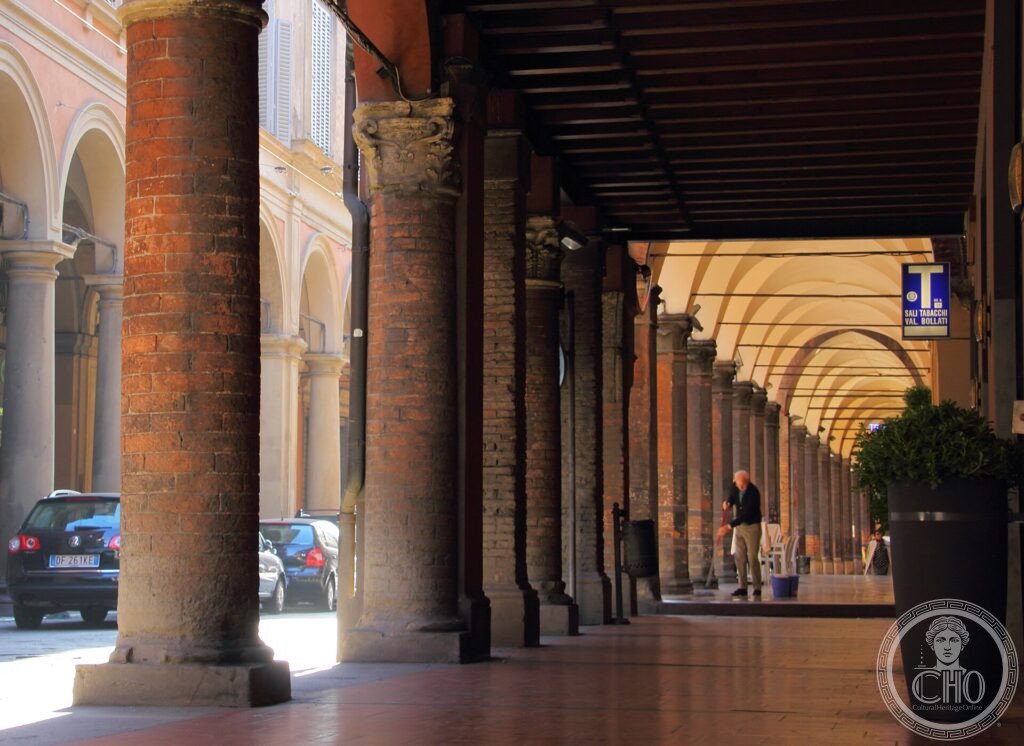
The medieval portico system of Bologna — 62 kilometres of continuous covered arcades in the historic centre alone, built under a city law of 1288 that required all new buildings on major streets to include ground-floor porticoes at a minimum height of seven Bolognese feet — is the most extensive urban covered-walking infrastructure in the world, the only European city to have mandated porticoes by law for seven hundred years, and the invention that turned a medieval commercial city into a covered market on an urban scale.
At a glance
The Portici of Bologna (Bologna; UNESCO 2021, ref. 1650) — collectively the largest urban portico system in the world (62 km in the historic centre, approximately 53 km currently open to the public) — are the defining characteristic of Bologna’s built environment: a continuous covered sidewalk running along virtually every street in the historic centre, providing shelter from rain and sun and connecting every building to every other without the need for an umbrella. The Strada Maggiore is the most historically intact stretch of the medieval portico system: approximately 850 m of almost uninterrupted medieval and 14th-century porticoes connecting Piazza di Porta Ravegnana (Due Torri crossroads) to Via dei Mille (former Porta Maggiore area). The WHC inscription recognized the Bologna portico system as “an outstanding example of an architectural type that has transformed a city by creating an infrastructure of public space that blends the public and private spheres.”
Key facts
- L’obbligo dei portici (Statuto del 1288): The city statute of 1288 was the first legally binding urban planning regulation in European history to mandate ground-floor porticoes on all new buildings along major streets; it specified a minimum height of 7 Bolognese feet (approximately 2.66 m — enough for a man on horseback to pass); subsequent statutes (1294, 1375, 1488) extended and refined the requirement, raising the minimum height and extending the obligation to secondary streets; the current network of 62 km is the direct result of 700 years of continuous statutory enforcement. No other European city maintained a compulsory portico system for this long or at this scale
- La tipologia del “portico in legno” (XII-XIII sec.): The oldest surviving porticoes in Bologna are built in wood (sporto or porticus in ligno) — a horizontal timber corbel system projecting from the facade of the upper floor and supported by wooden posts at street level; the wood portico has a different proportional character from the later stone arches (lower, narrower, more domestic); approximately 8-10 wooden porticoes survive in Bologna, on Via Marsala, Via del Pratello, and Via degli Orefici (the most intact wooden portico system in Italy)
- I portici e l’Università: Bologna’s portico system is directly linked to the University of Bologna (founded 1088, the world’s first university): in the 12th-13th century, the porticoes of Via Zamboni and Via Belle Arti became the study and tutoring market — students rented benches and stools under the porticoes for tutoring sessions; professors lectured under the porticoes before permanent lecture halls were built; the portico as classroom was so characteristic that the word “portico” became synonymous with “university lecture” in medieval Latin
- UNESCO: 2021, rif. 1650
- GPS Strada Maggiore: 44.4937, 11.3497 — Google Maps (Portici di Strada Maggiore, Bologna)
History
The Bologna portico tradition predates the 1288 statute — stone or wood porticoes appear in documentary records from the 12th century, initially as private building projections that gradually colonised the public pavement. The 1288 statute codified and made universal a practice that had already developed organically in the city’s commercial streets. The medieval porticoes served multiple functions simultaneously: covered commercial space (market stalls and workshops opened directly onto the portico); residential extension (the upper floor of the building, projecting above the portico, added living space without reducing the ground-floor width); civic infrastructure (the portico became the default walking surface in a city without pavements); and social equalizer (the portico made the entire city walkable in all weather conditions, for all classes, without cost). The Strada Maggiore porticoes date mostly from the 13th-14th century and are the city’s best surviving example of the medieval portico streetscape.
What you see
The Strada Maggiore portico walk (from Due Torri crossroads to Via dei Mille: 850 m, 15-20 min) is the most rewarding portico walk in Bologna after the San Luca route. The specific things to observe: the variation in arch height along the street (the 1288 statute required a minimum but not a maximum — some porticoes are only 2.7 m high, others 4 m, others 6 m; this variation gives the street its characteristic rhythm); the wooden porticoes on Via degli Orefici (the goldsmith street, 2 blocks west of Strada Maggiore — the best surviving medieval timber porticoes in Italy, on the left side going toward Piazza Maggiore); the difference between the 13th-century stone arches (round arches, heavy columns, deep shadow) and the 14th-15th-century pointed arches (taller, lighter, with terracotta pilasters); the relationship between the portico rhythm and the plot-width pattern of the medieval building lots (each proprietor built their own arch, so the column spacing varies with the lot width).
Gallery
Practical information
- Portici di Strada Maggiore: Open at all times, free. Start: Piazza di Porta Ravegnana (Due Torri), GPS 44.4941, 11.3474. End: Via dei Mille / Via Emilia Levante, GPS 44.4904, 11.3617. Duration: 15-20 min walking leisurely (one-way). The portico walk continues past the canonical Strada Maggiore section into the Via Emilia east — the porticoes are virtually uninterrupted for several more kilometres toward the Porta Maggiore area.
- Mappa dei portici: The best map of the entire portico network is available from the IAT Bologna tourist information office (Piazza Maggiore, free) and from the Bologna Portici website. The UNESCO-inscribed elements (12 specific sites) are marked with a trail app (VisitBologna, free download).
Getting there
Portici di Strada Maggiore, Bologna (BO), Emilia-Romagna. GPS 44.4937, 11.3497. The Strada Maggiore section starts 5 min walk from Piazza Maggiore (east via Via Rizzoli/Croce di Piazza). The entire portico network of the historic centre is walkable from Bologna Stazione Centrale in 10-15 min. Bologna served by AV trains from Milan (1h05), Florence (35 min), Rome (2h10); by A1/A13/A14 motorway interchange.
Nearby
- Basilica di Santo Stefano (Sette Chiese) — 300 m south-east of Strada Maggiore; the complex of seven medieval churches built around a 5th-century martyrium, the most atmospheric medieval religious space in Bologna; the colonnaded courtyard of the Cortile di Pilato is the best surviving example of Romanesque cloister architecture in Emilia; free admission
- Museo Civico Medievale — 600 m north-west; the medieval collections in Palazzo Ghisilardi including the original Giambologna bronzes, medieval armour, and tomb sculptures
- Pinacoteca Nazionale di Bologna — 1 km north via Via Zamboni; the city’s major art museum with the most complete collection of 14th-17th-century Bolognese painting in the world: Giotto (attributed), Vitale da Bologna, Lorenzo Costa, Francesco Francia, the Carracci brothers, Guido Reni, Guercino, and Giovanni Francesco Barbieri
Sources
- UNESCO: whc.unesco.org/en/list/1650
- Wikipedia EN: Bologna Porticoes
- Statuto di Bologna del 1288 (facsimile): Biblioteca Comunale dell’Archiginnasio, Bologna
- Bologna Portici: porticidibologna.it
Find it on the map
See this place and what’s around it →📷 Become a Cultural Heritage Online photographer
Share your photos of places: they stay published under your name as the author. The more they're seen, the more you get noticed — and soon a contest will reward the most appreciated photos.
Log in or sign up free to add a photo