
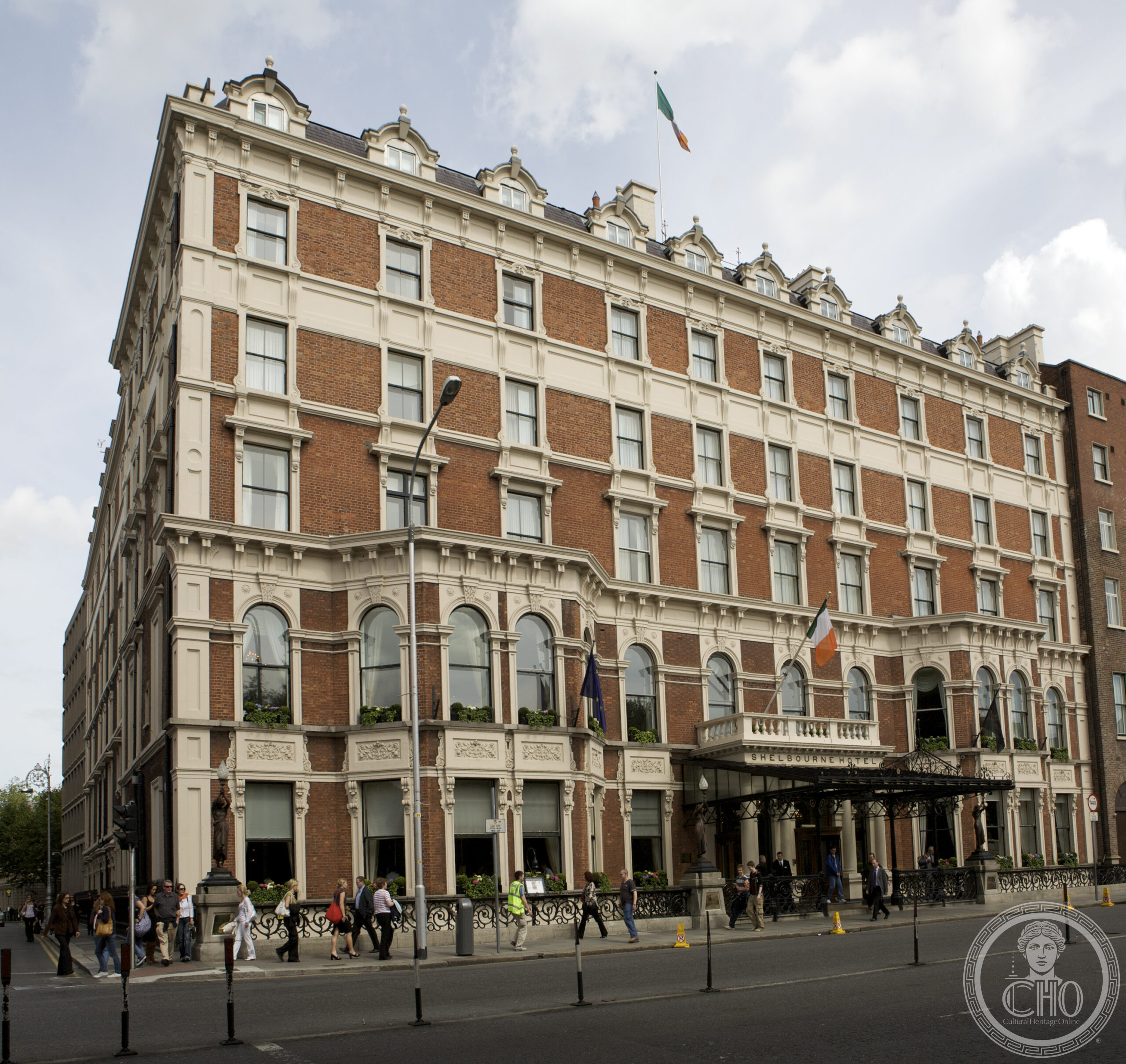
The Irish Free State Constitution was drafted in Room 112 of the Shelbourne in 1922 — the document that established Irish independence was written in a hotel suite overlooking St. Stephen’s Green.
At a glance
The Shelbourne opened its current building in 1867, on the north side of St. Stephen’s Green at the social centre of Georgian Dublin. The hotel had occupied this site since 1824 when Martin Burke opened the original establishment; the 1867 building, in a restrained Second Empire style, replaced the earlier structure with one of the most ambitious hotels in Ireland. Its position facing St. Stephen’s Green — the largest enclosed park in the British Isles — and its proximity to the Dáil Éireann (Irish Parliament) on Kildare Street gave it a dual identity as social centre and political venue that has defined its character for 150 years.
Key facts
- Founded: 1824 by Martin Burke; current building 1867
- Style: Victorian / Second Empire; red brick and Portland stone facade
- Address: 27 St. Stephen's Green, Dublin 2, D02 EY46, Ireland
- GPS: 53.3384, -6.2540
- Status: Renaissance Hotels (Marriott); five-star; National Historic Site
- Key event: Irish Free State Constitution drafted in Room 112, May–June 1922
History
During the Easter Rising of April 1916, Irish Volunteers occupied the roof of the Shelbourne and used it as a firing position overlooking St. Stephen’s Green, where the Irish Citizen Army under Michael Mallin had established their headquarters. British troops retook the roof position within days. The hotel itself continued to operate under occupation conditions — a typically Irish combination of political crisis and civilian routine that has characterised its history throughout.
The drafting of the Irish Constitution in Room 112 in May and June 1922 was the single most important event in the hotel’s history. Michael Collins, Arthur Griffith, and the other members of the Irish delegation used a suite on the first floor to draft the constitutional document that would establish the Irish Free State. The room is preserved and is accessible to hotel guests who request it. The writer Elizabeth Bowen, who documented Anglo-Irish society in her novels, was a regular guest; William Makepeace Thackeray visited the original hotel in 1841 and described it in “The Irish Sketch Book.”
What you see
The 1867 building presents a symmetrical red brick and Portland stone facade to St. Stephen’s Green — five bays wide, four storeys tall, with French Second Empire mansard dormers above the cornice. The principal entrance, flanked by bronze statues of two slave girls (a subject of ongoing public debate regarding their appropriateness), leads to the Horseshoe Bar and the Lord Mayor’s Lounge — the two public rooms that have been the social heart of Dublin since the Victorian era.
Practical information
The Horseshoe Bar is a Dublin institution — the traditional gathering place for journalists, politicians, and the legal profession after work. St. Stephen’s Green park directly opposite is one of Dublin’s primary public spaces. The National Museum, the National Gallery, and Trinity College Library (Book of Kells) are all within a 15-minute walk. Dublin Airport is 40 minutes by taxi.
Find it on the map
See this place and what’s around it →📷 Become a Cultural Heritage Online photographer
Share your photos of places: they stay published under your name as the author. The more they're seen, the more you get noticed — and soon a contest will reward the most appreciated photos.
Log in or sign up free to add a photo