
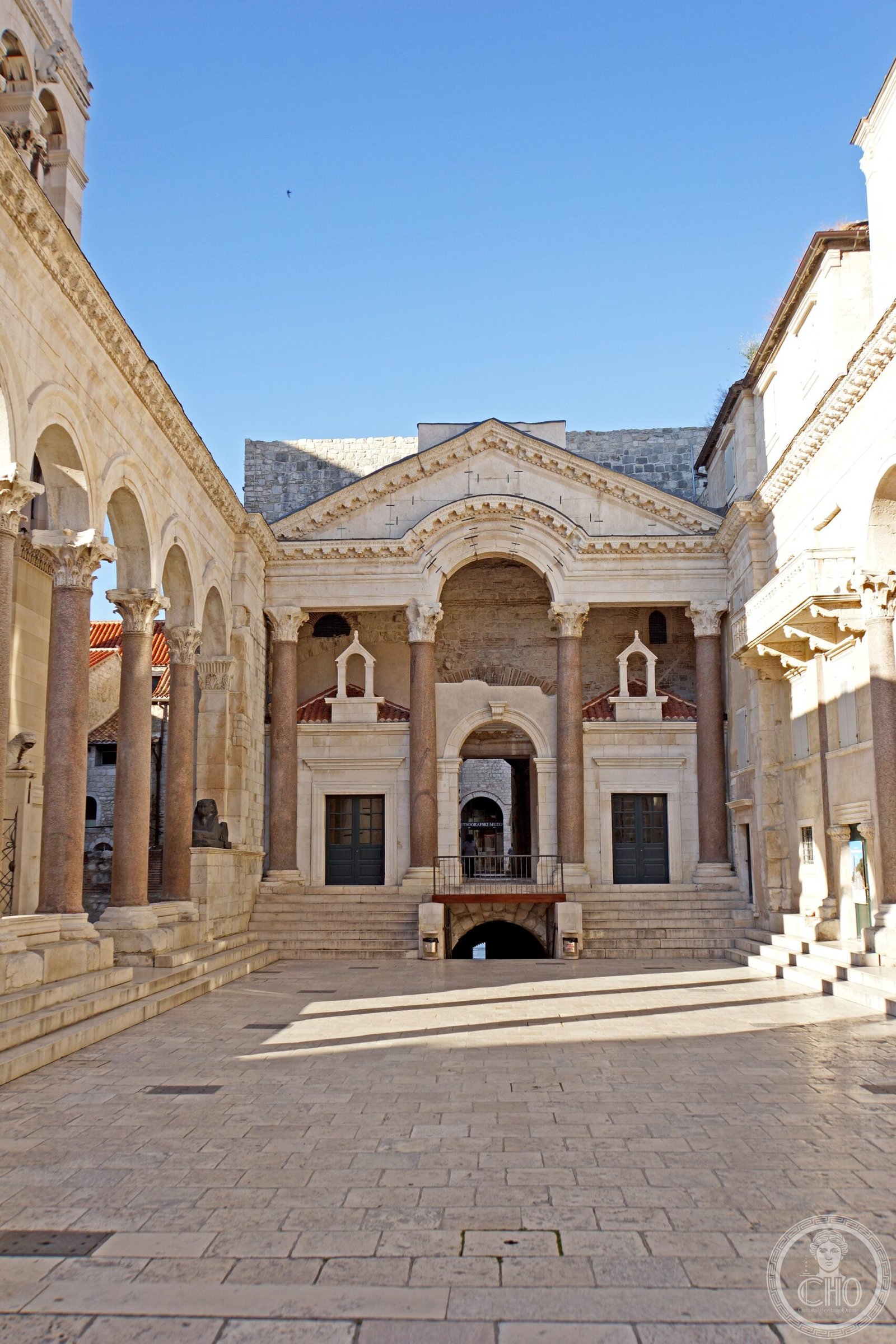
No hotel in the world has a more remarkable address: inside the walls of a Roman imperial palace built by Emperor Diocletian in 305 AD, still inhabited without interruption for 1,700 years.
At a glance
The Palace Hotel Split occupies a late 19th-century building constructed within the peristyle zone of Diocletian’s Palace — the Roman imperial complex that Diocletian built as his retirement residence on the Dalmatian coast between 293 and 305 AD. The palace walls, towers, and substructures remain intact, forming the street grid, walls, and foundations of the entire historic centre of Split; approximately 3,000 people live and work within the Roman enclosure. The hotel stands at the edge of the peristyle, the original ceremonial courtyard where Diocletian received obeisance. The site was inscribed as a UNESCO World Heritage Site in 1979.
Key facts
- Building: Late 19th century structure within the walls of Diocletian's Palace (305 AD)
- Style: Historicist exterior; Roman Imperial archaeological context throughout
- Address: Trg Gaje Bulata 1, 21000 Split, Croatia
- GPS: 43.5083, 16.4411
- Status: Operating hotel; UNESCO World Heritage Site setting (inscribed 1979)
- Historical context: Diocletian's Palace has been continuously inhabited since 305 AD — unique in the Roman world
History
Diocletian, born in the Dalmatian province and the only Roman emperor to voluntarily abdicate, built his retirement palace between 293 and 305 AD on a promontory of the Adriatic coast. After his death in 312 the palace was used as a military garrison, then gradually occupied by civilians fleeing the decline of the nearby city of Salona. By the 7th century, when Avars destroyed Salona, its entire population resettled inside the palace walls, converting the Roman military and ceremonial spaces into houses, churches, and workshops. This process of organic urban occupation continued for 1,700 years; the medieval city, the Renaissance palaces, and the 19th-century civic buildings all grew up within or against the Roman enclosure.
The Palace Hotel was established in the early 20th century in a building that incorporates Roman substructure walls as its foundations. The hotel’s position within the UNESCO-listed complex means that archaeological excavation is routine in its immediate vicinity — Roman drainage channels, floor mosaics, and column fragments emerge regularly from the soil of the courtyard gardens.
What you see
The Roman palace was designed as a hybrid: part military castrum (rectangular enclosure with towers at the corners), part luxury villa (south facade open to the sea with a loggia of 42 arches). The enclosure is 215 × 180 metres, built of Brač limestone from the adjacent island. The main ceremonial axis — the Decumanus — runs east-west; the peristyle, where the hotel stands, is the original throne forecourt. The Cathedral of Saint Domnius, directly adjacent to the hotel, occupies what was Diocletian’s own mausoleum — the most direct conversion of a pagan monument into a Christian church anywhere in the Roman world.
Practical information
The hotel is at the geographic centre of the UNESCO site; the peristyle is one minute on foot. The Roman substructure cellars (Vestibule) are publicly accessible and provide an immediate sense of the palace’s scale. The Riva promenade along the south palace wall offers the sea view that Diocletian would have seen from his loggia. Split airport is 25 minutes by taxi.
Find it on the map
See this place and what’s around it →📷 Become a Cultural Heritage Online photographer
Share your photos of places: they stay published under your name as the author. The more they're seen, the more you get noticed — and soon a contest will reward the most appreciated photos.
Log in or sign up free to add a photo