
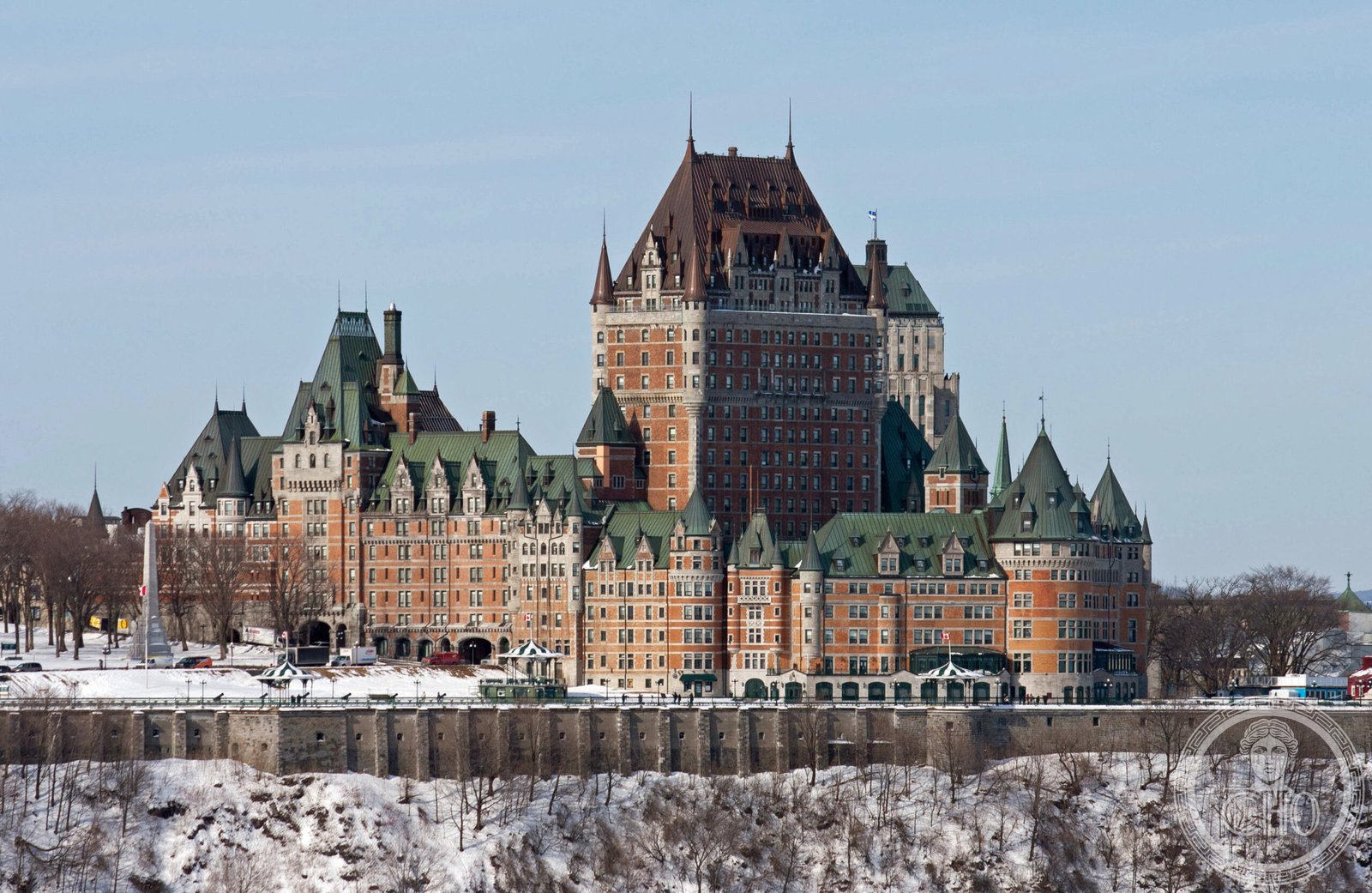
The most photographed hotel in the world sits on the Cap Diamant above the St. Lawrence — a 19th-century Scottish Baronial château that became the visual symbol of French Canada.
At a glance
Designed by architect Bruce Price for the Canadian Pacific Railway and opened on 18 December 1893, the Château Frontenac stands on the site of the former Château Haldimand, itself built over the foundations of the residence of the Counts of Frontenac — governors of New France in the 17th century. The hotel was the anchor of the CPR’s strategy to attract luxury tourism to Canada by building grand château-style hotels along the transcontinental railway. Its copper-green roofs and turreted profile above the Dufferin Terrace have become inseparable from the identity of Quebec City and the UNESCO-listed historic district below.
Key facts
- Built: 1893; architect Bruce Price; successive additions through 1924
- Style: Château Style (Scottish Baronial adapted for Canada) — a CPR-defined architectural vocabulary
- Address: 1 Rue des Carrières, Québec, QC G1R 4P5, Canada
- GPS: 46.8196, -71.2047
- Status: Fairmont Le Château Frontenac; National Historic Site of Canada since 1981
- Key event: Quebec Conference, August 1943: Churchill and Roosevelt planned D-Day strategy here
History
Bruce Price drew on the Scottish Baronial tradition — the same vocabulary used at Balmoral Castle — but adapted it to the steep limestone promontory of Cap Diamant and the French-Canadian historical narrative of the site. The original 1893 building was significantly expanded in 1897 and again in 1924 when the central tower (now the defining feature) was added by architect Edward Maxwell. The hotel immediately became the symbolic heart of Quebec City: a Victorian fantasy of medieval France transplanted to North America, inseparably linked to the Old Town’s cobblestone streets below.
The Quebec Conferences of 1943 and 1944 cemented the hotel’s place in 20th-century history. Churchill and Roosevelt used the Château Frontenac as the venue for two Allied strategy summits during the Second World War, planning the Normandy landings and the subsequent advance into Germany from its meeting rooms. Photographs of Churchill and Roosevelt on the terrace overlooking the St. Lawrence were among the most widely published images of the wartime alliance.
What you see
The composition is a formal château plan with a circular corner tower rising 90 metres above the Dufferin Terrace — the tall copper-sheathed roof is visible from the St. Lawrence River 20 kilometres downstream. Price’s original design drew on his study of French Loire Valley châteaux, interpreted through a Scottish Baronial lens consistent with the CPR’s corporate aesthetic. The public rooms were fitted out with French Renaissance detail work: coffered ceilings, stone fireplace surrounds, and heraldic ironwork. The Dufferin Terrace boardwalk directly below the hotel, built in 1838, offers the panoramic view of the Old City and the St. Lawrence that made Quebec City the most visually dramatic city in North America.
Practical information
The hotel is walkable from all major sites in Old Quebec (UNESCO since 1985). The Dufferin Terrace in front of the hotel is the main public promenade. The hotel’s 1608 Wine and Cheese Bar and the Champlain restaurant are the principal dining venues. Winter visits include the adjacent Ice Hotel and the Plains of Abraham skiing.
Find it on the map
See this place and what’s around it →📷 Become a Cultural Heritage Online photographer
Share your photos of places: they stay published under your name as the author. The more they're seen, the more you get noticed — and soon a contest will reward the most appreciated photos.
Log in or sign up free to add a photo