
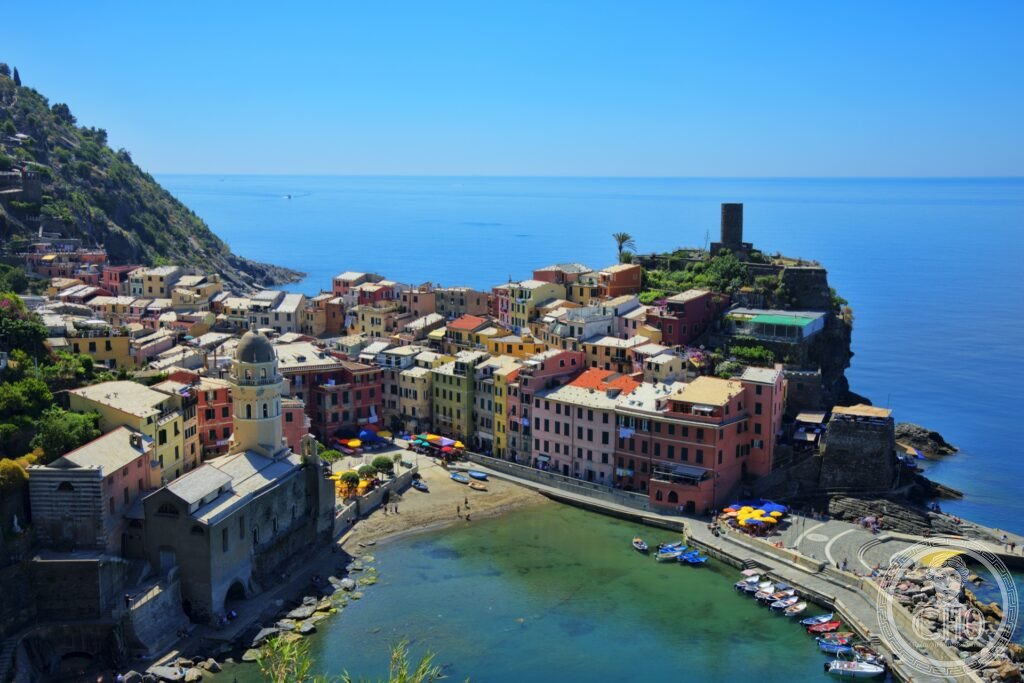
The Cinque Terre — five medieval fishing villages (Riomaggiore, Manarola, Corniglia, Vernazza, Monterosso al Mare) clinging to the nearly vertical cliffs of the Ligurian coast between the Gulf of La Spezia and the Gulf of Genoa, connected by a path network cut into the slate cliff face since the 14th century, and surrounded by dry-stone terraced vineyards producing the Sciacchetrà dessert wine — are inscribed by UNESCO as a cultural landscape whose outstanding universal value lies in the accumulated human labour of building and maintaining a productive, inhabited coastline on terrain that should be, geologically, uninhabitable.
At a glance
The Cinque Terre (province of La Spezia, Liguria; UNESCO 1997, ref. 826 — inscribed jointly with the islands of Porto Venere and the Palmaria, Tino, and Tinetto islands) is a serial inscription covering a coastal stretch of approximately 18 km in the eastern Ligurian Riviera. The WHC Outstanding Universal Value recognizes: (1) the dry-stone terracing system (fascie in local dialect), built from the 14th century onward to convert near-vertical slate cliff faces into narrow terraced plots for viticulture (the Bosco and Albarola grape varieties, used for the Cinque Terre DOC white wine and the Sciacchetrà DOC passito), olive cultivation, and vegetable growing; (2) the five medieval village centres, with their distinctive stacked multi-storey architecture (houses built vertically up the cliff face to minimize the footprint of habitation and maximize the terrace area for cultivation); and (3) the path network (including the famous “Sentiero Azzurro” / Via dell’Amore sections) that connects the five villages along the cliff face and allowed pre-road commerce and daily life between communities with no road access until the 20th century.
Key facts
- Le fascie e lo Sciacchetrà: The dry-stone terrace walls (fascie) of the Cinque Terre represent one of the most labour-intensive landscape modifications in Italy: the total length of the terrace walls in the Cinque Terre UNESCO zone is estimated at approximately 7,000 km (for reference: the distance from New York to Los Angeles is 4,500 km); the walls are built from local slate (ardesia ligure) without mortar, and require continuous maintenance — a single heavy rain event can collapse several sections; the active terrace area has declined from approximately 1,400 hectares in 1900 to approximately 300 hectares today, as the economic viability of the terraced viticulture has declined relative to mass-produced wine from the Po plain; the Parco Nazionale delle Cinque Terre maintains a terrace recovery programme; the Sciacchetrà DOC (passito wine, produced from partially-dried Bosco/Albarola/Vermentino grapes) is produced from the steepest and most preserved terraces (only ~7-10 tonnes/year, making it one of the rarest Italian DOC wines)
- I cinque borghi: Riomaggiore (the southernmost, founded in the 13th century; the castle; the Via dell’Amore starting point); Manarola (the most photographed, for its stacked houses above the sea cliff; the largest wine production of the five; the Christmas Nativity scene built on the slope above the village); Corniglia (the only village not directly on the sea — elevated 100 m on a promontory, accessible only by 377-step staircase from the train station or by bus; the smallest, ~150 residents); Vernazza (the most “complete” medieval village — the only one with a natural harbor, the 11th-century Santa Margherita di Antiochia church, and the 14th-century Doria castle tower; the most expensive property in the Cinque Terre); Monterosso al Mare (the largest, with the only accessible beach, the old village, and the newer 19th-century town; the lemon groves and anchovies under salt — the Monterosso acciuga IGP — are the most famous local products)
- Il Sentiero Azzurro (sentiero 2): The coastal trail connecting the five villages (16 km, full traverse 5-7 hours; most sections are easy-to-medium; the Via dell’Amore section — between Riomaggiore and Manarola — requires a ticket ~€7-10 and has limited daily capacity due to cliff stabilization works ongoing since 2012) is the most-walked trail in Italy; approximately 2.5 million hikers per year (pre-Covid data) attempt portions of it; the alternative “Alta Via” (sentiero 1, running 600 m above sea level through the vineyards) is far less crowded and gives a bird’s-eye view of the terraces and the villages from above
- UNESCO: 1997, rif. 826
- GPS: 44.1461, 9.6552 — Google Maps (Vernazza, Cinque Terre)
History
The earliest documented settlements on the Cinque Terre coast date to the 11th century (Riomaggiore is first mentioned in 1251, Vernazza in 1080); the communities were under the domination of various Ligurian lords (Malaspina, Fieschi, Doria) before becoming part of the Republic of Genoa in 1276. The economies of the five villages were fishing (anchovies, primarily), viticulture on the terraces (begun systematically in the 14th century), and coastal trade (the villages were connected by sea far more than by land); the construction of the terraces was driven by the Genoese demand for wine and the relative shelter from pirate raids provided by the cliff-top locations. The railway (La Spezia to Genova, opened 1874) transformed the Cinque Terre by providing a fast connection to the Ligurian coast markets and eventually to tourism; the car-accessible road to each village was built only in the 1960s. The transformation from primarily agricultural economy to tourism economy began in the 1970s and accelerated sharply after the UNESCO inscription in 1997; the Cinque Terre now receive approximately 2.5 million visitors per year on a permanent resident population of approximately 4,000.
What you see
The Cinque Terre is best experienced by a combination of train (the La Spezia–Genova local line stops at all five villages, with trains every 15-30 min), boat (seasonal ferry service between all five villages and Portovenere from May to October), and walking (the Sentiero Azzurro and the Alta Via). Day-visit circuit from south: start Riomaggiore (the most photogenic at low tide from the marina level, 07:00-08:00 before the crowds) → train or walk to Manarola (15 min walk, signed path; the most-photographed village from the panoramic terrace north of the harbour) → Corniglia (train only, the hill climb is inadvisable in high summer heat; the Basilica di San Pietro, 14th century, has the best Ligurian Gothic facade in the Cinque Terre) → Vernazza (walk from Corniglia, 1h30, the full cliff traverse with views of all five villages; or train 5 min; the castle tower climb, 1.5€, is the essential panoramic vantage) → Monterosso (train 5 min from Vernazza; the old town with the 14th-century San Giovanni Battista church and the sea-giant statue by Carre on the beach). Sea-kayaking between villages (from Riomaggiore or Vernazza, with licensed guides) is the least-crowded and most spectacular way to see the cliff faces from the water.
Gallery
Practical information
- Cinque Terre Card: The Parco Nazionale Cinque Terre Trekking Card (~€7.50/day, ~€14.50/2 days) gives unlimited access to the marked trails (including Sentiero Azzurro where open), the park visitor centres, and the Wi-Fi network; it does NOT include the Via dell’Amore (separate ticket, ~€7-10, pre-book at cinqueterre.info). The Train Card (~€18.20/day) includes the Cinque Terre Card plus unlimited train rides on the La Spezia–Levanto section. Buy at La Spezia Centrale or at any of the five village stations.
- Limiti visitatori (alta stagione): The Cinque Terre introduced visitor caps in 2022 for the Sentiero Azzurro sections: pre-booking is required in July-August. Day-trip visitors from cruise ships (Genova or La Spezia based) add 3,000-5,000 people/day to the village populations in summer; arrive before 09:00 or after 16:00 for a more reasonable experience.
- Sciacchetrà e acciughe: Buy Sciacchetrà DOC wine directly at the Cooperativa Agricoltura di Qualità Terre Cinque Terre in Groppo/Manarola (the last surviving cooperative winery in the Cinque Terre). Monterosso anchovies under salt (acciughe sotto sale, IGP): Cantina 5 Terre or Cantina del Molo in Monterosso.
Getting there
Cinque Terre (SP), Liguria. GPS 44.1461, 9.6552 — Vernazza. By train (recommended): Trenitalia regional from La Spezia Centrale (every 15-30 min; La Spezia is served by Frecciarossa from Milan 2h15, Florence 2h, Rome 3h20; or Intercity from Pisa 1h15, Livorno 1h30); all 5 villages are on the La Spezia–Genova line. By car: A12 (Genova–Livorno) exit La Spezia or Carrodano; NO cars in the villages (ZTL permanent); park in La Spezia or the Riomaggiore car park (200m above the village). By ferry: Navigazione Golfo Poeti from La Spezia, Lerici, and Portovenere (seasonal, May-October).
Nearby
- Portovenere — 20 km south of La Spezia; part of the same UNESCO inscription (ref.826); the medieval fishing village with the 11th-century Byzantine church of San Pietro on the promontory, the Doria castle, and the Grotta di Lord Byron (the cave where Byron swam before his famous swim across the Gulf of La Spezia in 1822)
- Genova, Strade dei Palazzi dei Rolli — 100 km north-west; (UNESCO 2006, ref.1211); the 16th-18th century patrician palaces on Via Garibaldi and Via Balbi (inscribed as “a civic tradition unique in the world”), including the Palazzo Rosso, Palazzo Bianco, and Palazzo Doria Tursi now as the Via Garibaldi Museums
- Carrara marble quarries — 50 km south-east; not UNESCO but an industrial landscape of iconic visual power; the white marble extracted here since Roman times (and used by Michelangelo for the David, the Pietà, and the Moses) is still quarried from the same quarries in the Apuane Alps above Carrara; guided quarry tours available
Sources
- UNESCO: whc.unesco.org/en/list/826
- Wikipedia EN: Cinque Terre
- Parco Nazionale Cinque Terre: parconazionale5terre.it
Find it on the map
See this place and what’s around it →📷 Become a Cultural Heritage Online photographer
Share your photos of places: they stay published under your name as the author. The more they're seen, the more you get noticed — and soon a contest will reward the most appreciated photos.
Log in or sign up free to add a photo