
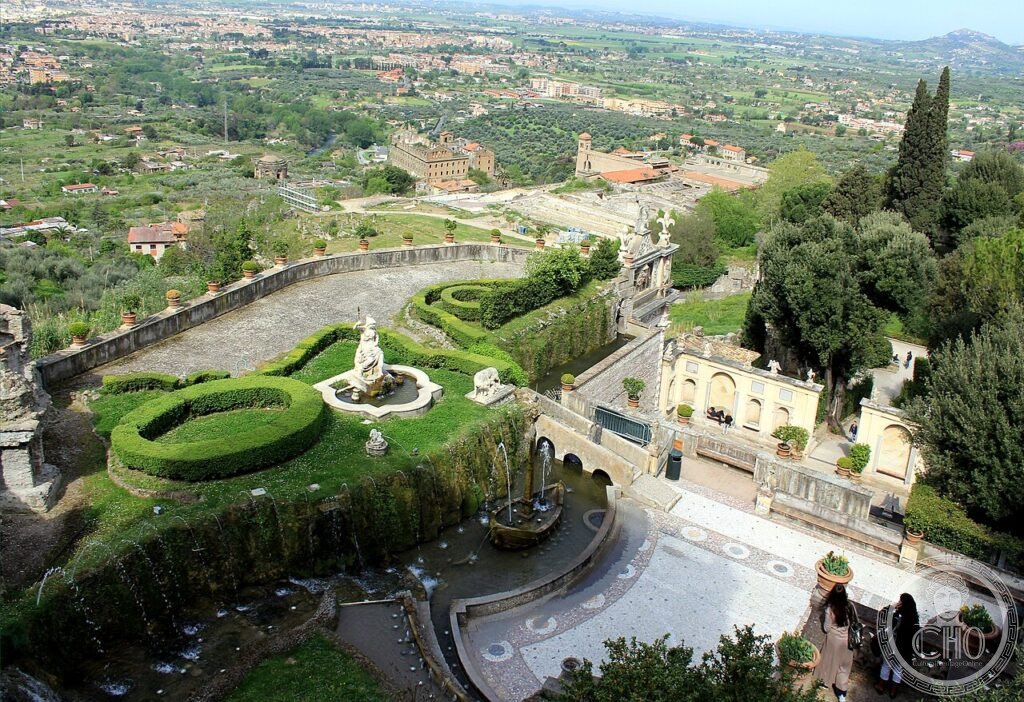
The gardens of the Villa d’Este at Tivoli contain 500 fountains, springs, nymphaea, and water outlets arranged on four terraces dropping 50 metres on the slope of the ancient hill of Tibur — a garden that the Venetian ambassador described in 1584 as “a miracle of art, the most beautiful thing in Italy and perhaps in the entire world” and that remained the single most imitated garden in Europe for 200 years, giving the world the giardino all’italiana (the formal Italian terraced garden), the waterfall garden, the symbolic garden, and the hydraulic organ.
At a glance
Villa d’Este is a UNESCO World Heritage Site inscribed in 2001 (ref. 1025) as “Villa d’Este, Tivoli.” The cardinal Ippolito II d’Este (1509-1572), son of Alfonso I d’Este and Lucrezia Borgia, commissioned the villa and its garden from the antiquarian architect Pirro Ligorio starting in 1560, after his failure to be elected Pope in the conclave of 1559. The garden was designed as an elaborate symbolic programme: a humanist allegory of the Este dynasty’s virtue, wisdom, and cultural supremacy, expressed through a system of fountains, water games, grottos, and mythological figures arranged on the steep hillside of the ancient city of Tivoli, fed by the diverted waters of the Aniene river. The garden was completed between 1560 and 1572 and established the model for the Italian formal garden that influenced garden design across Europe for two centuries.
Key facts
- The water system: The garden is fed entirely by gravity from a horizontal tunnel (the “cunicolo”) cut into the hillside above the garden, diverting a part of the flow of the Aniene river; the cunicolo feeds a cistern at the top of the garden that distributes water to 500 separate outlets via a system of pipes and conduits; the total water flow is approximately 900 litres per second at full capacity; there are no pumps in the entire system
- Fontana dell’Organo (Fountain of the Organ): The central feature of the upper terrace; a musical fountain powered entirely by water pressure (no mechanical power): as water fills a chamber below the organ pipes, it compresses air and forces it through the organ pipes in a sequence; the original 16th-century hydraulic organ played 6 “melodies” (repeated sequences of pipe sounds); the organ was rebuilt in 1927 and gives a recital at regular intervals (every 2 hours approximately)
- Viale delle Cento Fontane (Avenue of a Hundred Fountains): A 130-metre horizontal terrace at mid-garden level, lined with three parallel rows of water jets issuing from carved stone lion heads, eagle heads (the Este emblem), and boat-shaped basins; the avenue divides the garden horizontally and provides the main cross-axis between the Fontana dell’Ovato (east) and the Fontana di Roma / Rometta (west)
- Fontana dell’Ovato: The largest fountain in the garden (17 m wide, 9 m tall); an oval pool with a 9-metre central cascade enclosed by a semicircular colonnade; nymph figures in the niches of the colonnade; the sound of the falling water in the enclosed oval space creates a specific acoustic effect that interested Franz Liszt during his long residence at the villa (1865-1885)
- UNESCO: 2001, ref. 1025
- GPS: 41.9609, 12.7962 — Google Maps
History
Ippolito II d’Este, the second son of Alfonso I d’Este (duke of Ferrara) and Lucrezia Borgia, was an extraordinarily wealthy and ambitious prince of the Church who had expected to be elected Pope in the conclave of 1559 (he had campaigned extensively and was considered the frontrunner). His failure to be elected — Henri II of France put forward the French cardinal Gilles de Noailles, and the cardinals deadlocked until electing the elderly Gian Angelo Medici as Pius IV — was the decisive shock that led him to withdraw from the papal court and concentrate his resources on the villa and garden at Tivoli, where he had been appointed Governor in 1550.
Pirro Ligorio (c. 1512-1583), the antiquarian architect who designed the garden, was the greatest expert on ancient Roman villas in 16th-century Italy (he produced a survey of ancient Tibur/Tivoli, the site of Hadrian’s Villa, that was the most systematic ancient topography of the period). Ligorio’s design for the Villa d’Este garden was explicitly modelled on descriptions of ancient Roman gardens (particularly the gardens of Lucullus in Rome and the horti of the emperors on the Palatine Hill) and incorporated references to the ancient mythological programme of the Tiburtine Sybil. The symbolic programme of the garden was designed as a humanist allegory: the garden descends from the peak of Virtue (the palace) to the Valley of Nature (the lowest terrace, near the town), with the three main axes representing the three roads to Virtue — philosophy, music, and heroic action.
What you see
The Villa d’Este garden is entered from the villa building (a converted Benedictine convent with 16th-century frescoed rooms by Livio Agresti, Federico Zuccaro, and Muziano) at the top of the garden, and the visitor descends through the four terraced levels to the lowest terrace and the fishponds. The most important elements to see in sequence from top to bottom are: the Loggia fresco rooms in the villa (view of the garden from above); the Fontana dell’Organo (top terrace); the Viale delle Cento Fontane (middle terrace); the Fontana dell’Ovato (east side); the Fontana di Nettuno (a 20th-century reconstruction of the lower central cascade, the most spectacular visual element); and the Fontana dei Draghi (the Dragon Fountain, 1572, reportedly built in one night for a visit by Pope Gregory XIII — the Este dragons are in the fountain pediment).
The garden is most beautiful in the morning light (the upper terraces face east and receive direct sun until noon; the afternoon light illuminates the lower terraces). Franz Liszt lived in the Villa d’Este for extended periods between 1865 and his death in 1886 and composed the piano piece “Les Jeux d’Eau à la Villa d’Este” (1877) while living there — a piece that directly inspired Ravel’s Jeux d’Eau and Debussy’s Reflets dans l’eau, initiating the entire tradition of French Impressionist piano writing on water.
Gallery
Practical information
- Opening: Tuesday-Sunday 9:00-1 hour before sunset; closed Monday, 25 December, 1 January. Last entry 1 hour before closing. Admission ~€8 (reduced ~€2). The Fontana dell’Organo concert (hydraulic organ recital): every 2 hours (approximately 10:30, 12:30, 14:30, 16:30, 18:30 — check at the entrance).
- Duration: 1.5-2 hours for the complete garden circuit (the garden is compact; the four terraces can be walked in sequence). The villa rooms (frescoes) add 30 minutes.
- Season: Spring (April-May) is best (the garden is green and the fountains at full capacity). Summer is hot but the fountains create natural cooling. October-November: reduced fountain pressure (Aniene flow lower in late summer); the garden colors are good.
Getting there
Piazza Trento 1, Tivoli (RM), Lazio, 30 km east of Rome. By bus: COTRAL bus from Ponte Mammolo (end of Metro B, line B1, Roma) to Tivoli Acque Albule (40 min); from Tivoli bus terminus, walk 15 min downhill to the Villa d’Este. By train: Trenitalia from Roma Tiburtina to Tivoli (45 min; runs hourly); from Tivoli station, walk 20 min or take local bus. By car: from Rome, A24 east (Roma-L’Aquila autostrada) to Tivoli exit (30 km, 30 min in light traffic); parking near Piazza Garibaldi above the Villa d’Este entrance (10 min walk downhill).
Nearby
- Villa Adriana (Hadrian’s Villa), Tivoli — 5 km south-west of Villa d’Este; the Roman Imperial villa of Hadrian (118-138 CE, UNESCO 1999); one of the largest and most complex Roman imperial residences (120 hectares, 30+ distinct building complexes); the Canopo (the reflecting pool with statues, modelled on the canal of Canopus in Egypt), the Pecile (a rectangular portico 232 × 97 m, modelled on the Stoa Poikile in Athens), and the Teatro Marittimo (an island villa within the villa, surrounded by a moat) are the most important areas; see separate CHO card
- Tivoli centro storico — the medieval hilltop town above the Villa d’Este; the Temple of Vesta (1st century BCE, circular Ionic temple on the cliff above the Aniene gorge; the most photographed classical ruin in Lazio after those of Rome) and the Temple of the Sibyl (adjacent, rectangular, 1st century BCE); the Aniene gorge below the temples was the subject of major landscape paintings in the 18th century (Claude Lorrain, Gaspard Poussin, Thomas Jones)
- Roma centro storico — 30 km west; (UNESCO 1980 ref.91)
Sources
- UNESCO: whc.unesco.org/en/list/1025
- Wikipedia EN: Villa d’Este, Tivoli
- Coffin, David R.: The Villa d’Este at Tivoli, Princeton University Press, 1960
- Villa d’Este (Polo Museale del Lazio): villadestetivoli.info
Find it on the map
See this place and what’s around it →📷 Become a Cultural Heritage Online photographer
Share your photos of places: they stay published under your name as the author. The more they're seen, the more you get noticed — and soon a contest will reward the most appreciated photos.
Log in or sign up free to add a photo