
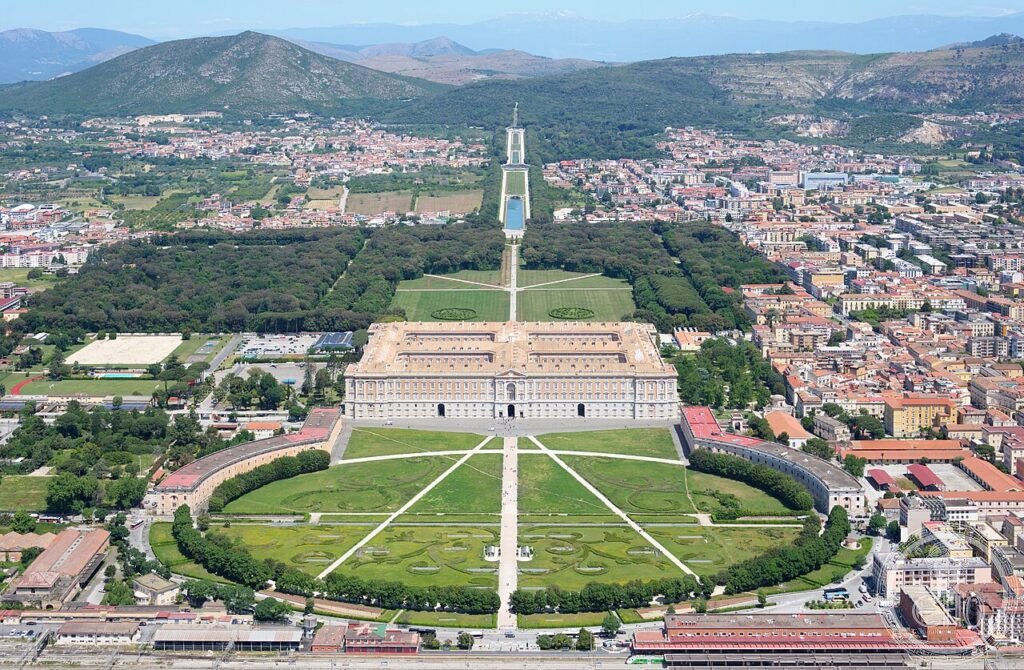
In 1752, King Charles III of the Two Sicilies commissioned the architect Luigi Vanvitelli to build a palace that would surpass Versailles — not in elegance or style, but in sheer physical scale — and Vanvitelli delivered: the Royal Palace of Caserta is the largest royal residence in the world by volume, a building 249 metres long, 190 metres wide, 37 metres tall, with 1,200 rooms, 1,790 windows, and 34 staircases, set at the end of a 3-kilometre park axis that runs from the main facade to a 78-metre waterfall on the hillside behind, with a cascade system fed by the Acquedotto Carolino (an aqueduct 38 km long, designed by Vanvitelli and built 1753-1759).
At a glance
The Reggia di Caserta (Royal Palace of Caserta) is a UNESCO World Heritage Site inscribed in 1997 (ref. 549) as “18th-Century Royal Palace at Caserta with the Park, the Aqueduct of Vanvitelli, and the San Leucio Complex.” The inscription covers three components: the Palazzo Reale (the palace building itself, 1752-1845), the Parco Monumentale (the formal park running 3 km from the palace to the waterfall), and the San Leucio complex (a model industrial village built by Ferdinand IV in 1750-1780 for silk production, with the workers’ houses, the factory, and a small palace). The palace was built for King Charles VII of Naples (later Charles III of Spain) from 1752 as the new royal residence, replacing the Neapolitan palaces of Capodimonte and the Portici.
Key facts
- Dimensions: 249 m × 190 m × 37 m; total floor area: approximately 47,000 m²; total volume: approximately 2.5 million m³ (the largest enclosed volume of any royal building in the world); 1,200 rooms; 1,790 windows; 34 staircases; 5 floors (4 above ground + basement)
- Luigi Vanvitelli (1700-1773): The principal architect of the palace; son of the Dutch-Italian landscape painter Gaspar van Wittel; trained in Rome; worked on the restoration of the Pantheon, the harbour of Ancona, and various other royal commissions before receiving the Caserta commission in 1752; the palace was his masterwork and the largest commission in 18th-century Italian architecture
- Staircase of Honour (Scalone d’Onore): The central staircase of the palace, a double-ramp marble staircase that rises from a vestibule on the ground floor to the royal apartments on the piano nobile; the staircase is 44 m long, 17 m wide, and 35 m high to the ceiling vault; it is considered the finest ceremonial staircase in Europe (visitors frequently stop on the lower landing to photograph upward)
- Parco Monumentale: A formal garden (Italian/French mixed style) extending 3 km from the rear facade of the palace to the waterfall (78 m high) on the hillside; the central axis is a canal (3 km, with pools and fountains) flanked by allée of trees; the “English Garden” (Giardino Inglese) is a landscape garden laid out by John Andrew Graefer in 1785-1793 at the instruction of Maria Carolina of Austria, with artificial ruins, a lake, and an exotic plant collection
- UNESCO: 1997, ref. 549
- GPS: 41.0742, 14.3266 — Google Maps
History
King Charles VII of Naples (Carlo di Borbone, 1716-1788, later Charles III of Spain) chose the Caserta plain — 30 km north of Naples, at the foot of the Campanian Apennines — as the site for his new royal residence in 1750. The choice was partly strategic (the coast was vulnerable to naval attack; Caserta was inland and defensible) and partly political (Naples was too cramped to expand a new royal quarter; Caserta offered unlimited space). The commission to Luigi Vanvitelli, delivered in 1751, specified that the new palace should be “the most beautiful palace in Europe” — a direct reference to Versailles, which Charles had visited as a child when his father Philip V of Spain made his court there, and which had made a profound impression on him.
Vanvitelli’s design (presented to the king in 1751 in a series of 14 engraved plates, published in 1756 as Dichiarazione dei disegni del Reale Palazzo di Caserta) was based on a rectangular plan with four interior courtyards — a plan derived from the Escorial, the great Spanish royal palace built by Philip II (Charles’s ancestor) in 1563-1584. The building was laid out on a strict axial system: the main entrance faces Caserta and Naples (south-east); the main facade faces the gardens (north-west); the garden axis runs 3 km from the palace to the hillside cascade at an exact angle calculated by Vanvitelli to create a continuous perspective that could be seen from the main salon on the piano nobile.
What you see
The visit to the Reggia di Caserta has two main components: the palace interiors (the state apartments, accessible via the Staircase of Honour) and the Parco Monumentale (the 3-km garden axis, accessible on foot, by bicycle, or by electric cart). The state apartments on the piano nobile include the Sala di Marte (the ceremonial antechamber), the Sala di Astrea (the throne room), the Cappella Palatina (the royal chapel, modelled on the Versailles chapel, with the principal painting by Anton Raphael Mengs), and the private apartments of Francesco II — the last Bourbon king of the Two Sicilies, who used the palace until Italian unification in 1861.
The Parco Monumentale is best seen in the opposite direction: starting from the fountain at the far end (the Fountain of Diana and Actaeon, at the base of the 78-metre cascade, 3 km from the palace) and walking back toward the palace — so that the visitor always has the palace facade as the view, with the cascade behind. The Fountain of Venus and Adonis (2.4 km from the palace) and the Fountain of Aeolus (1.5 km) are the principal sculptural groups along the axial canal. The English Garden is to the right of the main axis approximately 2.5 km from the palace (separate entrance from the canal path).
Gallery
Practical information
- Palace interiors: Piazza Carlo di Borbone 22, Caserta; open Wednesday-Monday 9:00-19:00 (summer), 9:00-17:00 (winter); closed Tuesday. Admission ~€16 (includes palace + park; combined ticket with Caserta Vecchia ~€20). Free first Sunday of month (park only; palace under the “free Sundays” scheme).
- Park: The full 3-km walk from palace to cascade and back is approximately 8 km round trip; allow 2-3 hours. Electric carts available at €4/person per direction. Bicycles available at the park entrance (~€5/2 hours). No shade on the main axis in summer; bring water and sun protection.
- Duration: Minimum 3 hours for palace + a short walk in the park; full day for palace + entire park + English Garden.
Getting there
Piazza Carlo di Borbone 22, Caserta, Campania. By train: Trenitalia from Napoli Centrale (40 km; 40 min regional; 25 min Intercity); direct trains also from Roma Termini (2h10 Intercity). The Caserta station is adjacent to the main entrance of the palace (the south-east facade). By car: from Naples, A1 north to Caserta Sud exit (40 km, 35 min); from Rome, A1 south to Caserta Nord exit (205 km, 2h20). Paid parking adjacent to the palace.
Nearby
- Caserta Vecchia — 10 km north-east of the palace; the original medieval hilltop city abandoned when the Bourbons built the new Caserta below; the Cathedral of San Michele Arcangelo (1113 CE, Romanesque, with a 13th-century campanile; a cloister and an unusual octagonal dome; one of the best-preserved Norman-Romanesque buildings in southern Italy)
- San Leucio — 3 km north-west of the palace; the Bourbon model silk-production village (1750-1780, Ferdinand IV); the production complex (the silk factory), the workers’ village (small identical houses with shared facilities — an early example of enlightenment social planning), and the Belvedere palace are open for visits; the San Leucio silk (produced here continuously from 1778) is still one of the finest plain silk weaves in Italy, used for Vatican upholstery and luxury interiors
- Pompei e Ercolano — 50 km south via Naples; (see separate CHO cards)
Sources
- UNESCO: whc.unesco.org/en/list/549
- Wikipedia EN: Palace of Caserta
- Vanvitelli, Luigi: Dichiarazione dei Disegni del Reale Palazzo di Caserta, Naples, 1756 (facsimile: 1977)
- Reggia di Caserta: reggiadicaserta.beniculturali.it
Find it on the map
See this place and what’s around it →📷 Become a Cultural Heritage Online photographer
Share your photos of places: they stay published under your name as the author. The more they're seen, the more you get noticed — and soon a contest will reward the most appreciated photos.
Log in or sign up free to add a photoIs this page about you?
This page is read by travellers and heritage enthusiasts who find it on Google. Tell us how you are connected to this place and we will take it from there.