

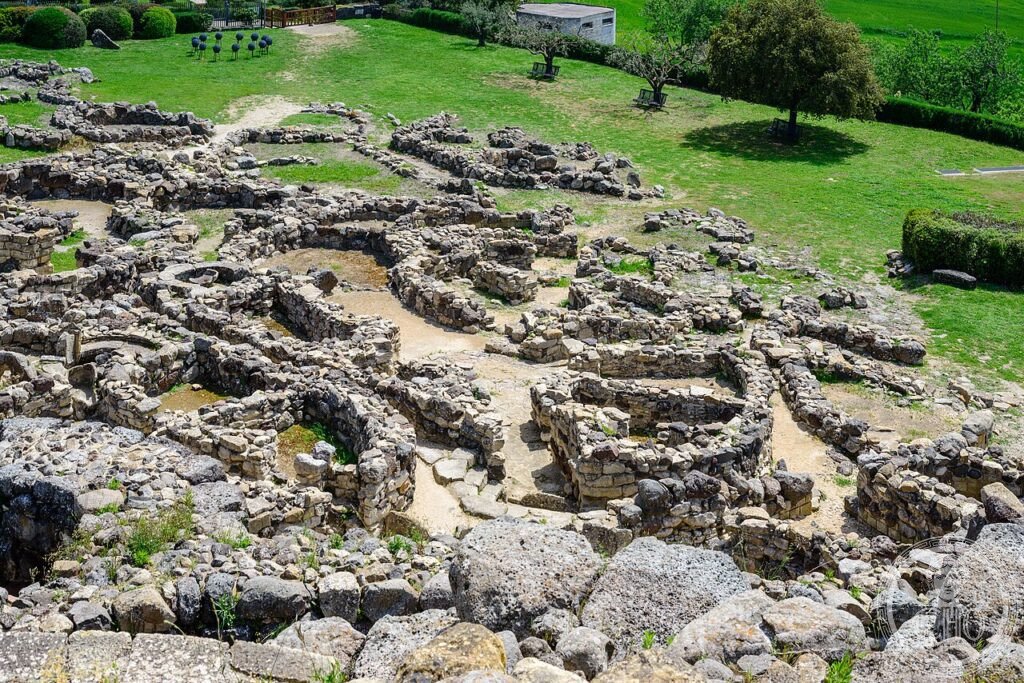
The most complete and best-preserved nuragic complex in Sardinia — a Bronze Age tower-village covering 10,000 square metres that was built, expanded, and inhabited without interruption from 1600 BCE to the early first millennium CE, using large basalt blocks set without mortar in dry-stone corbelled courses, and demonstrating a level of architectural ambition in the middle Bronze Age that has no equivalent anywhere else in the western Mediterranean.
At a glance
Su Nuraxi di Barumini is a nuragic complex in the municipality of Barumini in the Marmilla district of Sardinia, 60 km north of Cagliari. The complex consists of a central tower (nuraghe) built in the seventeenth century BCE, a quadrilobate bastion with four corner towers added in the fourteenth-thirteenth century BCE, and a village of circular huts (about 200 structures) built around the fortified core from the tenth-eighth centuries BCE. The complex was inscribed on the UNESCO World Heritage List in 1997 (ref. 833) as “Su Nuraxi di Barumini,” and is managed by the Fondazione Barumini Sistema Cultura. It is the only nuragic site on the World Heritage List and is the finest example of nuragic architecture in a culture that produced approximately 7,000 nuraghi across Sardinia.
Key facts
- Age of the central tower: Approximately 1600-1500 BCE (middle Bronze Age); built by the nuragic culture of Sardinia
- Construction: Dry-stone construction using large basalt blocks (up to 2.5 m long) without mortar; corbelled vaulting (false vault) in the interior chambers; the technique is called “opera poligonale” or “opera ciclopica” by archaeologists
- Size: Central tower: approximately 15 m surviving height (originally taller); quadrilobate bastion with four corner towers: diameter approximately 37 m; village: approximately 200 circular hut foundations over 10,000 m²
- Materials: Local basaltic stone quarried nearby; no mortar used in any construction phase; the structural stability relies entirely on the weight and fitting of the stones
- Occupation: From approximately 1600 BCE continuously until the early Roman period (approximately 1st century CE); the village area was reoccupied in the early Middle Ages
- UNESCO: 1997, ref. 833 — “Su Nuraxi di Barumini.” The only nuragic site on the World Heritage List.
- GPS: 39.7071, 9.0061 — Google Maps
History
The nuragic culture of Sardinia (approximately 1800-238 BCE, when Sardinia was conquered by Rome) is unique among the cultures of the western Mediterranean Bronze Age in its production of a distinctive architectural type — the nuraghe (pl. nuraghi) — a truncated conical tower built in dry stone using the corbelling technique. Approximately 7,000 nuraghi survive across Sardinia (many more may have existed), ranging from single towers (the simplest type) to complex multi-tower fortifications like Su Nuraxi. The function of the nuraghi is debated: defence, chieftain’s residence, religious site, and territorial marker have all been proposed; the larger complexes like Su Nuraxi, which combine a fortified tower with a substantial village, suggest a political-administrative function (the residence and administrative centre of a local chieftain or chief).
Su Nuraxi was excavated between 1950 and 1957 by the archaeologist Giovanni Lilliu (1914-2012), the most important Sardinian archaeologist of the twentieth century, who spent his career documenting and interpreting the nuragic culture. Before Lilliu’s excavations, Su Nuraxi had been covered by a large mound of earth that accumulated over the abandoned site; the excavation revealed the quadrilobate bastion and the village for the first time since antiquity. Lilliu’s work established that Su Nuraxi was not a single-phase construction but had been built, expanded, and rebuilt over approximately 800 years (1600-800 BCE).
What you see
The visit to Su Nuraxi (access via the Fondazione Barumini visitor centre on the east side of the site; guided tours obligatory) begins with the central tower, which can be entered through the ground-floor entrance. The interior has three superimposed chambers connected by a spiral staircase within the wall; the lower chamber (accessible) has a corbelled vault with a height of approximately 4 metres. The corbelling technique — courses of stone that progressively overhang inward to form a pointed dome without a keystone — is visible in the ceiling: the construction achieves structural stability through dead weight alone, with the outer mass of the tower holding the inner courses in compression.
From the central tower, the bastion with four corner towers is visible as a horseshoe of rubble rising to approximately 7-8 m (the corner towers are ruined to various heights). The village surrounding the bastion is a field of circular foundations — the base walls of the circular huts that surrounded the nuraghe from the tenth century BCE — visible as stone rings of approximately 4-6 m diameter, in some cases preserving the entrance threshold stone and the interior division walls. The scale of the village (200 huts covering 10,000 m²) makes clear that this was not merely a fortification but the centre of a significant settlement.
Gallery
Practical information
- Opening: Daily 9:00–17:00 (winter) / 9:00–19:00 (summer). Last admission 1 hour before closing. Guided tours obligatory (no independent access to the site); tours depart every 30-40 min from the visitor centre.
- Admission: €12 adults; €8 reduced (under 18, over 65, university students with ID); under 6 free. Combined ticket with Casa Zapata museum (antiquarium in the village centre, with finds from Su Nuraxi) recommended: ~€15.
- Dress and access: Uneven ground and some climbing within the central tower; comfortable closed shoes required. The site is fully exposed (no shade); sun protection essential in summer.
- Duration: 1 hour for the guided tour of the site; 45 minutes for Casa Zapata; 2 hours combined.
Getting there
Via Nazionale, Barumini (CA), Sardegna. By car: from Cagliari, 60 km north via SS197 and SS197dir, approximately 1 hour; from Oristano, 55 km south-east via SS131 and SS197. There is no direct public transport from Cagliari to Barumini; an ARST bus runs from Sanluri (accessible by train from Cagliari Centrale, 40 min), but with long connections. Car hire or organised tour from Cagliari are strongly recommended. By air: Cagliari Elmas airport (CAG); car hire companies at the airport.
Nearby
- Casa Zapata, Barumini — 500 m north in the village centre; the antiquarium of the Fondazione Barumini; exhibits finds from Su Nuraxi (bronze figurines, pottery, tools); the building itself was constructed over an underlying nuraghe (visible through a glass floor in the museum)
- Giara di Gesturi — 10 km north; a basaltic plateau rising to 580 m above the plain; one of the few surviving habitats of the Giara horse (cavallino della Giara), a small semi-wild horse that lives only on this plateau; accessible on foot or horseback
- Nuraghe Is Paras, Isili — 30 km north-east; one of the best-preserved nuraghi in Sardinia; a single-tower nuraghe with an exceptionally complete corbelled interior; less visited than Su Nuraxi
Sources
- UNESCO: whc.unesco.org/en/list/833
- Wikipedia EN: Su Nuraxi di Barumini
- Fondazione Barumini Sistema Cultura: fondazionebarumini.it
- Lilliu, Giovanni: La civiltà dei Sardi dal Paleolitico all’età dei nuraghi, ERI, 1967 (revised 1988)
Find it on the map
See this place and what’s around it →📷 Become a Cultural Heritage Online photographer
Share your photos of places: they stay published under your name as the author. The more they're seen, the more you get noticed — and soon a contest will reward the most appreciated photos.
Log in or sign up free to add a photoIs this page about you?
This page is read by travellers and heritage enthusiasts who find it on Google. Tell us how you are connected to this place and we will take it from there.