
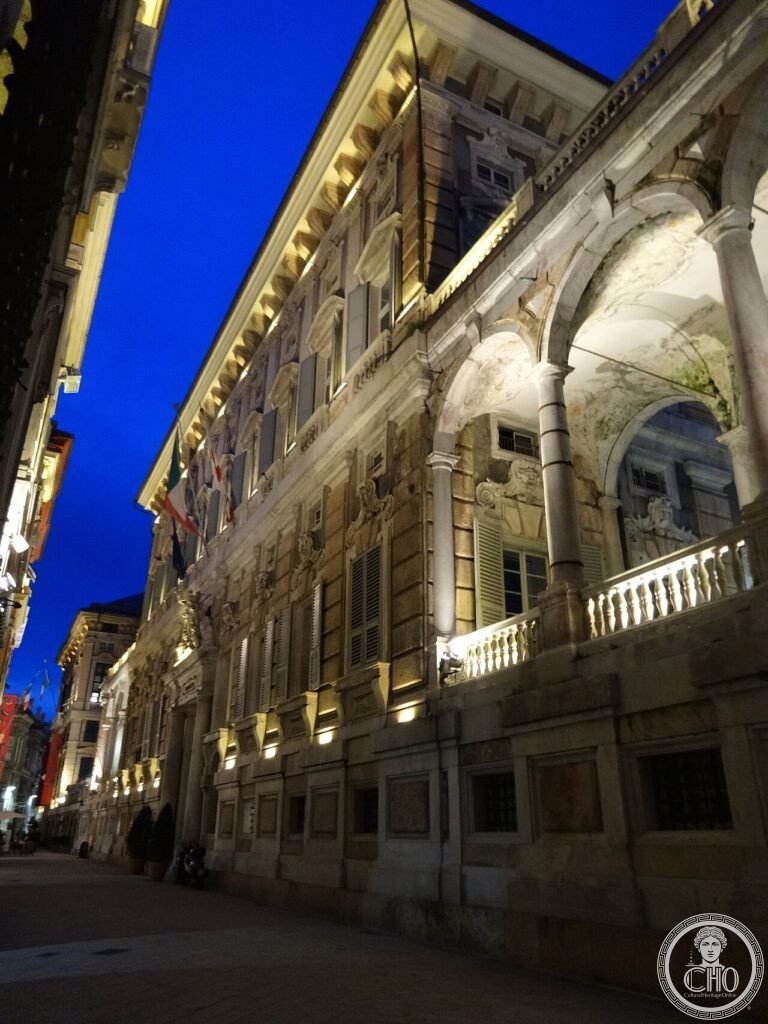
Europe’s first public system of hospitality for visiting dignitaries — the Palazzi dei Rolli — was established by the Genoese republic in 1576 by decree: a list (rollo) of 42 patrician palaces whose owners were obliged by lot to host official guests of the republic, in exchange for civic privileges. The palaces that housed this system are concentrated on two streets (the Strade Nuove, begun 1551) that are still the most architecturally coherent sequence of sixteenth-century palaces in Italy.
At a glance
The Strade Nuove (“New Streets”) is the name given to the two parallel streets built in Genoa between 1551 and 1636: Via Garibaldi (known until 1882 as Strada Nuova) and Via Balbi. Together they form a planned urban development of approximately 800 metres of new streets lined with patrician palaces — the largest single programme of planned urban expansion in any Italian city in the sixteenth century, and the best preserved. The Palazzi dei Rolli are 42 patrician palaces (mostly on the Strade Nuove but some elsewhere in the city) that were enrolled in the republic’s official list of “rolli” — palatial residences available for hosting visiting dignitaries of the Genoese republic, assigned by lottery among the enrolled palaces according to the dignity of the guest.
UNESCO inscription: 2006, ref. 1211, “Genoa: Le Strade Nuove and the System of the Palazzi dei Rolli.”
Key facts
- Strade Nuove: Via Garibaldi (Strada Nuova) 1551–1556; Via Balbi 1618–1636; combined approximately 800 m; the widest streets in Genova at the time of construction (9–12 m width; all other streets were 2–4 m)
- Sistema dei Rolli: 1576 senatorial decree; 42 palaces originally enrolled; owners required to house visiting dignitaries “according to their dignity” by lottery; the three categories (1st, 2nd, 3rd class) corresponded to the importance of the guest; the system operated until the end of the republic (1797)
- Palazzo Rosso: 1671–1677; Brignole Sale family; now a public museum (Musei di Strada Nuova); paintings by van Dyck, Veronese, Rubens, Dürer
- Palazzo Bianco: 1530s, rebuilt 1711; now a public museum; collection includes Caravaggio, Filippino Lippi, Hans Memling, Jan Provost (Flemish and Genoese paintings)
- Palazzo Doria-Tursi: 1565 (Grimaldi commission, later Doria), 1597 (purchased by city, now Municipio); the largest of the Rolli palaces; contains Paganini’s violin (“il Cannone,” 1743 Guarneri del Gesù)
- UNESCO: 2006, ref. 1211
- GPS: 44.4090, 8.9327 — Google Maps
History
Genoa in the sixteenth century was one of the richest cities in Europe, with a financial empire that had grown from its role as banker to the Spanish crown: the Genoese “asientos” (financial contracts lending money to Philip II of Spain) gave Genoese banking families a share in the profits of the Spanish silver trade from the Americas. This wealth produced the building campaign of the Strade Nuove, which began in 1551 when the patrician Adorno family sponsored the construction of a new street (later called Via Garibaldi) in what had been a marginal area of the city. The patrician families who built on the street — Spinola, Grimaldi, Doria, Brignole-Sale — were among the wealthiest families in Europe; their palaces were specifically designed to receive visitors from the Spanish court (including, in 1533 and again in 1548, the Emperor Charles V, who was entertained in Genoese patrician houses).
The Rolli system (1576) formalised what had been an informal practice: the republic now maintained an official list of palaces approved for hosting state guests, with inspections every few years to ensure that enrolled palaces maintained the necessary standard of luxury. The guests who passed through the Rolli palaces included Philip III of Spain (1598), the Archduke Albert of Austria (1599), the Duke of Savoy (1603), and Cardinal Federico Borromeo (1612). The system was abolished with the republic in 1797 when Napoleon absorbed Genoa into France.
What you see
Via Garibaldi (the “Strada Nuova”) runs east-west for approximately 250 metres through the old centre of Genoa, lined on both sides by palace facades. The sequence is continuous and consistent — all six stories of rusticated masonry, piano nobile windows, and loggie — in a way that is unique among Italian streets of this period. The three public museums (Palazzo Rosso, Palazzo Bianco, and Palazzo Doria-Tursi) can be visited on the Musei di Strada Nuova combined ticket.
Palazzo Rosso (north side, via Garibaldi 18) contains the most important single painting collection — van Dyck’s series of portraits of the Genoese aristocracy (1627–1627) is the centrepiece, but the collection also includes works by Guercino, Veronese, Tintoretto, Palma il Vecchio, and Albrecht Dürer. The piano nobile suite (state rooms) still has its original gilt-and-fresco ceiling decorations from the 1670s, giving the best surviving sense of how these spaces were used for state entertainment. Palazzo Doria-Tursi contains the “Cannone” — Niccolò Paganini’s 1743 Guarneri del Gesù violin, still played publicly in Genova each October on the anniversary of Paganini’s death.
Gallery
Practical information
- Musei di Strada Nuova: Palazzo Rosso + Palazzo Bianco + Palazzo Doria-Tursi; combined ticket ~€9 (standard) / €7 (reduced); Tuesday–Friday 9:00–19:00, Saturday–Sunday 10:00–19:30. The ticket is valid for both days if visiting across two days.
- Open houses Rolli Days: Twice yearly (spring and autumn; check rollidays.it) the enrolled private Rolli palaces open for free public visits — the only time to see many of the 42 palaces that are not otherwise accessible (corporate headquarters, private residences, university buildings). Exceptionally worthwhile.
- Duration: 1.5 hours for the street + all three Musei; longer if visiting during Rolli Days. Allow a full afternoon for Via Garibaldi + the adjacent alleyways of the medieval centro storico (one of the largest medieval city centres in Europe).
Getting there
Via Garibaldi, Genova, Liguria. By metro: Linea 1 station “Darsena” (5 min on foot east), “San Giorgio” (3 min on foot west). By train: Genova Piazza Principe station (15 min on foot; or 1 metro stop to Darsena). By car: do not drive — the historic centre is a ZTL zone; use the A7/A10/A26 to exit “Genova Ovest” or “Genova Est” and park at Multipiano Piazza Caricamento or the Via Balbi car park. From Milan: 140 km, 1h30 by Freccia (Milano Centrale–Genova Piazza Principe).
Nearby
- Porto Antico e Acquario di Genova — 10 min on foot south; the old harbour redesigned by Renzo Piano for the 1992 Columbus anniversary; the Bigo crane structure (1992); the Aquarium (one of the largest in Europe); the Galata Museo del Mare (the most important maritime museum in Italy)
- Cattedrale di San Lorenzo — 5 min on foot; the main cathedral (XII–XIV century); the striped black-and-white facade in Genoese Romanesque; the Tesoro (Treasury) contains the Sacro Catino, the chalice said (probably incorrectly) to be the Holy Grail, brought from Caesarea in 1101
- Cinque Terre — 90 km south-east (1h by Intercity train); the five coastal villages (Monterosso, Vernazza, Corniglia, Manarola, Riomaggiore) in the steep Ligurian coast; UNESCO 1997 (ref. 826); hiking trails connect all five villages (the Via dell’Amore, partially closed after a rockslide, is being restored)
Sources
- UNESCO: whc.unesco.org/en/list/1211
- Wikipedia EN: Strade Nuove and the Palazzi dei Rolli
- Poleggi, Ennio; Cevini, Paolo: Genova, Laterza, 1981
- Rolli Days: rollidays.it
Find it on the map
See this place and what’s around it →📷 Become a Cultural Heritage Online photographer
Share your photos of places: they stay published under your name as the author. The more they're seen, the more you get noticed — and soon a contest will reward the most appreciated photos.
Log in or sign up free to add a photo