
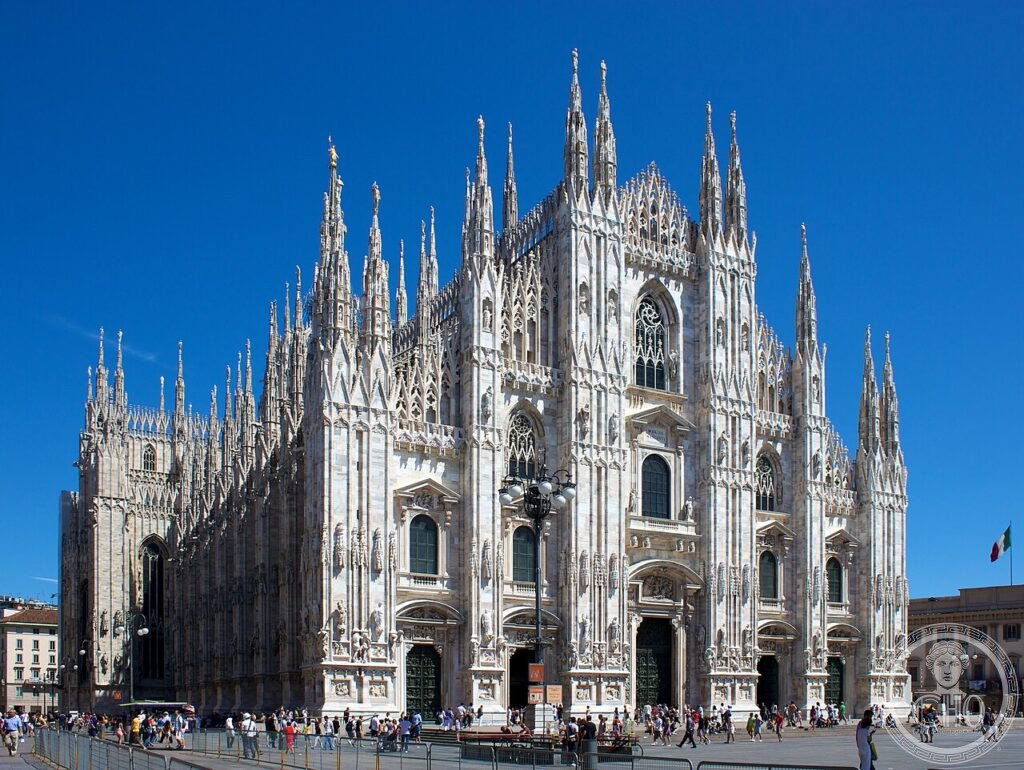
The third-largest cathedral in the world by internal floor area and the largest Gothic building in Italy — a 3.400-statue mountain of white Candoglia marble begun in 1386 by Gian Galeazzo Visconti, completed 579 years later by Mussolini in 1965, decorated with more statues than any other building on earth except possibly Chartres — and, on its roof, one of the strangest spaces in European architecture: a forest of 135 marble spires at different heights, walkable from the outside, with the Madonnina (copper gilded, 4 metres, 1774) on the central gugliotto 108.5 metres above Piazza del Duomo.
At a glance
The Cattedrale di Santa Maria Nascente — universally known as the Duomo di Milano — stands in Piazza del Duomo at the geographical and symbolic centre of Milan. Construction began in 1386 under the patronage of Gian Galeazzo Visconti, the first Duke of Milan, who imported French and German Gothic master builders and established the Veneranda Fabbrica del Duomo (the building authority that still manages the cathedral) to oversee the project. The building took approximately 579 years to complete in all its parts: the last of the original Gothic exterior elements were completed in the 1960s, including the last bronze doors designed by Lucio Fontana (1965).
The Duomo is not a UNESCO World Heritage Site as an individual monument (the city of Milan does not have a UNESCO inscription), but it is the most important building in Lombardy and one of the most visited monuments in Italy, receiving approximately five million visitors annually.
Key facts
- Foundation: 1386 (first stone laid 23 May 1386); patron Gian Galeazzo Visconti, first Duke of Milan
- Dimensions: length 157 m; width 92 m (transept); height of nave 45 m; total floor area 11,700 m² (3rd in the world)
- Material: White Candoglia marble from Lago Maggiore (given to the Veneranda Fabbrica in perpetuity by Gian Galeazzo, 1387)
- Statues: 3,400 exterior statues (more than any other building except possibly Chartres); 2,244 on the exterior, 96 gargoyles, 1 bronze Madonnina (1774, Giuseppe Perego, 4m high)
- Gugliotti: 135 spires; central spire 108.5 m to the Madonnina
- Terraces: roof terraces walkable (accessible by stairs or lift; €15 with lift, €10 stairs)
- Last completed element: Bronze doors by Lucio Fontana (south portal, 1965)
- GPS: 45.4641, 9.1919 — Google Maps
History
The decision to build a new cathedral in Milan in 1386 was part of Gian Galeazzo Visconti’s project to make Milan the capital of northern Italy — architecturally, politically, and economically. The choice of Gothic rather than the Romanesque tradition of northern Italy was deliberate: Gothic was the style of the great cathedrals of France and Germany, the pan-European expression of the Catholic church at its most ambitious. Gian Galeazzo imported French master builders (Nicolas de Bonaventure, 1388), Flemish engineers, and German stone-cutters; the debates among them about structural principles, proportional systems (ad triangulum vs. ad quadratum), and the height of the nave are documented in extensive building records that survive in the Archivio della Veneranda Fabbrica — one of the most important archives in the history of medieval construction.
The pace of construction was uneven across the five centuries: rapid under the Visconti and Sforza (XV–XVI century), then slowing under Spanish domination (XVII century), then accelerating under Napoleon, who ordered the facade completed for his coronation as King of Italy in 1805 (giving rise to the Italian expression “fare il Duomo di Milano” for a project that takes forever). The neo-Gothic facade was completed under Napoleon’s orders between 1805 and 1813, though in a style slightly different from the original Gothic of the body of the building.
What you see
From Piazza del Duomo, the facade presents a wall of white marble verticals — 135 spires visible from the front, rising from the buttresses to the central gugliotto — with an elaborateness that is almost beyond comprehension from ground level. The five bronze portals (1895–1965) are the work of different sculptors in different centuries; the finest is the central portal with panels by Ludovico Pogliaghi (1906), depicting the life of the Virgin.
Inside, the nave is divided by 52 colossal piers into 5 aisles; the total volume is approximately 440,000 cubic metres. The oldest stained glass windows in the cathedral (XIV century, nave clerestory) are among the largest surviving medieval windows in the world: each window is approximately 24 metres high. The treasury, in the sacristy, contains some of the most important medieval goldsmith’s work in Lombardy.
The roof terraces are the most extraordinary space in the building: accessible from inside the cathedral or via stairs at the side of the facade, the terraces give direct access to the forest of 135 marble spires and gargoyles, to the Madonnina at close range (30 metres), and to panoramic views of Milan, the Alps, and on clear days the Apennines. Walking between the spires, between the Gothic pinnacles and the grotesque gargoyle forms, is unlike any other architectural experience in Italy.
Gallery
Practical information
- Cathedral: Free except during special events. Open daily 9:00–19:00 (Thursday until 18:30). Long queues at peak times; book online at duomomilano.it.
- Roof terraces: €15 with lift; €10 stairs. Open daily 9:00–18:00 (last ascent). Advance booking strongly recommended in July–August.
- Duomo Museum (Museo del Duomo): ~€6; in the Palazzo Reale on the south side of Piazza del Duomo; original medieval sculptures, goldsmith’s work, scale models of the building.
- Dress code: Shoulders and knees covered; enforced.
- Combined ticket: Various combined tickets available including Duomo + Museum + Terraces.
Getting there
Piazza del Duomo, Milano. Metro Line M1 (red) or M3 (yellow): Duomo station (exit directly under the piazza). Tram 1, 2, 3, 4, 12, 14, 16, 24, 27 to Piazza del Duomo. On foot from Milan Centrale railway station: 25 minutes on foot or 5 minutes by metro (M2 from Centrale to Loreto, change M1 to Duomo — or M3 from Centrale via Repubblica to Duomo, 10 min). Malpensa Express from Malpensa airport to Cadorna station, then metro M1 to Duomo (total 1h15). Linate airport: bus to city centre then metro.
Nearby
- Galleria Vittorio Emanuele II — immediately adjacent on the north side of Piazza del Duomo; the most architecturally important shopping arcade in Italy (Mengoni, 1865–1877); the central octagon dome (39 m) is one of the great iron-and-glass structures of the nineteenth century
- Teatro alla Scala — 5 minutes north; the most important opera house in the world (Piermarini, 1778); the Museo Teatrale alla Scala adjacent has the finest collection of opera memorabilia in Italy
- Pinacoteca di Brera — 10 minutes north; the most important painting collection in Lombardy; Raphael’s “Marriage of the Virgin,” Mantegna’s “Dead Christ,” Caravaggio’s “Supper at Emmaus”
Sources
- Veneranda Fabbrica del Duomo: duomomilano.it
- Wikipedia EN: Milan Cathedral
- Ackerman, James S.: “Ars Sine Scientia Nihil Est” (on the 1392 Milanese Gothic debates), The Art Bulletin 31.2 (1949)
- Rossi, Francesco: Il Duomo di Milano, Silvana Editoriale, 2009
Find it on the map
See this place and what’s around it →📷 Become a Cultural Heritage Online photographer
Share your photos of places: they stay published under your name as the author. The more they're seen, the more you get noticed — and soon a contest will reward the most appreciated photos.
Log in or sign up free to add a photoIs this page about you?
This page is read by travellers and heritage enthusiasts who find it on Google. Tell us how you are connected to this place and we will take it from there.