
Cattedrale di Modena, Ghirlandina e Piazza Grande — UNESCO 1997
The masterpiece of Romanesque architecture in the Po Valley — a cathedral begun in 1099 by the architect Lanfranco, whose facade sculptures by Wiligelmo (c. 1100–1120) represent the first monumental figurative programme in post-antique Italian art — and the tower beside it, the Ghirlandina (87 metres, XII–XIV century), whose elegant proportions and slight lean define the skyline of Modena: together, the highest achievement of the Emilian Romanesque and the earliest evidence that Italian sculpture had recovered from its medieval disappearance.
At a glance
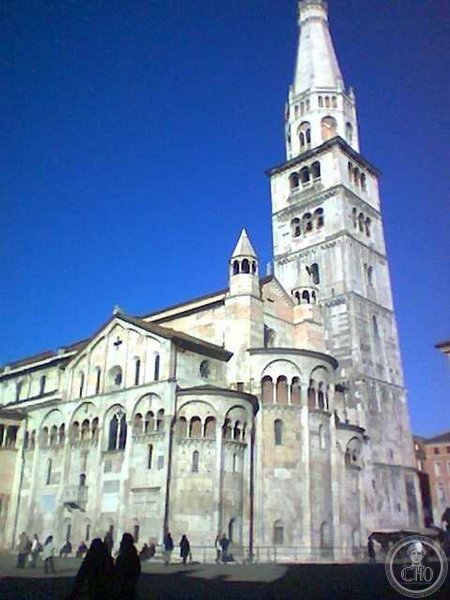
The Cattedrale Metropolitana di San Geminiano stands in the Piazza Grande at the centre of Modena. It was begun in 1099 at the instigation of the countess Matilde di Canossa by the architect and sculptor Lanfranco, whose name is known from a dedicatory inscription; the building was consecrated in 1184 by Pope Lucius III but not fully completed until the thirteenth century. The facade, the apse, and the crypt were decorated with sculptures by Wiligelmo (active c. 1100–1120), whose programme of Genesis reliefs on the facade represents the first monumental narrative sculpture in post-antique Italian art — 70 years before the comparable developments at Chartres, Vézelay, and Autun in France.
The inscription “Cathedral, Torre Civica and Piazza Grande of Modena” (UNESCO 1997, ref. 827) covers three elements: the cathedral itself, the Ghirlandina bell tower (87 metres; construction 1169 to XIV century; slight lean of approximately 6° from vertical), and the Piazza Grande that they define together.
Key facts
- Foundation: 1099; architect Lanfranco; patron Matilde di Canossa
- Consecration: 1184 (Pope Lucius III), though not fully complete
- Wiligelmo sculptures: c. 1100–1120; 4 Genesis bas-relief panels on the facade; Metope frieze; earliest monumental sculpture in post-antique Italy
- Ghirlandina (Torre Civica): begun 1169; completed XIV century; 87 m; lean of ~6°; holds the Secchia Rapita (famous stolen bucket, symbol of the city)
- Piazza Grande: medieval civic square; site of the duelling field; surrounded by communal buildings
- UNESCO: 1997, ref. 827 — “Cathedral, Torre Civica and Piazza Grande of Modena”
- GPS: 44.6467, 10.9257 — Google Maps
History
The construction of the Modena Cathedral in 1099 was a political act as much as a religious one. The city of Modena, recently liberated from the control of the bishops who had run it for centuries, wanted a cathedral that expressed its independence and civic ambition. The choice of the architect Lanfranco — whose name appears in a dedication stone still preserved in the sacristy — was unusual: the cathedral’s design would be attributed to a named individual architect, which was almost unprecedented in medieval Europe. Lanfranco was not just a builder but an administrator: a contemporary document, the Relatio de innovatione Ecclesie sancti Geminiani (1106), describes the process by which he organised the construction logistics, the quarrying of marble, and the programme of sculptural decoration.
The Wiligelmo sculptures represent a moment of decisive invention in Italian visual culture. The four bas-relief panels on the facade, depicting scenes from Genesis (creation of Adam and Eve; original sin; expulsion from Eden; Noah’s ark; Cain and Abel), are in a style that breaks sharply with the flat, diagrammatic figures of Byzantine and Ottonian art: the figures are volumetric, expressively posed, dressed in drapery with physical weight. It is not yet the classicism of Nicola Pisano (Pisa, 1260) but it is already something fundamentally different from the art that preceded it. Wiligelmo is the first sculptor in medieval Europe of whom it is possible to say that an individual artistic personality is recognisable across a body of work.
What you see
The facade: the three portals (central portal, Porta Regia; south portal, Porta dei Principi; north portal, Porta della Pescheria) are framed by the Wiligelmo reliefs and by the extraordinary marble leonine arches (lions as column supports) that were a hallmark of the Emilian Romanesque. The four Wiligelmo Genesis panels are in the lowest register of the facade, between the portals and the base of the blind arcading above. They are at a height of approximately 1.5 metres and can be read at close range; allow 15 minutes with the sculptures.
Inside, the nave is austere — typical Emilian Romanesque; light enters from windows in the upper nave and the tribunes on the north and south sides; the crypt (below the high altar) contains the relics of St Geminianus and more Wiligelmo sculptures. The Ghirlandina can be climbed (book in advance) for views over Modena and the Po plain; at the base of the tower, in the civic treasure room, is the Secchia Rapita — the bucket stolen from Bologna in the war of 1325 that inspired the mock-heroic poem by Alessandro Tassoni (1622).
Gallery
Practical information
- Cathedral: Free; open daily 7:00–19:00.
- Ghirlandina: ~€3; climbing is possible but the internal stairs are steep; book at the Ufficio Informazioni in Piazza Grande. Open Tuesday–Friday 9:30–12:30 and 15:00–18:00; weekends 9:30–18:00.
- Museo del Duomo: attached to the south side of the cathedral; admission ~€5; the Metopes (Wiligelmo frieze, originals), the Cimasa del Portale della Pescheria, medieval reliquaries.
- Duration: 1.5–2 hours for cathedral, museum, and Ghirlandina.
Getting there
Modena is 40 km north-west of Bologna on the A1 motorway (Autostrada del Sole). By train: Bologna–Modena (20 minutes, frequent; also Reggio Emilia route). Modena railway station is 15 minutes on foot from Piazza Grande or 5 minutes by bus. By car: A1 exit Modena Nord or Modena Sud; follow signs to the historic centre (ZTL zone; park at Parcheggio della Motorizzazione or Parcheggio Novi Sad outside the walls). From Milan: 165 km, 1h40 by car; 55 minutes by fast train to Bologna then 20 minutes to Modena.
Nearby
- Palazzo dei Musei e Galleria Estense — 10 minutes on foot; the Este dukes’ collections, including the Tavole Estensi (geographical manuscripts), the Este armory, the best collection of Emilian Renaissance painting outside Parma
- Acetaia di Giorgio (and other traditional balsamic vinegar acetaie) — in the hills south of Modena (10–15 km); the only place in the world where traditional aceto balsamico di Modena IGP is made; several producers open to visitors by appointment
- Maranello e Museo Ferrari — 15 km south; the Ferrari production town and brand museum; the factory tour (advance booking required) is possible for certain visit types
Sources
- UNESCO: whc.unesco.org/en/list/827
- Wikipedia EN: Modena Cathedral
- Glass, Dorothy F.: Portals, Pilgrimage, and Crusade in Western Tuscany, Princeton UP, 1997 (on Wiligelmo)
- Verzár Bornstein, Christine: Portals and Politics in the Early Italian City-State: the Sculpture of Nicholaus in Context, Parma, 1988
Find it on the map
See this place and what’s around it →📷 Diventa un fotografo di Cultural Heritage Online
Condividi le tue foto dei luoghi: restano pubblicate con la tua firma come autore. Più vengono viste, più ti fai conoscere — e presto un concorso premierà le foto più apprezzate.
Accedi o registrati gratis per aggiungere una foto