
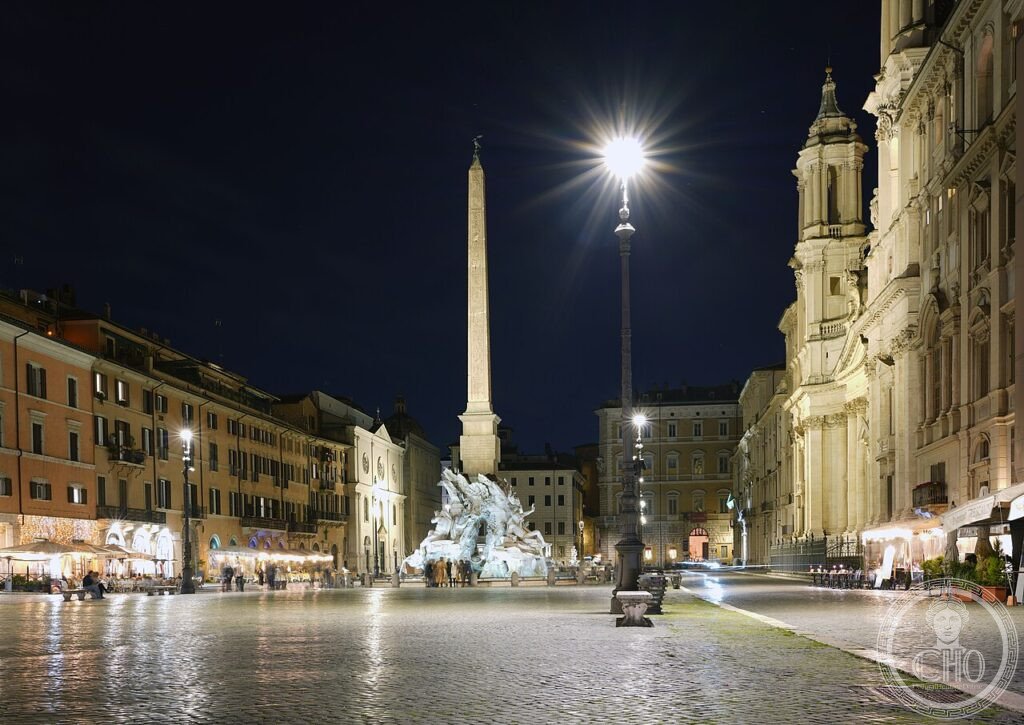
The finest Baroque piazza in Europe — an elongated oval that preserves exactly the footprint and dimensions of the stadium built by the Emperor Domitian in 86 CE, surrounded by the palaces and facades that the Pamphilj family (patrons of Borromini and Bernini) built in the seventeenth century, with at its centre the most theatrical fountain composition in the world: Bernini’s Fontana dei Quattro Fiumi (1651), four river gods supporting an Egyptian obelisk on a hollow rock from which water falls in multiple directions.
At a glance
Piazza Navona occupies the site of the Circus Agonalis — the stadium built by the Emperor Domitian in 86 CE for athletic games (agones) in the Greek tradition. The stadium measured 276 by 106 metres and held approximately 30,000 spectators; its curved north end gave the piazza its distinctive oval form. After the fall of Rome, the stadium’s seating was built over by medieval houses; the arena floor became a public space. By the fifteenth century it was the most important market square in Rome (the Wednesday market remained here until 1869).
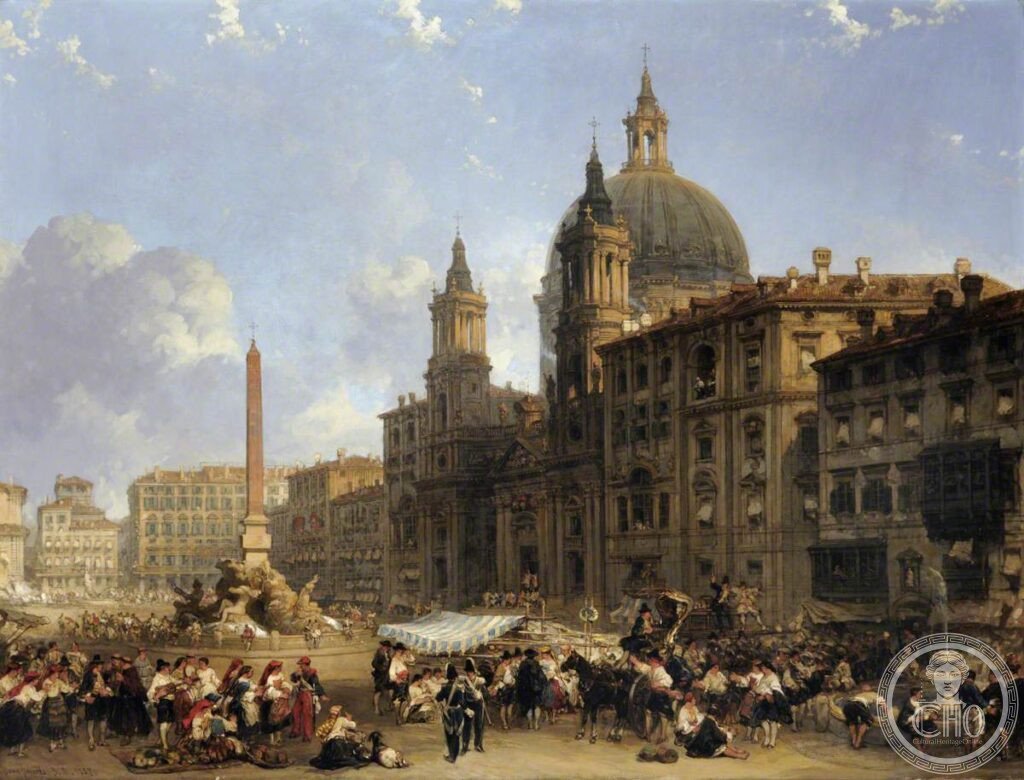
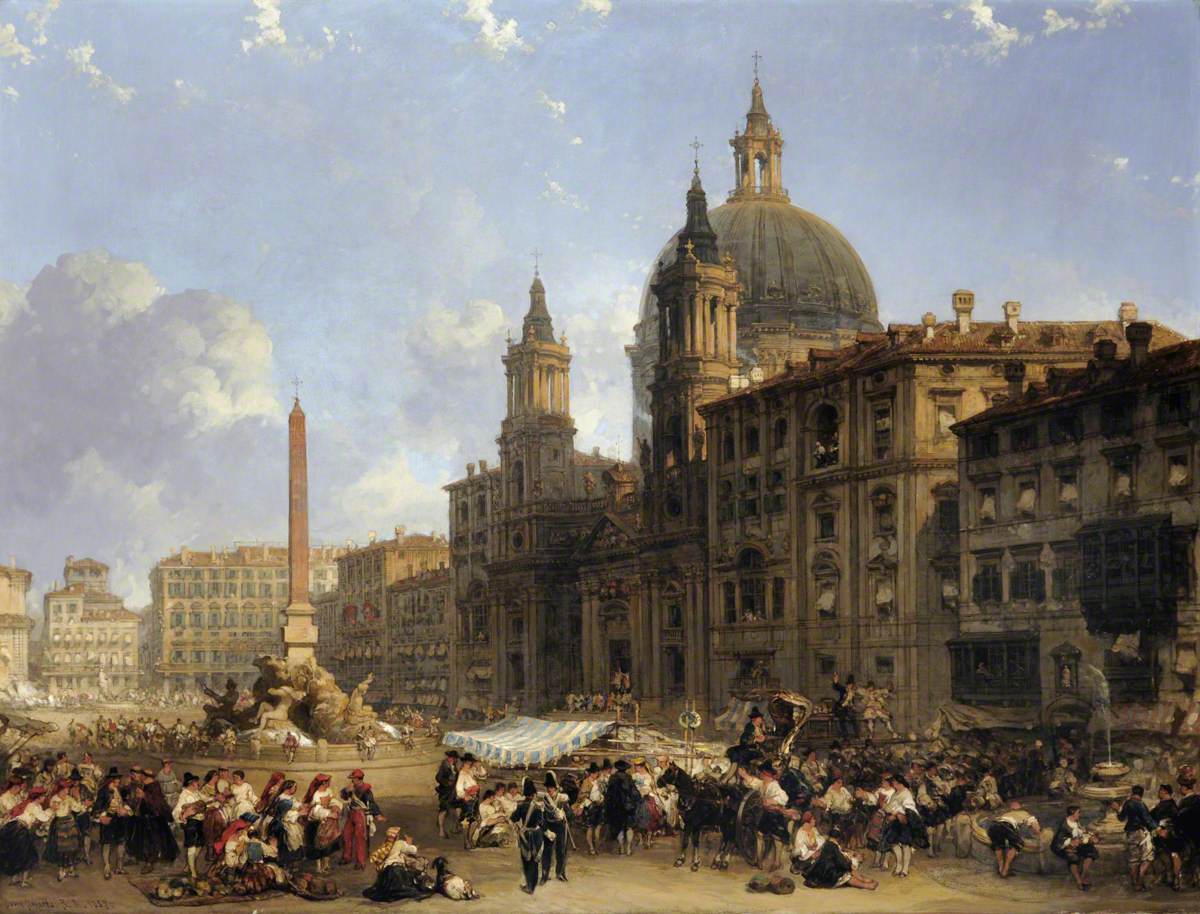
The Baroque transformation of the piazza was driven by the Pamphilj family, whose palace (Palazzo Pamphilj) occupies the entire western side of the square. Pope Innocent X (Giovanni Battista Pamphilj, pope 1644–1655) commissioned Bernini to create a central fountain (1651) and Borromini to redesign the church of Sant’Agnese in Agone (begun 1653) on the western side. The resulting ensemble — Bernini’s fountain, Borromini’s concave church facade, and the three Baroque palaces framing the oval — is one of the defining achievements of seventeenth-century European architecture.
Key facts
- Stadium of Domitian: 86 CE; 276 × 106 m; 30,000 spectators; curved north end gives the piazza its oval plan
- Medieval market: Wednesday market from XIV century to 1869
- Fontana dei Quattro Fiumi: Bernini, 1651; four river gods (Nile, Ganges, Danube, Río de la Plata); obelisk of Domitian; travertine rock with water falling from multiple openings
- Sant’Agnese in Agone: Borromini (and Rainaldi), begun 1653; concave facade; twin towers; dome over the site of St Agnes’s martyrdom
- Palazzo Pamphilj: 1644–1650 (Girolamo Rainaldi); now the Brazilian Embassy
- UNESCO: 1980, ref. 91 rev. — “Historic Centre of Rome”
- GPS: 41.8992, 12.4731 — Google Maps
History
The Stadium of Domitian was built in 86 CE as part of Domitian’s programme of Hellenising Roman culture — introducing Greek athletic games (Agones Capitolini) to Rome alongside the traditional gladiatorial games of the arena. The stadium was the largest in Rome (larger than the Circus Maximus in its proportions, though smaller in absolute size); its curved form, derived from the Greek stadium tradition, was unusual in the Roman urban fabric. After the conversion of the arena floor to residential use in the medieval period, the memory of the ancient building was preserved in the name: “in agone” → “navone” → “navona.”
The seventeenth-century transformation of Piazza Navona represents the high point of Papal Baroque urbanism. Innocent X, who had grown up in the Pamphilj palace on the western side of the piazza, determined to make the square a monument to his family and his papacy. The commission of the central fountain to Bernini was politically complicated: Bernini had been the favourite architect of Urban VIII (Innocent’s predecessor and political enemy); Innocent initially refused to use him, then was persuaded by a small wax model of the fountain that Bernini made and had placed where Innocent would encounter it. The fountain was completed in 1651, two years before Innocent’s death.
What you see
The piazza is best understood from the north end — the curved terminus that preserves the hemicycle of Domitian’s stadium most clearly. Standing at the north end and looking south, the full 276-metre length of the oval is visible: the Fontana del Moro (south end, 1575, with additions by Bernini) and the Fontana di Nettuno (north end, 19th century) flank the central Fontana dei Quattro Fiumi. The western side is dominated by Borromini’s concave church facade — a deliberate response to the Baroque principle that a building’s exterior should engage its surroundings rather than merely face them; the concave form pulls the eye toward the central obelisk, with which it is in dialogue across the 100-metre width of the piazza.
The Fontana dei Quattro Fiumi (1651): four colossal river gods — each representing one of the four great rivers of the known world (Nile with covered head, because its source was unknown; Ganges; Danube; Río de la Plata with coins, symbol of the New World’s riches) — are arranged on a hollowed travertine rock from which water falls in complex patterns. An Egyptian obelisk (originally from the Circus of Maxentius, 4th century CE; surmounted by the Pamphilj dove) rises 16 metres from the centre of the rock. The arrangement was innovative in placing the obelisk on a hollow structure through which the rock, the water, and the figures can be seen simultaneously.
Gallery
Practical information
- Piazza: Always open; free. The piazza is a major gathering place at all hours; busiest in summer evenings and during the Christmas market (mid-December to 6 January).
- Sant’Agnese in Agone: Free; open Tuesday–Sunday 9:00–13:00 and 15:00–19:00. The crypt excavations (showing the ancient stadium substructures and the martyrdom site of St Agnes) are accessible for a small fee.
- Stadio di Domiziano: Entrance at Piazza di Tor Sanguigna 3 (north end of the piazza); €7; shows the substructures of the ancient stadium
- Cafes: Cafes framing the piazza are significantly more expensive than surrounding streets; budget accordingly.
Getting there
Piazza Navona is in the heart of Rome’s historic centre, 5 minutes on foot from the Pantheon and 15 minutes from Campo de’ Fiori. No metro stop is close; nearest are Spagna (Line A, 25 minutes on foot) and Barberini (Line A, 20 minutes). Bus to Senato/Navona: 40, 46, 62, 63, 70, 81. Taxis available at Largo Argentina, 5 minutes south-east. Most visitors approach from the Pantheon (Via della Rotonda → Via del Salvatore → Piazza Navona: 8 minutes on foot).
Nearby
- Pantheon — 8 minutes east; the most perfectly preserved ancient building in the world, open daily (€5 admission)
- Campo de’ Fiori — 10 minutes south; Rome’s liveliest morning market square, with Giordano Bruno’s statue at its centre; becomes a bar and restaurant area by evening
- Palazzo Altemps (Museo Nazionale Romano) — 5 minutes north; the finest collection of ancient sculpture in a Renaissance palace setting; the Ludovisi Throne and the Galatian Suicide
Sources
- UNESCO: whc.unesco.org/en/list/91
- Wikipedia EN: Piazza Navona
- Blunt, Anthony: Borromini, Harvard UP, 1979
- Wittkower, Rudolf: Gian Lorenzo Bernini, Phaidon, 1955
Gallery
Find it on the map
See this place and what’s around it →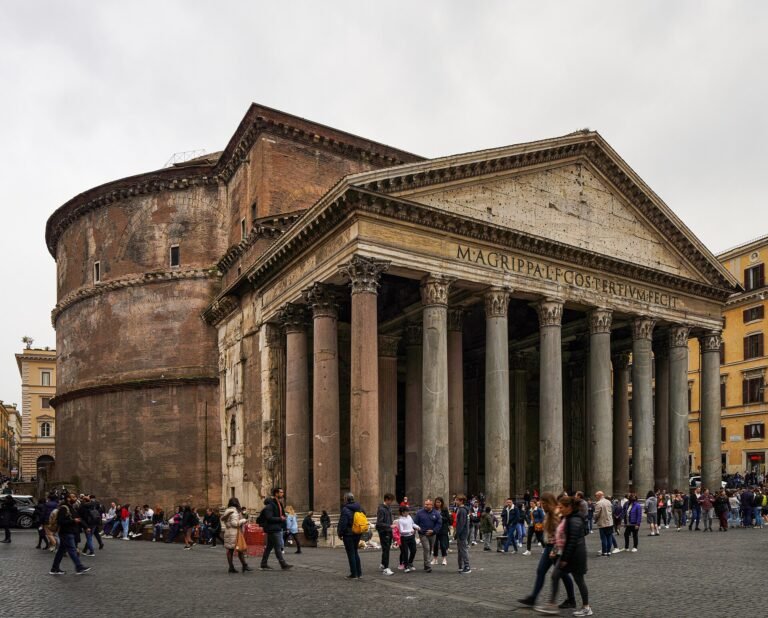
Events here — now on & upcoming
- Feast of Saint Agnes — January 2121 Jan 2027See the event →
Historical events at this place (2)
📷 Become a Cultural Heritage Online photographer
Share your photos of places: they stay published under your name as the author. The more they're seen, the more you get noticed — and soon a contest will reward the most appreciated photos.
Log in or sign up free to add a photo