
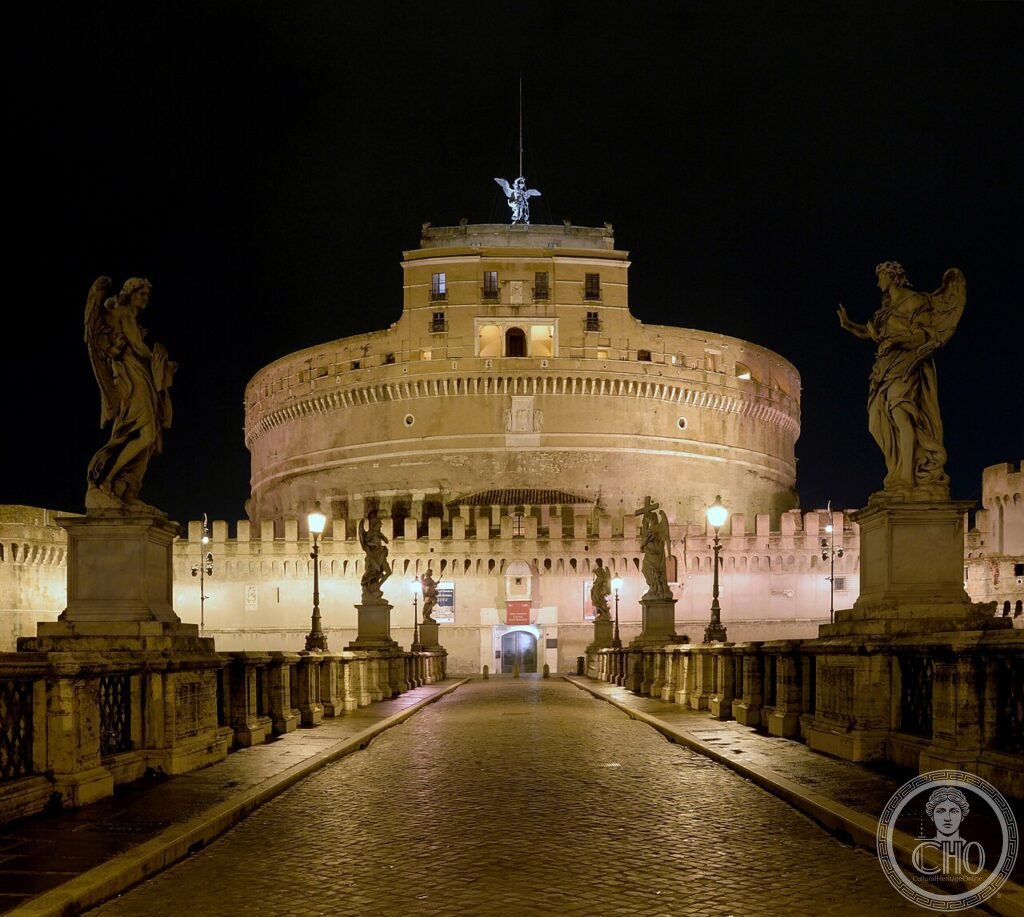
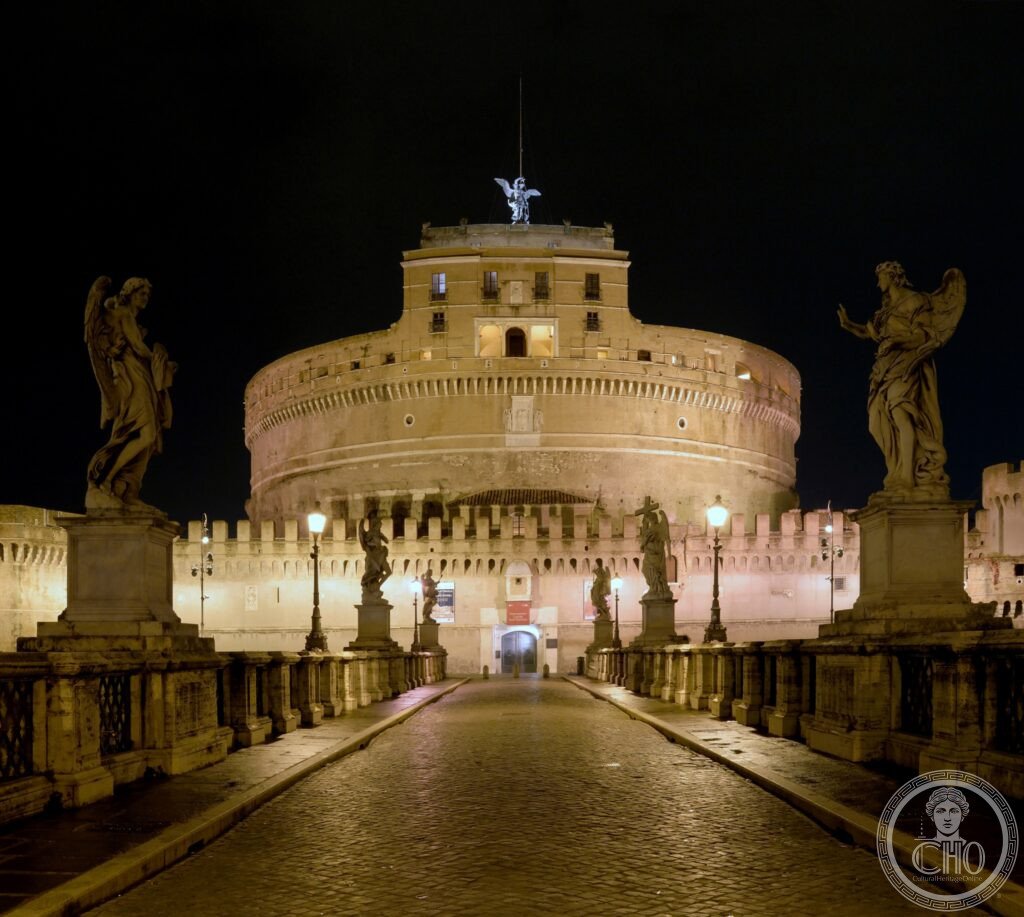
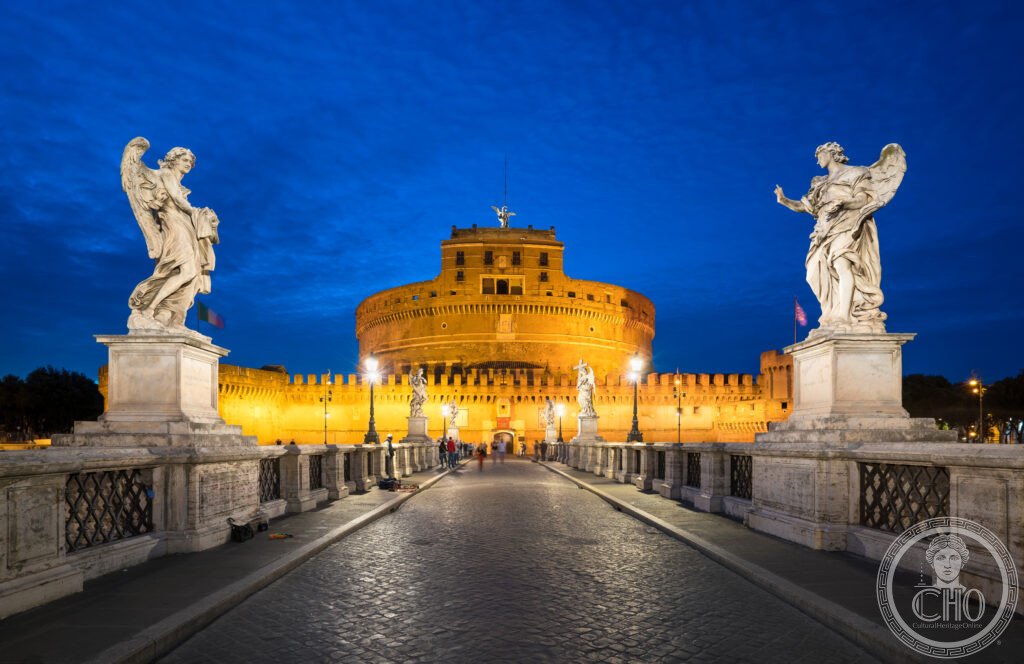
The circular mausoleum built by the Emperor Hadrian for himself and his successors (139 CE), transformed by the popes into their primary military stronghold, connected to the Vatican by a 800-metre elevated corridor (the Passetto di Borgo), and now the Museo Nazionale di Castel Sant’Angelo: four functions in sequence — imperial tomb, medieval castle, Renaissance palace, national museum — each overlaid on the others in a building that reads simultaneously as all four.
At a glance
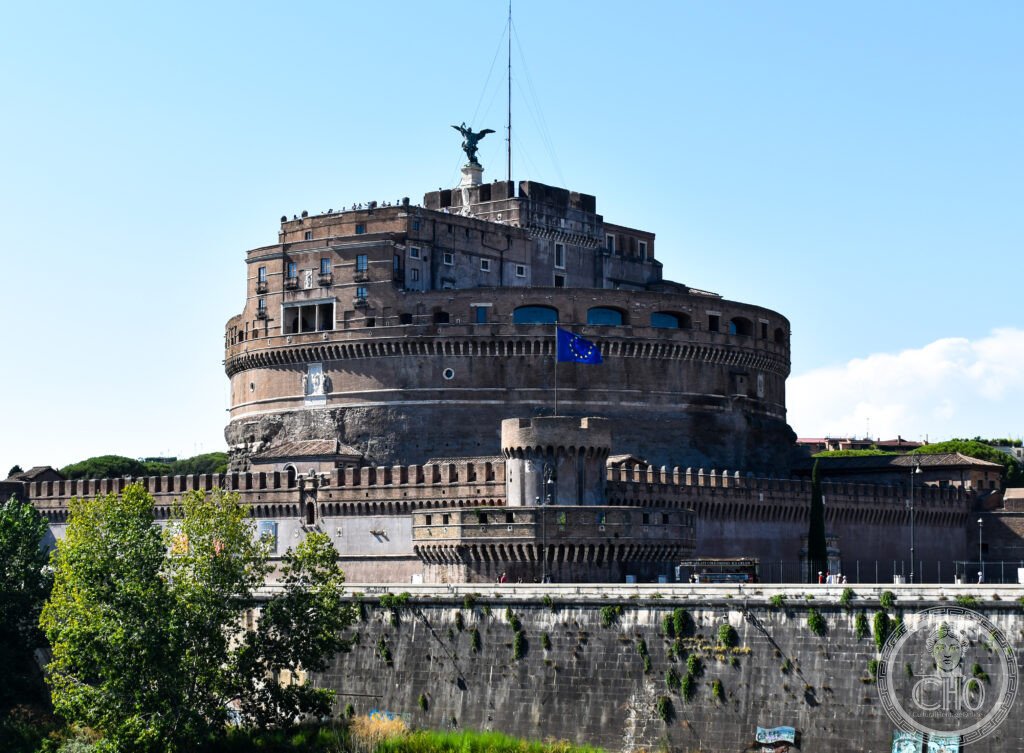
Castel Sant’Angelo stands on the right bank of the Tiber at the west end of Ponte Sant’Angelo, 800 metres north-east of the Vatican. The building was begun by the Emperor Hadrian in 135 CE as his personal mausoleum and that of his successors; it was completed and dedicated by Antoninus Pius in 139 CE. The cylindrical drum (64 metres in diameter, 21 metres high) was topped by a tumulus planted with cypress trees and, at the summit, a bronze quadriga with Hadrian’s statue. The ashes of the emperors from Hadrian to Septimius Severus were placed in the burial chamber at the centre of the drum.
The building takes its current name from a legend recorded in the Middle Ages: during the plague of 590 CE, Pope Gregory the Great, leading a procession of supplication, saw the Archangel Michael sheathing a sword at the summit of the mausoleum — an apparition interpreted as signalling the end of the plague. A succession of angel statues (the current one, in bronze, dates from 1752) has marked the summit ever since.
Key facts
- Mausoleo di Adriano: 135–139 CE; diameter 64 m; height 21 m; cylindrical drum + tumulus; burial chamber at centre
- Popes interred: later used as papal burial site (Boniface IX, other medieval popes)
- Passetto di Borgo: elevated corridor 800 m, connecting Castel Sant’Angelo to the Vatican; built by Nicholas III (1277); used as escape route by 7 popes
- Bronze angel statue: summit; current version by Peter Anton von Verschaffelt (1752)
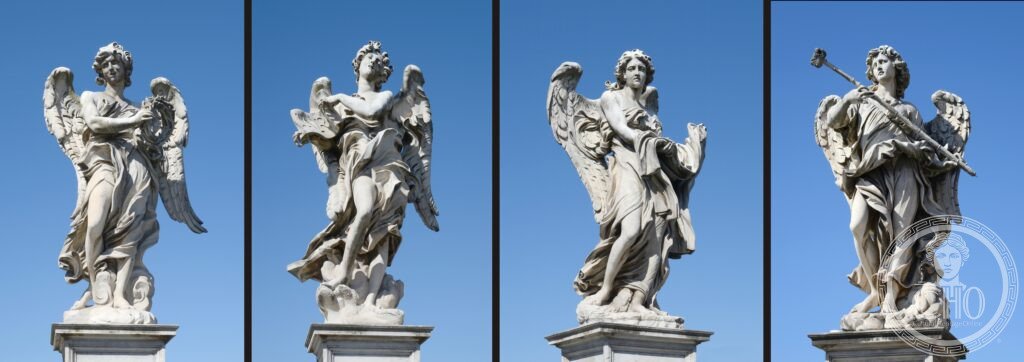
- Ponte Sant’Angelo: bridge across the Tiber; original 134 CE (Pons Aelius); 10 Baroque angel statues by Bernini’s workshop (1667–1672)
- Museum: Museo Nazionale di Castel Sant’Angelo; 58 rooms open to visitors
- UNESCO: 1980, ref. 91 rev. — “Historic Centre of Rome”
- GPS: 41.9031, 12.4663 — Google Maps
History
After the depletion of the imperial mausoleum under Septimius Severus (died 211 CE), the building was no longer used for burials. In the third century it was incorporated into the Aurelian Walls — the defensive ring around Rome completed in 275 CE — as a bastion. This incorporation into the city walls transformed its function: from tomb to military structure. In the sixth century, the Ostrogothic king Theodoric used it as a prison; the philosopher Boethius is said to have been held here before his execution in 524 CE, though this is disputed.
From the ninth century, successive popes used the structure as a refuge and fortress. Pope Nicholas III (1277–1280) built the Passetto di Borgo — the elevated corridor that runs along the top of the Leonine Walls from the Vatican to the castle — to allow rapid papal escape in case of attack. The utility of this construction was demonstrated in 1527, when Pope Clement VII fled via the Passetto while the troops of Charles V sacked Rome (the Sack of Rome, 1527). He remained besieged in the castle for six months before escaping in disguise.
What you see
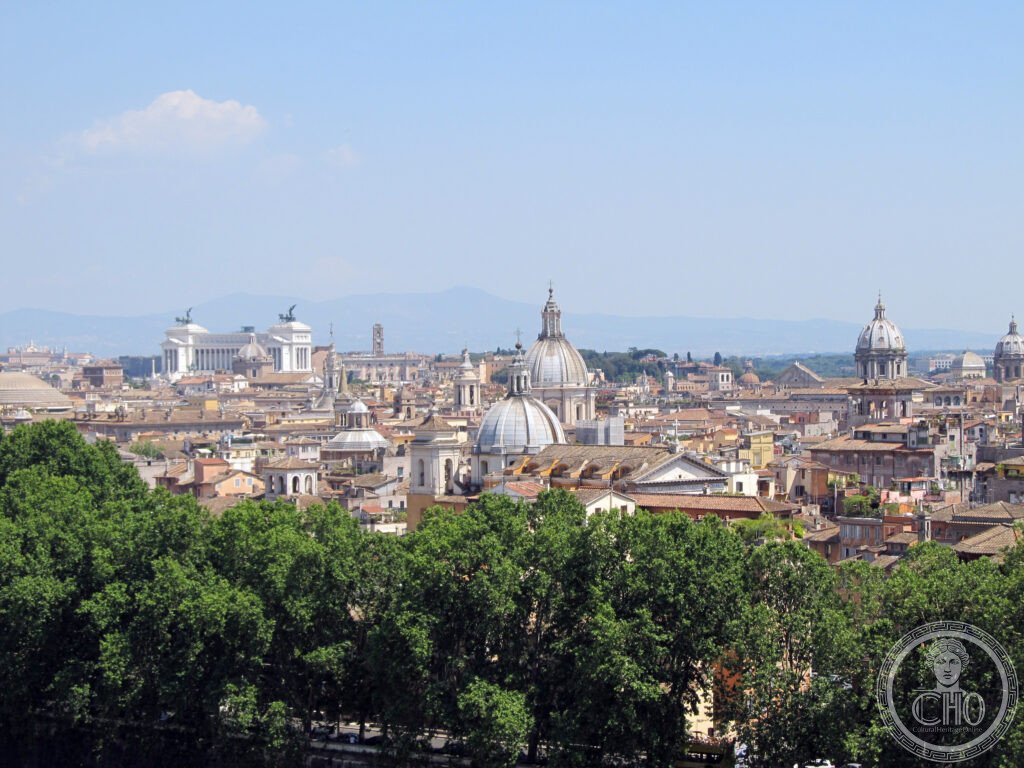
The interior is organised on a spiral ramp that rises from the ground level of the cylindrical drum to the papal apartments at the top of the building. The route passes through the original burial chamber (now empty, its bronze fittings stripped in antiquity), the medieval prison levels (where Casanova was famously imprisoned and escaped in 1756), the Renaissance apartments of Alexander VI and Paul III (with ceiling frescoes by Perin del Vaga, 1545–1547), and the terrace that gives the most famous view in Rome: the Tiber, the Vatican, Ponte Sant’Angelo with its ten angel statues, and the panorama of the city to the south.
On clear days, the terrace (58 metres above street level) gives unobstructed views in all four directions: west to St Peter’s dome (800 metres), east along the Tiber to the Colosseum and the historic centre, north to the Prati district and the railway, south to the Gianicolo. The Passetto di Borgo corridor is visible running to the north-west from the castle to the Vatican walls; it has recently been opened for guided visits (advance booking required).
Gallery
Practical information
- Museum: Open Tuesday–Sunday 9:00–19:30; closed Mondays. Admission ~€15; included in MiC’s free museum days (first Sunday of each month).
- Terrace: Included in the museum ticket; 238 steps from ground level to the terrace (no lift).
- Queues: Moderate; the museum is less crowded than the Colosseum or Vatican Museums. Arrive at opening or in the late afternoon.
- Passetto di Borgo: Accessible only on specific guided tours (infrequent; book in advance through museiciviciroma.it).
- Duration: 1.5–2 hours for a thorough visit; 45 minutes for the highlights.
Getting there
Lungotevere Castello 50, Roma. On foot from St Peter’s Square: 10 minutes east along Via della Conciliazione. On foot from Piazza Navona: 15 minutes west. On foot from Piazza del Popolo: 20 minutes south. Bus 23, 34, 40, 49, 62, 64, 87 to Lungotevere Tor di Nona / Castel Sant’Angelo. No metro stop is close; nearest is Lepanto (Line A, 15 minutes on foot). Ponte Sant’Angelo (across the Tiber from the castle) is one of Rome’s most attractive pedestrian bridges; arriving on foot across the bridge, between the Bernini angel statues, is one of the classic Rome approach sequences.
Nearby
- Ponte Sant’Angelo (Pons Aelius) — 50 m south; built by Hadrian in 134 CE to provide access to his mausoleum; the ten Baroque angel statues (some by Bernini, others by his school) were added by Clement IX (1667–1672)
- Basilica di San Pietro e Piazza San Pietro — 800 m west; the Passetto di Borgo corridor connects the two buildings above ground level
- Piazza del Popolo — 1.5 km north; the northern gateway to Rome, with twin Baroque churches and an Egyptian obelisk (1279 BCE, moved 10 BCE)
Sources
- UNESCO: whc.unesco.org/en/list/91
- Wikipedia EN: Castel Sant’Angelo
- Casanova, Giacomo: Histoire de ma vie, Vol. 4, Venice, 1757 (escape from the castle described)
- Partner, Peter: The Lands of St Peter, University of California Press, 1972
Find it on the map
See this place and what’s around it →📷 Become a Cultural Heritage Online photographer
Share your photos of places: they stay published under your name as the author. The more they're seen, the more you get noticed — and soon a contest will reward the most appreciated photos.
Log in or sign up free to add a photoIs this page about you?
This page is read by travellers and heritage enthusiasts who find it on Google. Tell us how you are connected to this place and we will take it from there.