
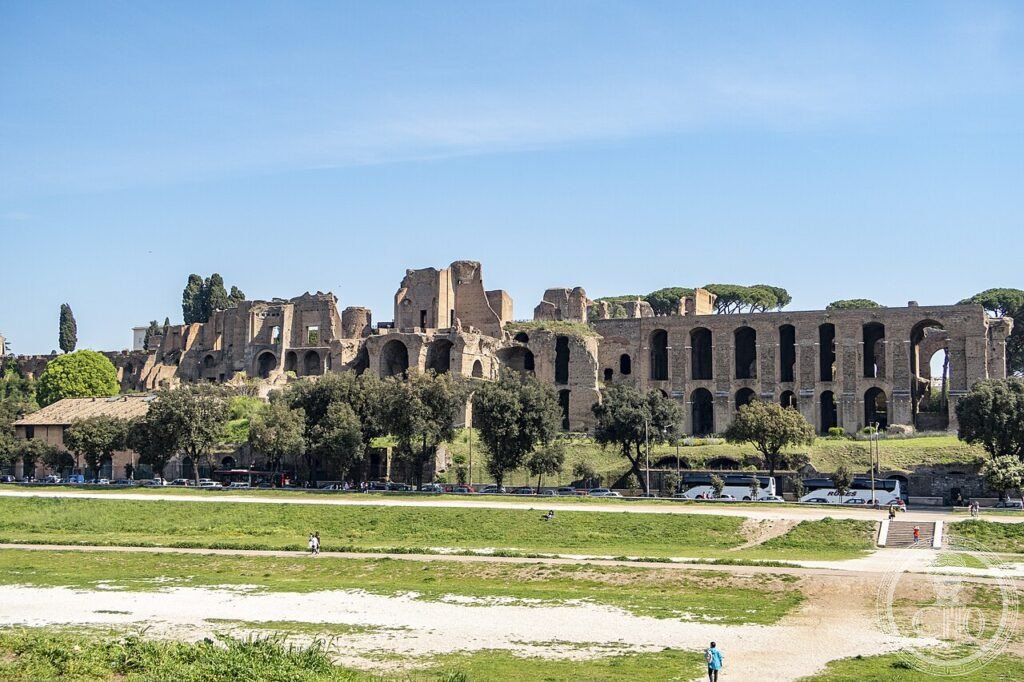
The oldest inhabited hill in Rome and the site of the palaces of the Roman Emperors from Augustus to Septimius Severus — the Palatino — combined with the Forum Romanum on its northern flank: three hundred years of public architecture in a single valley, from the Temple of Saturn (497 BCE), through the Temple of Vesta and the House of the Vestal Virgins, to the Arch of Septimius Severus (203 CE) and the Basilica of Maxentius (308–312 CE), read in sequence along the Via Sacra.
At a glance
The Palatino (Palatine Hill) and the Foro Romano (Roman Forum) together form the archaeological heart of ancient Rome. The Palatine Hill — the most prestigious address in the ancient world, traditional site of the foundation of Rome by Romulus in 753 BCE — became the location of the imperial palaces from Augustus (27 BCE–14 CE) onward; the word “palace” derives from the hill’s Latin name, Palatium. The Roman Forum — the valley between the Palatine, Capitoline, and Esquiline Hills — was the political, commercial, religious, and ceremonial centre of the Roman Republic and Empire from the sixth century BCE to the fourth century CE.
Both are part of the UNESCO “Historic Centre of Rome” inscription (1980, ref. 91 rev.) and are visited on a single combined ticket (shared with the Colosseum, valid 24 hours).
Key facts
- Temple of Saturn: 497 BCE (original), rebuilt 42 BCE; the oldest surviving structure in the Forum
- Tempio di Vesta and Casa delle Vestali: IV century BCE onwards; the circular temple and the complex of 18-20 Vestal Virgins, the most sacred keepers of Rome’s eternal flame
- Arco di Settimio Severo: 203 CE; triumphal arch celebrating the Parthian Wars; one of the best-preserved in Rome
- Basilica di Massenzio e Costantino: 308–312 CE; three barrel-vaulted bays, 35 m high; the model for the nave of St Peter’s Basilica
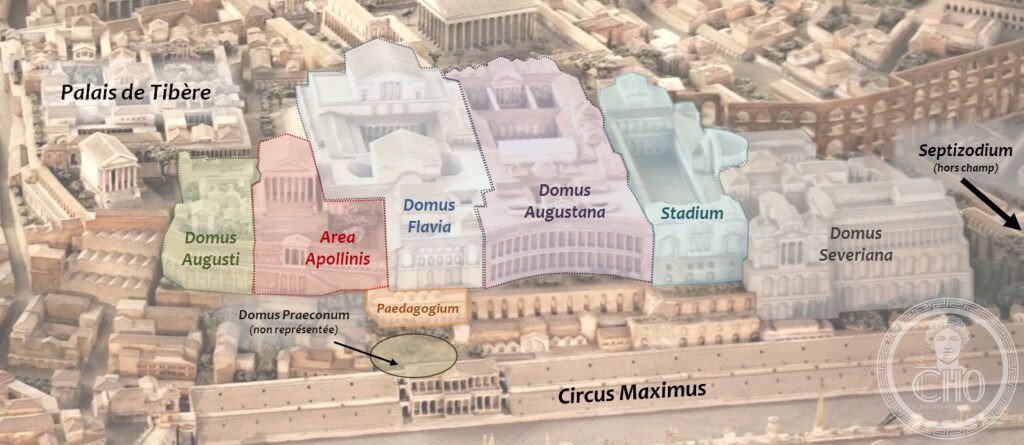
- Domus Augustana: I century CE; the residential palace of Augustus and subsequent emperors on the Palatine; stadium and garden complex
- Combined ticket (with Colosseum): ~€16; valid 24 hours
- UNESCO: 1980, ref. 91 rev. — “Historic Centre of Rome”
- GPS (Forum main entrance): 41.8924, 12.4853 — Google Maps
History
The Roman Forum was the central public space of the Roman Republic — the place where the Senate met (in the Curia Julia), where political speeches were delivered from the Rostra, where commercial and legal transactions were conducted in the basilicas, and where religious ceremonies were performed at the temples. The oldest parts of the Forum — the Lacus Curtius (a sacred spot), the Lapis Niger (a black stone marking an archaic sanctuary), the Rostra — date from the monarchic period (eighth–sixth centuries BCE). The Temple of Saturn (497 BCE), the Basilica Aemilia (179 BCE), the Temple of Castor and Pollux (484 BCE, rebuilt 117 CE) mark the Republican centuries.
Under Julius Caesar and Augustus, the Forum was radically reordered: the Rostra was moved, the Curia rebuilt, the Temple of Caesar dedicated. The Imperial Fora — the Forum of Augustus, Forum of Trajan (with Trajan’s Column, 113 CE), and Forum of Nerva — were built alongside the Republican Forum from the first century BCE to the second century CE, creating a complex of interlocking ceremonial spaces that covered approximately 5 hectares.
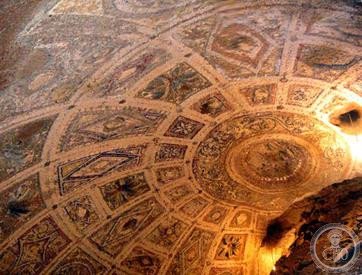
The Palatine Hill was the site of the Lupercal — the cave where, according to Roman tradition, the she-wolf nursed Romulus and Remus — and became the preferred residential district of the Roman aristocracy in the Republican period. Augustus built his relatively modest house (the Casa di Augusto, whose frescoes survive and are open to visitors) on the Palatine; later emperors built enormous palace complexes — the Domus Tiberiana, Domus Transitoria (Nero), Domus Flavia and Domus Augustana (Domitian, 81–96 CE) — that covered most of the hill’s surface by the third century CE.
What you see
Foro Romano (entered from Via Sacra or Via Sacra / Via dei Fori Imperiali): The Via Sacra — the main ceremonial street of ancient Rome, along which triumphal processions moved from the Colosseum to the Capitoline — runs the full length of the Forum from the Arch of Titus (81 CE; celebration of the sack of Jerusalem in 70 CE) at the east end to the Arch of Septimius Severus at the west. Along the south side: the Basilica of Maxentius (three vaulted bays, the largest building in the Forum, whose barrel vaults were the model for Renaissance nave designs); the Temple of Romulus (307 CE); the Temple of Antoninus Pius and Faustina (141 CE, converted to the church of San Lorenzo in Miranda). Along the north: the Basilica Aemilia; the Curia (Senate house, rebuilt by Diocletian; the bronze doors are original); the Temple of Castor and Pollux (three standing columns). At the centre: the Temple of Vesta (circular, surrounded by the Casa delle Vestali).
Palatino (entered by staircase from the Forum or from Via Sacra): the hill is laid out as a landscaped archaeological park; the stadium garden of the Domus Augustana is the most evocative space — a sunken oval track surrounded by the walls of the imperial palace complex. The Museo Palatino on the hill contains the best objects excavated on the site, including fragments of the Domus Livia frescoes.
Gallery
Practical information
- Ticket: €16 full (combined with Colosseum, Palatine, Forum); book online at coopculture.it. Walk-up queues at the Forum entrance on Via Sacra can be 1 hour+.
- Entrances: Via Sacra (Forum); Largo Romolo e Remo (Palatino/Forum from near Circus Maximus); Via dei Fori Imperiali (at the Colosseum end).
- Hours: Daily 9:00 to one hour before sunset; last entry 1 hour before closing.
- Duration: 2–3 hours for both Forum and Palatine.
- App: The coopculture App provides audio guides for self-guided visits.
Getting there
The Forum Romano main entrance is on Via Sacra, 200 metres west of the Colosseum, with secondary entrances on Via dei Fori Imperiali and Largo Romolo e Remo. Metro Line B: Colosseo (3 minutes on foot from the Colosseum, then 200 m to the Forum). Bus 51, 75, 85, 87 to Colosseo. Tram 3. The Palatine Hill is entered through the Forum (from Via Sacra) or from the Largo Romolo e Remo entrance (Circus Maximus side; good for the Domus Augustana). On foot from Piazza Venezia: 15 minutes along Via dei Fori Imperiali (the axial road Mussolini opened in 1932, now partially closed to traffic).
Nearby
- Colosseo — 200 m east; the same combined ticket is valid; the Arch of Constantine is between them, at the head of the Via Sacra
- Fori Imperiali (Foro di Traiano, Colonna Traiana, Foro di Augusto) — 200 m north, visible from Via dei Fori Imperiali; the Mercati di Traiano (Trajan’s Markets) are accessible as a separate museum
- Capitolino (Musei Capitolini) — 10 minutes north-west up the Capitoline Hill; the world’s oldest public museums (opened 1734), with the Marcus Aurelius equestrian statue, the Capitoline Wolf, and the best collection of Roman portrait busts
Sources
- UNESCO: whc.unesco.org/en/list/91
- Wikipedia EN: Roman Forum; Palatine Hill
- Claridge, Amanda: Rome: An Oxford Archaeological Guide, Oxford UP, 2010 (2nd ed.)
- Carandini, Andrea: The Atlas of Ancient Rome, Princeton UP, 2017
Find it on the map
See this place and what’s around it →📷 Become a Cultural Heritage Online photographer
Share your photos of places: they stay published under your name as the author. The more they're seen, the more you get noticed — and soon a contest will reward the most appreciated photos.
Log in or sign up free to add a photo