
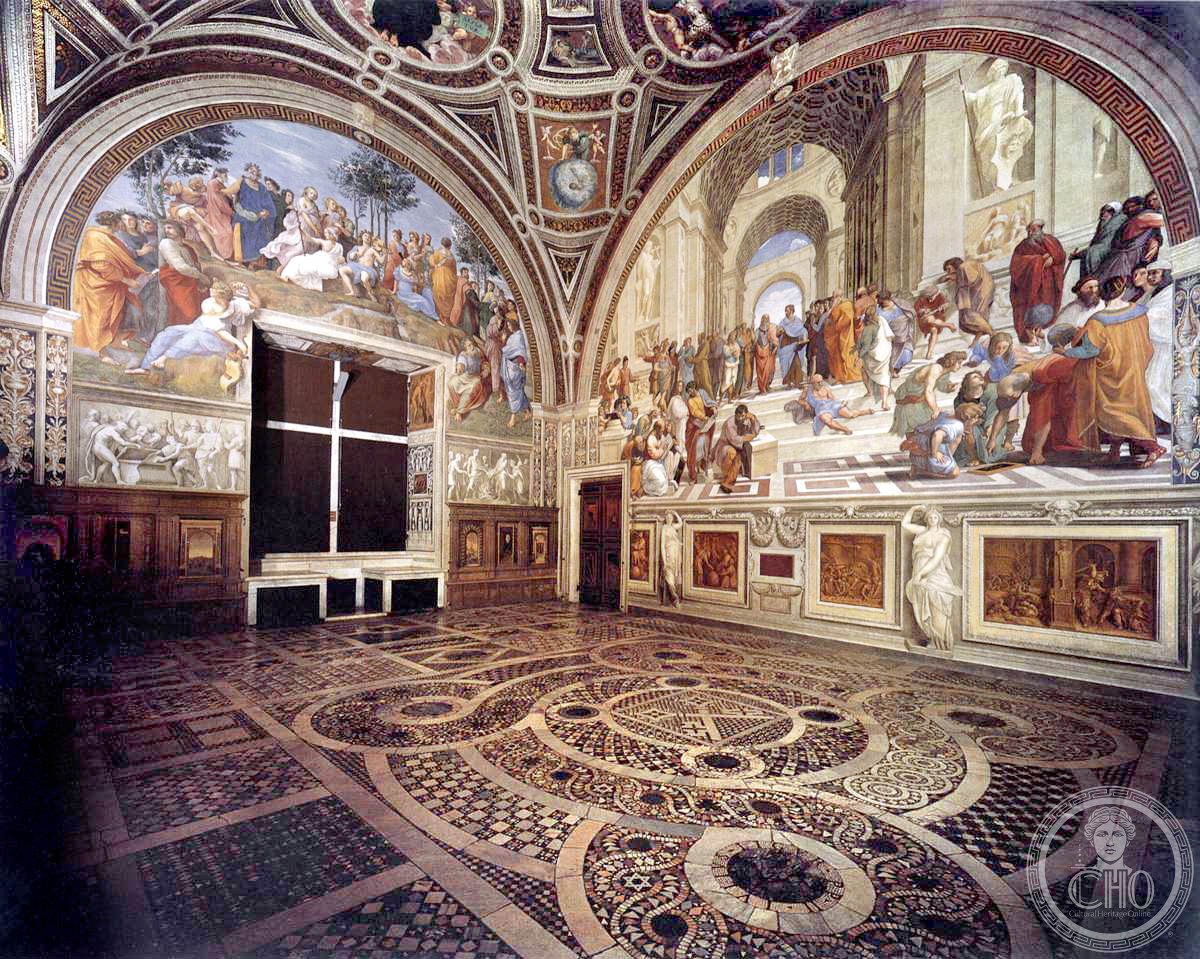
Four masterpieces of Renaissance fresco painting commissioned by Pope Julius II, decorated by Raffaello Sanzio between 1508 and 1524. The rooms showcase the pinnacle of High Renaissance artistic achievement in the heart of the Vatican.
At a glance
Four interconnected chambers in the Vatican Museums form a sequence of papal apartments decorated entirely with frescoes by Raphael and his workshop. Located in the wing built by Nicolò V in the mid-fifteenth century, these rooms represent the visual and intellectual ambitions of the High Renaissance.
History
Pope Julius II (1503–1513) refused to inhabit the apartments of his predecessor Alexander VI, which had been frescoed by Pinturicchio, and commissioned new decorations upstairs. Raphael began the project in 1508, systematically erasing earlier work by artists including his own teacher Perugino.
The artist executed the frescoes in four stages: Stanza della Segnatura (1508–1511), Stanza di Eliodoro (1511–1514), Stanza dell’Incendio di Borgo (1514–1517), and Sala di Costantino (1517–1524). Raphael’s sudden death on 6 April 1520 left the Constantine Room largely unfinished; his students completed the work.
What you see
The four main rooms progress west to east along a rectangular corridor. Three chambers—Fire, Segnatura, and Heliodorus—measure approximately 7 by 8 metres and feature cross vaults. The Constantine Room is larger at 10 by 16 metres. Each room takes its name from dominant fresco scenes.
The complex originally included additional spaces: the Sala dei Chiaroscuri (frescoed by Raphael’s design in 1517, later repainted), the Niccolina Chapel (decorated by Beato Angelico under Nicolò V), and the papal loggia overlooking the Cortile del Belvedere. Visitors typically encounter the rooms in reverse sequence via a sixteenth-century balcony.
Cultural significance
These rooms represent the intellectual and artistic centre of papal authority during the High Renaissance. The frescoes synthesize classical philosophy, theology, and contemporary knowledge through an integrated program of imagery.
In May 2017, the Vatican Museums implemented a new lighting system developed by the German company Osram in collaboration with the University of Pannonia, enhancing visibility of the frescoes while minimizing damage.
Key facts
- Address: Viale Vaticano, 00165 – Vatican City
- Coordinates: 41.9064878, 12.4536413
- Phone: 06 69884676
- Website: https://www.vaticanstate.va/it/monumenti/musei-vaticani/stanze-di-raffaello.html
- Artist: Raffaello Sanzio (1483–1520)
- Patron: Pope Julius II
Practical information
Opening hours: Monday to Saturday, 9:00 am–6:00 pm (last admission 4:00 pm); last Sunday of each month, 9:00 am–2:00 pm (last admission 12:30 pm). The Raphael Rooms form an obligatory part of the standard Vatican Museums route leading to the Sistine Chapel. Other rooms in the complex—the Chiaroscuri Room, papal loggia, and cubiculum—are accessible only to scholars.
Getting there
The Vatican Museums are located on Vatican territory. Access is via the main entrance at Viale Vaticano. Plan to allow substantial time; the Raphael Rooms are typically visited as part of a comprehensive museum visit.
Sources & resources
Find it on the map
See this place and what’s around it →📷 Become a Cultural Heritage Online photographer
Share your photos of places: they stay published under your name as the author. The more they're seen, the more you get noticed — and soon a contest will reward the most appreciated photos.
Log in or sign up free to add a photoIs this page about you?
This page is read by travellers and heritage enthusiasts who find it on Google. Tell us how you are connected to this place and we will take it from there.