
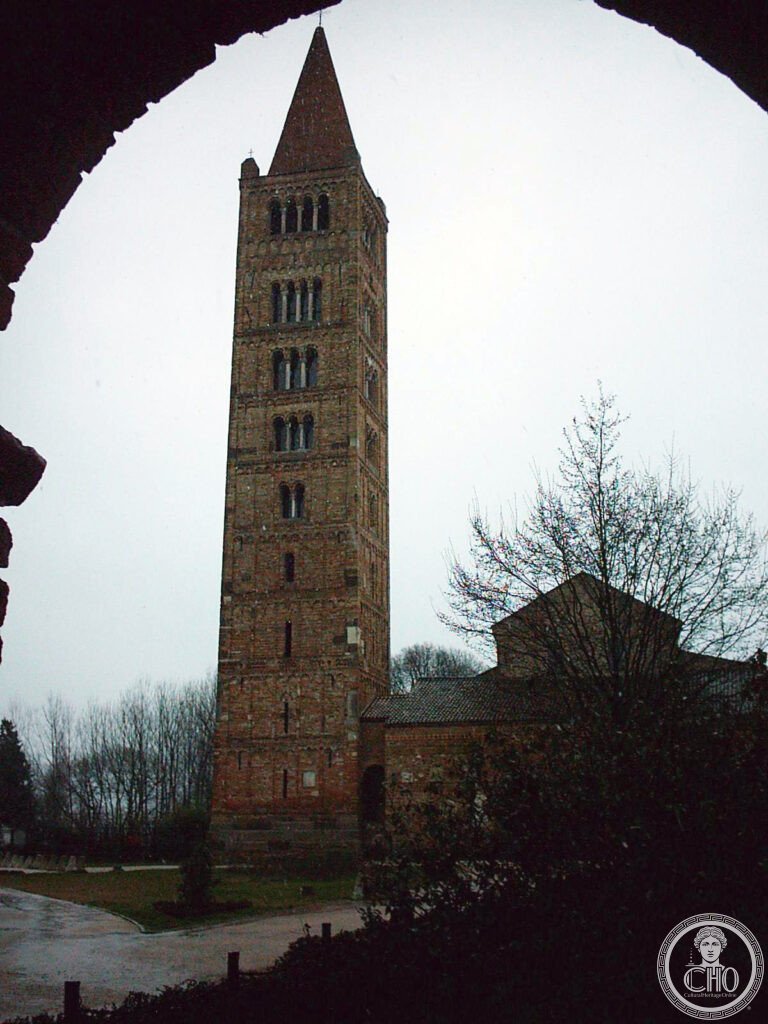
A Benedictine abbey in the Po Delta marshes where Guido d’Arezzo (c. 991–1050) invented the system of musical notation and the solmisation syllables that form the basis of Western music — one of the most consequential intellectual innovations of the medieval period, born in a monastery built on an island in the Po estuary.
At a glance
The Abbazia di Pomposa stands on the ancient island of Pomposa, now connected to the mainland by the drainage of the Po Delta marshes in the twentieth century, 50 km east of Ferrara near the Adriatic coast. A Benedictine monastery was established here in the ninth century; it reached its maximum importance in the eleventh century, when it functioned as a major scriptorium and library and attracted scholars from across northern Italy. The monk Guido d’Arezzo (Guido Aretino, c. 991–1050) spent part of his career here and may have developed or refined at Pomposa his system of hexachordal solmisation — the do-re-mi system of syllables assigned to the notes of the musical scale that remains the basis of Western solfège.
The abbey is part of the UNESCO “Ferrara, City of the Renaissance, and its Po Delta” inscription (1995, ref. 733), which extends the original Ferrara inscription to include the Po Delta landscape and the monasteries within it.
Key facts
- Foundation: IX century (Benedictine)
- Abbey church: IX–XIV century; nave with Byzantine-Ravennesque mosaics and frescoes
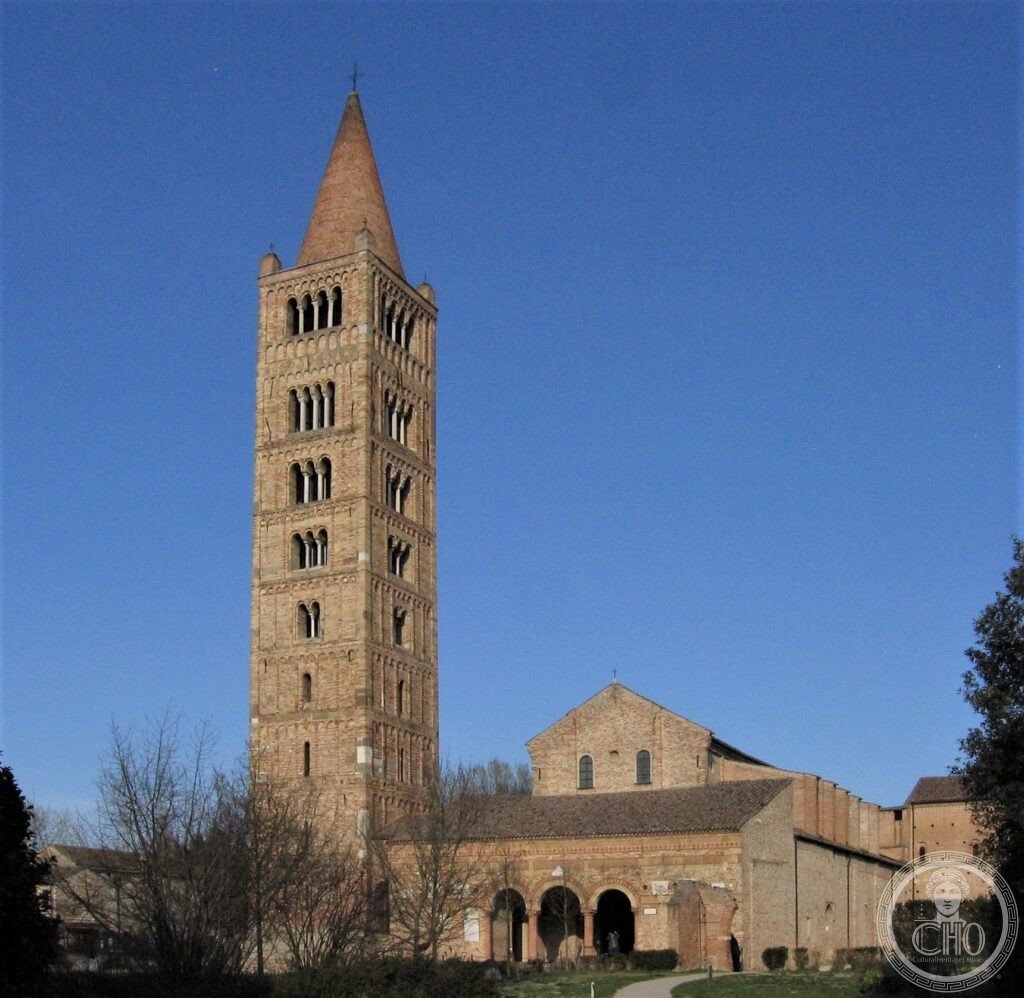
- Campanile: XI century, 48 metres; Lombard Romanesque in brick
- Guido d’Arezzo: c. 991–1050; inventor/codifier of hexachordal solmisation (do-re-mi) at Pomposa or Arezzo
- Palazzo della Ragione: XI century; the abbatial court building, rare survival of Romanesque civic architecture
- UNESCO: 1995, ref. 733 (extended 1999) — “Ferrara, City of the Renaissance, and its Po Delta”
- GPS: 44.8181, 12.1956 — Google Maps
History
The Po Delta in the early medieval period was a landscape of marshes, islands, and navigable channels, traversed by the trade routes between Ravenna (the western Roman imperial capital from 402 CE) and Venice. The Benedictines established themselves on the Pomposa island in the ninth century, building a modest church and monastic buildings. Under the abbots of the eleventh century — particularly Guido d’Arezzo’s contemporary Martino — the abbey became a centre of musical culture: it had a library, a scriptorium, and a reputation for liturgical choral singing that attracted scholars.
Guido d’Arezzo’s precise biography is uncertain, but he is known to have spent time at Pomposa before moving to Arezzo, and his Micrologus (c. 1025–1030), the foundational text of Western music theory, was completed at one of these two locations. The system of assigning syllables to the notes of the hexachord (ut-re-mi-fa-sol-la, taken from the first syllables of the lines of the Ut queant laxis hymn to John the Baptist) gave singers a way to sight-read music without a keyboard instrument — the foundation of Western musical education from the eleventh century to the present.
The abbey declined in the later medieval period as malaria made the Po Delta increasingly uninhabitable; in 1653 it was suppressed, and the monastic complex was used for agricultural storage until the nineteenth century. The church, campanile, and Palazzo della Ragione were consolidated and opened as a monument; the site has been managed as an archaeological monument by the Italian state since 1919.
What you see
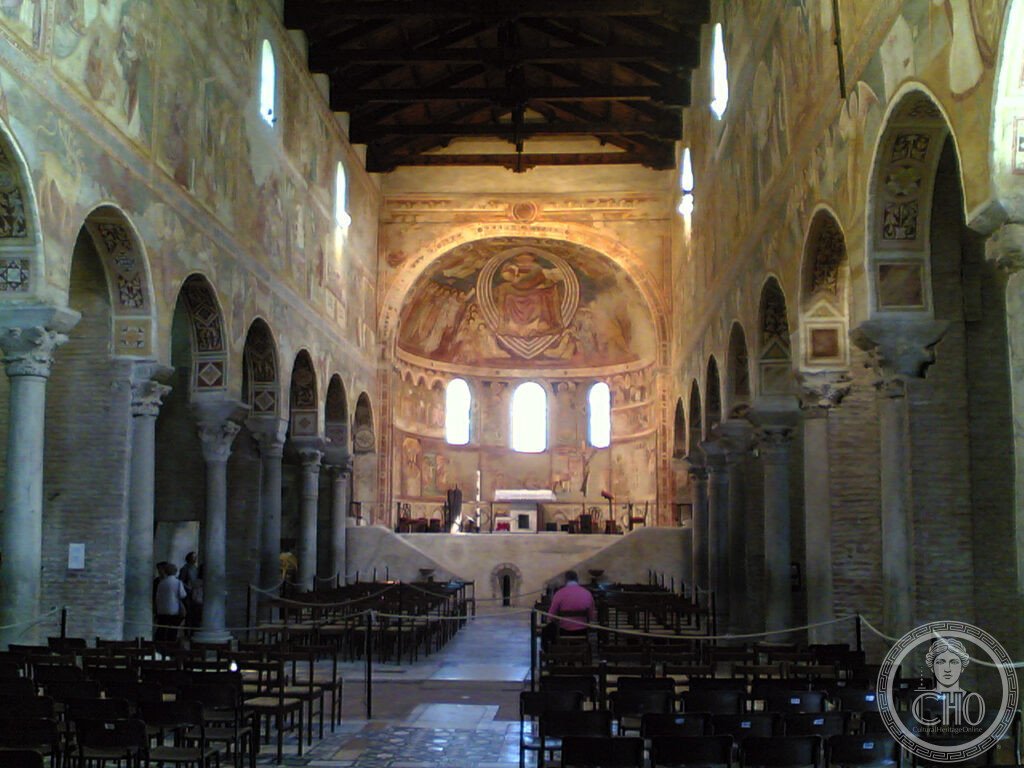
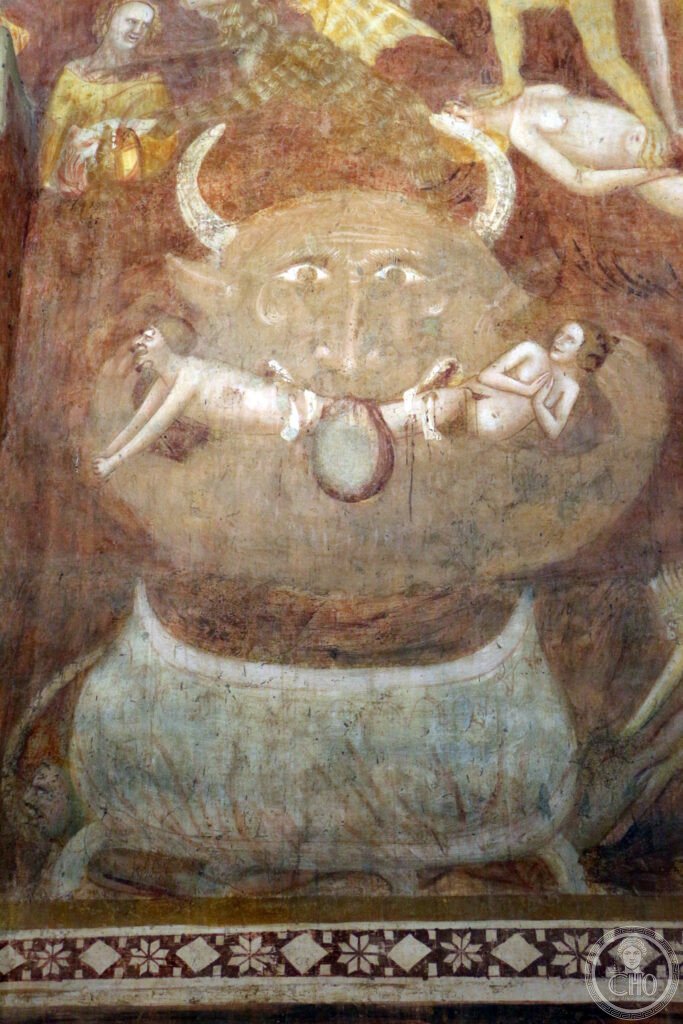
The atrium in front of the church is a Romanesque portico on slender columns with capitals carved in a local vernacular style — animals, interlace, human heads — less polished than the Lombard workshops of Milan or Pavia but vigorous and idiosyncratic. The church interior has a nave with floor mosaics of the fourth and tenth centuries (the earlier layer visible in sections), and fresco cycles on the nave walls by the school of the Riminese painter Giovanni da Bologna (c. 1350) — the largest surviving fresco programme in the Po Delta. The subjects are Biblical narratives and the Last Judgment; the quality is uneven but several individual scenes are of high pictorial interest.
The campanile (48 metres, begun IX century, completed XI) is the most dramatically proportioned element: a slender shaft of dark Ravenna brick with increasingly dense arcading on each storey, the whole rising from a flat landscape that maximises its apparent height. From the campanile base, the Po Delta horizon is visible in every direction — reeds, drainage channels, farm buildings, the slight shimmer of the Adriatic 20 km east.
Gallery
Practical information
- Opening: Tuesday–Sunday 8:30–19:30 (summer); 8:30–16:30 (winter). Monday closed.
- Admission: ~€6; reduced EU 18–25; combined ticket with nearby Museo del Delta del Po.
- Duration: 1.5 hours for church, campanile, and courtyard.
- Sound: In summer, the abbey sometimes hosts concerts of early music and Gregorian chant — particularly appropriate given the Guido d’Arezzo connection. Check the programme.
Getting there
Codigoro is 50 km east of Ferrara on the SS309 (Romea road). By car: from Ferrara 50 minutes; from Ravenna 60 minutes; from Bologna 100 minutes. No railway station at Codigoro (the ferrovia delta was closed); by bus from Ferrara (regional TPER service, 1h10, infrequent). The abbey is at the Pomposa intersection on the SS309, well signed. From Venice: 120 km, 1h30 by car via A13/Ferrara. The surrounding Po Delta landscape — lagoons, fishing huts, valley da pesca — makes the drive itself worthwhile.
Nearby
- Ferrara — 50 km west; Este Renaissance city, Palazzo dei Diamanti (Rossetti, 1493), Castello Estense; UNESCO 1995
- Comacchio — 15 km south; the “little Venice” of the Po Delta, with its characteristic seven-arched bridge and traditional eel fishing
- Oasi WWF di Comacchio — Delta del Po bird sanctuary; flamingos, avocets, herons; major European wetland
Sources
- UNESCO: whc.unesco.org/en/list/733
- Wikipedia EN: Pomposa Abbey
- Guidoboni, Emanuela (ed.): Pomposa: Storia, Arte, Architettura, Ferrara, 1999
Find it on the map
See this place and what’s around it →📷 Become a Cultural Heritage Online photographer
Share your photos of places: they stay published under your name as the author. The more they're seen, the more you get noticed — and soon a contest will reward the most appreciated photos.
Log in or sign up free to add a photoIs this page about you?
This page is read by travellers and heritage enthusiasts who find it on Google. Tell us how you are connected to this place and we will take it from there.