
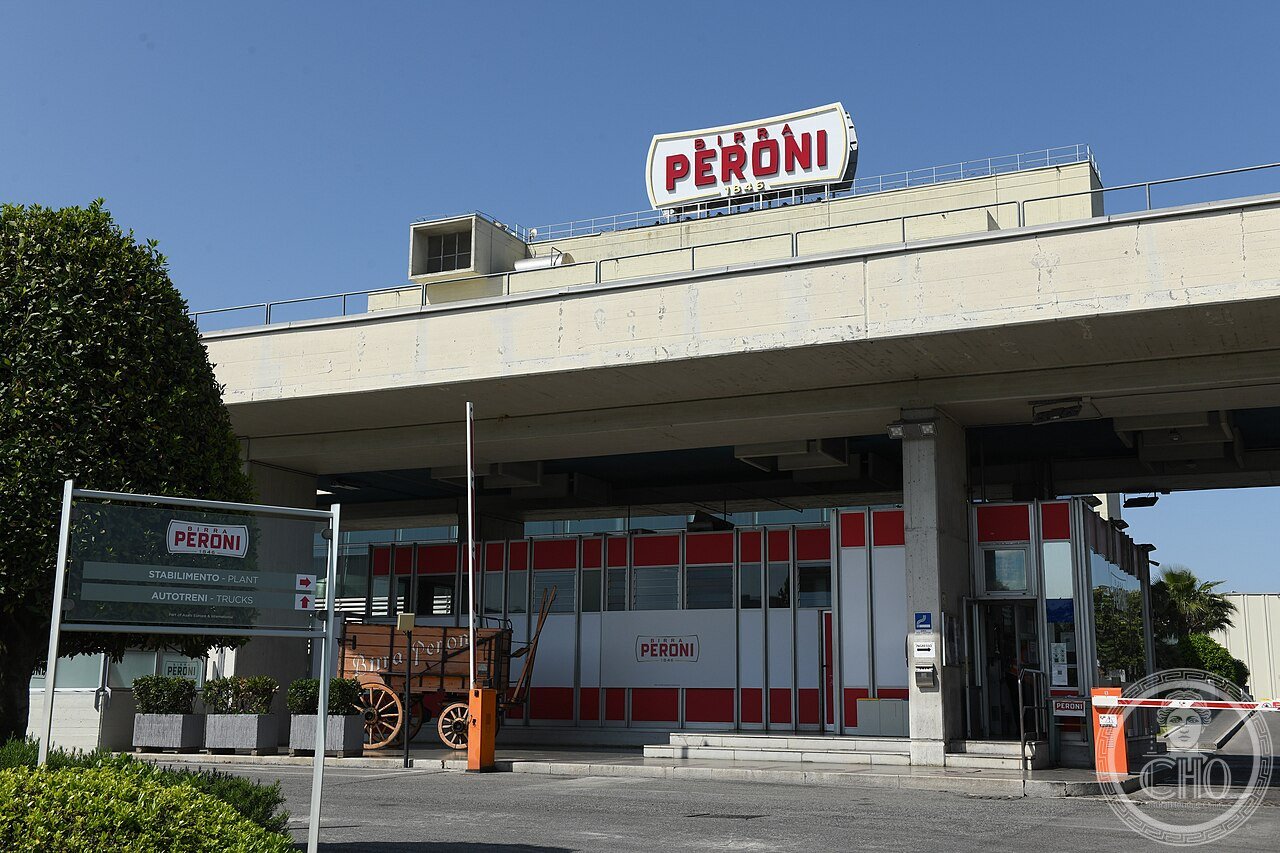
More than 12,000 photographs, 1,400 historical films and a permanent exhibition document 180 years of Italian brewing culture at this 600 m² corporate historical archive and museum on Via Renato Birolli. Peroni arrived in Rome in 1864 — eighteen years after Francesco Peroni founded the company in Vigevano — and the brewery has been making the city's beer ever since.
At a glance
The Archivio Storico e Museo Birra Peroni occupies a 600 m² permanent exhibition space at the Birra Peroni Roma headquarters on Via Renato Birolli, in the Prenestino district east of the historic centre. Founded in 1996, the Birra Peroni Historical Archive, protected by the Ministry of Cultural Heritage and Activities, preserves the paper documentation produced by the company between the late nineteenth century and the 1950s. The archive includes collections from the Bari, Naples, Livorno and Padua plants, as well as from acquired companies. An additional core of documentation covers the decades from approximately 1960 to the present, totalling 600 linear metres. Alongside the paper documents, the company's history is told through film — 1,400 reels deposited at the National Archive of Corporate Cinema — 12,000 photographs, and a library of more than 1,500 texts, which completes the cultural offering of the company.
The Museo Birra Peroni represents the history and the present of the company and its brands through objects, images, original documents and period films, illustrating their connection to the history of customs and society. The museum's three sections correspond to the three key aspects of Birra Peroni's success over time: its industrial history, both internally and in its relationships with local communities; the history of the product and its consumption in the Italian market; and its advertising, from the early 1900s to the invention of Bionda Peroni and its subsequent evolution.
Access to the archive is permitted for research purposes. Group visits to the museum, for a minimum of 15 people, are possible on weekdays by appointment. The collection is one of the most complete corporate food-and-beverage archives in Italy, and one of the few beer-specific museums in the country.
History
Francesco Peroni established his brewery in Vigevano, a small industrial city in the province of Pavia, in 1846. The region had a tradition of small-scale brewing dating to the medieval period, and Peroni's first operation produced beer primarily for local consumption, using German-style lager fermentation methods that were new to northern Italy at the time. The brewery grew steadily through the 1850s as industrialisation expanded the urban working class that would become its primary market.
In 1864, eighteen years after the founding, Peroni relocated its principal operation to Rome, recognising the capital's potential as a distribution hub for a unified Italy. The Rome brewery at Porta Pia became the company's centre of gravity, and the Vigevano operation was eventually closed. The late nineteenth century brought rapid expansion: new bottling lines, rail distribution across the peninsula, and a marketing campaign that made the Peroni name visible in bars and restaurants from Turin to Palermo.
The twentieth century tested and transformed the brand. Two world wars interrupted production and supply chains; postwar reconstruction brought the introduction of Peroni Nastro Azzurro in 1963, a premium lager that became the company's international flagship and is now its most exported product. In 2003 Peroni was acquired by SABMiller (later absorbed by AB InBev), and in 2016 by Asahi Group Holdings, though production in Rome continued and the brand maintained its Italian positioning. The museum was founded in 2001, two years before the first acquisition, as a deliberate act of institutional memory.
What you see
The exhibition space is organised thematically rather than chronologically. Brewing equipment from successive production eras stands alongside advertising material: posters, bottle labels, promotional objects, and packaging designs that chart the evolution of Italian graphic culture from the Liberty period through mid-century modernism to the branding of the 1980s and 1990s. Several label designers are identified by name, which is unusual for a corporate archive and gives the advertising collection the character of a minor design museum within the larger industrial narrative.
The film archive of 1,400 reels is the museum's most unusual holding. Corporate films commissioned from the 1920s onward — factory tours, workers' events, product launches — record social practices that no longer exist and industrial processes that have been replaced. Selected sequences are screened as part of the standard visit. The photographic collection of 12,000 images similarly documents the brewery's social world as much as its technical operations: faces of workers, celebrations, the fabric of the factory buildings across their various phases of expansion.
Behind the exhibition sits the archive proper: 600 linear metres of company documents, from the late nineteenth century to the present day, including the papers of the Bari, Naples, Livorno and Padua plants and of companies Peroni absorbed along the way. It is consultable for research by appointment, and it is the reason the museum reads as an archive with an exhibition attached rather than a display with a storeroom behind it.
Cultural significance
Corporate food-and-beverage museums occupy a particular niche in Italian industrial heritage: they combine the documentary density of a factory archive with the accessibility of a product that is part of everyday culture. Peroni's museum is notable for the quality and breadth of its film holdings, which have value for social historians as well as for design and industrial history researchers. The decision to open the archive to groups free of charge — atypical among corporate museums — reflects a cultural mandate that sits alongside the commercial operation and distinguishes it from purely promotional heritage projects.
Key facts
- Location: Via Renato Birolli 8, 00155 Roma (Prenestino district)
- Peroni founding: 1846, Vigevano (Pavia)
- Rome establishment: 1864
- Historical Archive opened: 1996
- Museum opened: 2001
- Exhibition area: 600 m²
- Collection: 12,000 photographs, 1,400 historical films, a library of more than 1,500 texts, 600 linear metres of documents, and a product and packaging collection from 1846 to the present
- Admission: free, only by appointment, for groups of at least 15 people
- Highlight: one of the few corporate beer museums in Italy; one of the most complete food-and-beverage corporate archives in the country
Practical information
- Access to the museum: weekdays by appointment, for groups of at least 15 people; contact the Birra Peroni communications office
- Access to the archive: for research purposes, by appointment
- Admission: free
- Duration: allow 60–90 minutes for a full visit
- Language: Italian; English available by prior arrangement
- Photography: permitted for personal and editorial use
- Nearest services: bars and restaurants along Via Prenestina, 5 minutes on foot
Getting there
The museum is in the Prenestino district, approximately 3.5 km east of Roma Termini. By metro, take Line A to Re di Roma or Line C to Mirti; from either station a 10–15 minute walk east along Via Prenestina reaches Via Birolli. By bus, routes 105 and 412 stop on Via Prenestina near the junction. GPS: 41.9064° N, 12.5316° E. Limited street parking; the ZTL does not extend to this area.
Nearby
- Cimitero del Verano: Rome's principal municipal cemetery, a major example of nineteenth-century funerary architecture with Liberty-era monuments, 2.5 km west
- Museo della Forma Urbis: the Museo dei Fori Imperiali holdings and archaeological collections, accessible from the historic centre, 4 km west
- Villa Gordiani: Roman imperial-era villa ruins and public park, 1.5 km east
Sources & resources
- Daniela Brignone, Archivio Storico e Museo Birra Peroni — written corrections and additions supplied to Cultural Heritage Online, 7 August 2026 (archive foundation and holdings, ministerial protection, museum sections, access conditions, ownership history)
- Birra Peroni Srl official website — peroni.it
- ISTAT, Atlante del patrimonio industriale italiano — istat.it
- Fondazione Ansaldo, Archivi d'impresa — fondazioneansaldo.it (comparative reference for Italian corporate archives)
Find it on the map
See this place and what’s around it →📷 Become a Cultural Heritage Online photographer
Share your photos of places: they stay published under your name as the author. The more they're seen, the more you get noticed — and soon a contest will reward the most appreciated photos.
Log in or sign up free to add a photoIs this page about you?
This page is read by travellers and heritage enthusiasts who find it on Google. Tell us how you are connected to this place and we will take it from there.