
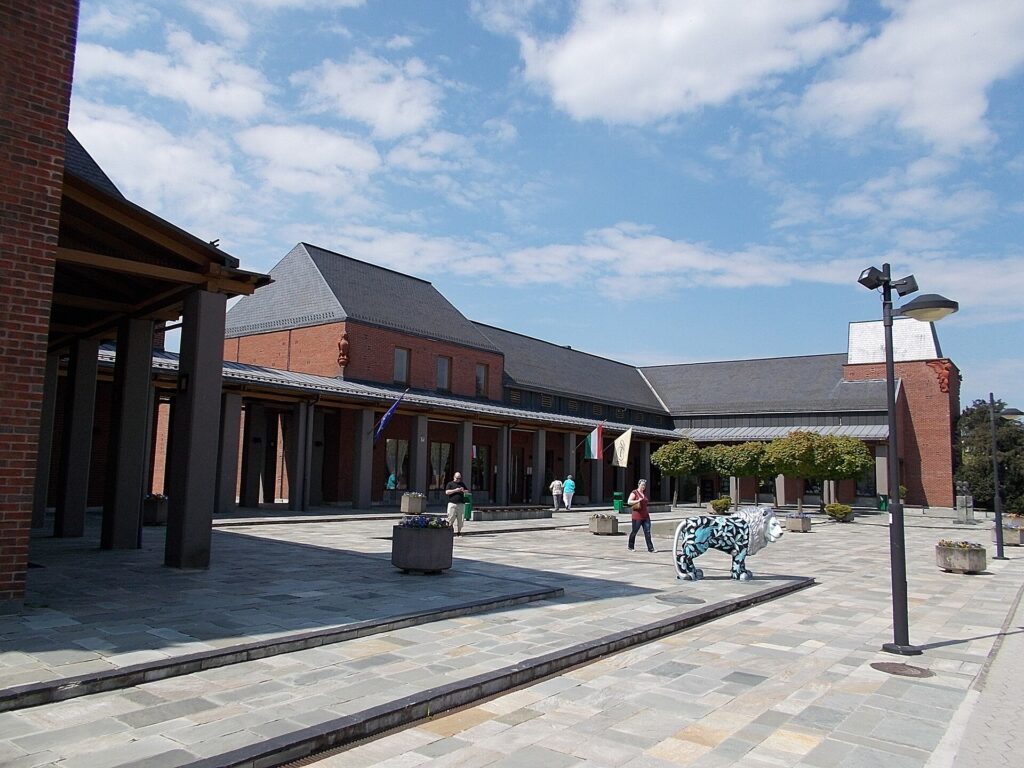
Herend Manufactory has produced hand-painted porcelain in the village of Herend since 1826, supplying the Habsburg imperial court, Queen Victoria, and royal households across Europe. The Porcelanium museum complex, opened in 2002, lets visitors observe every stage of production and trace 200 years of craft declared a Hungarian national treasure.
At a glance
Porcelanium is the museum complex of the Herend Porcelain Manufactory, located in the village of Herend, 15 kilometres from Veszprém in western Hungary. Opened in 2002, it occupies three linked pavilions that together cover the manufactory’s two-century history, its working production methods, and its contemporary design output. The Herend manufactory itself — the largest hand-painted porcelain producer in the world — employs approximately 1,200 craftspeople, all of whom work on the site that visitors tour. Herend porcelain has been declared a Hungaricum, a status reserved for products and traditions considered to embody Hungarian national identity at the highest level.
History
The Herend manufactory was founded in 1826 by Vince Stingl, who began producing everyday earthenware in the village. The decisive transformation came in 1839, when Mór Fischer purchased the struggling operation and redirected it entirely toward fine hard-paste porcelain hand-painted with elaborate decorative patterns. Fischer recognised that the European market for hand-painted porcelain — dominated at the time by Vienna, Meissen, and Sèvres — had room for a new entrant willing to combine technical quality with distinctive decorative vocabulary. Herend’s breakthrough came at the 1842 Vienna Exhibition, where the manufactory’s pieces drew the attention of the Habsburg court; Emperor Franz Joseph I became a patron. The next major recognition arrived at the London Great Exhibition of 1851, where Queen Victoria admired a Herend dinner service painted with butterflies and wild flowers — the pattern, now called Victoria, remains in production today. From the 1850s onward, Herend supplied royal courts across Europe, from the British royal family to the Shah of Persia. The factory survived both World Wars and the nationalisation of the communist period (1948–1993); since privatisation it has operated as a worker-owned cooperative, one of the few large craft manufacturers in Europe to maintain this structure.
What you see
The Porcelanium complex comprises three distinct pavilions connected by covered walkways. The History Pavilion presents the manufactory’s two-century arc through a chronological display of pieces from the Fischer era through to the present, with particular focus on the royal commissions of the nineteenth century and the exhibition triumphs of the 1851 London and 1855 Paris World’s Fairs. The Production Pavilion is the centrepiece for most visitors: a working mini-manufactory where craftspeople demonstrate each stage of porcelain production, from clay preparation and hand-throwing through the delicate process of hand-painting under magnification to the final kiln firing. Each visitor can observe a painter completing a piece in real time. The Contemporary Gallery in the third pavilion shows how Herend’s decorative vocabulary — the botanical patterns, the Chinese-inspired motifs, the animal figurines — has been interpreted by successive generations of in-house designers.
Cultural significance
Herend’s designation as a Hungaricum places it in the company of Tokay wine, Hungarian embroidery, and Rubik’s Cube — objects and traditions that the Hungarian state considers uniquely representative of national culture. This is not merely symbolic: the manufactory’s survival of nationalisation, privatisation, and the broader collapse of European artisan manufacturing is itself a cultural achievement. That 1,200 craftspeople still practise hand-painting and hand-throwing on a single site, producing pieces that compete in international luxury markets, is a genuinely rare phenomenon in contemporary Europe. For heritage tourists, Herend offers something increasingly uncommon: the complete, uninterrupted chain from raw material to finished object, all visible in one place.
Key facts
- Founded 1826; decisive reorientation to fine porcelain under Mór Fischer from 1839
- Declared a Hungaricum (Hungarian national treasure)
- Royal commissions: Habsburg imperial court (1842), Queen Victoria (1851 Great Exhibition)
- Warrants from royal courts across Europe and the Middle East
- Employs approximately 1,200 craftspeople, all hand-painting
- Worker-owned cooperative structure since 1993 privatisation
- Porcelanium opened 2002; three pavilions — history, production, contemporary gallery
- Location: Kossuth Lajos u. 140, Herend 8440, Hungary
Practical information
Porcelanium is open Tuesday to Sunday from 09:00 to 17:00 (extended to 18:00 in summer). Admission covers all three pavilions. The production demonstration runs continuously during opening hours; no booking is required for individual visitors. The manufactory shop on-site sells the full Herend range at factory prices, including limited-edition and exclusive pieces. Guided tours in English, German, and Hungarian are available on request for groups. The complex is accessible to wheelchair users. A small café operates within the grounds. Photography is permitted throughout.
Getting there
Herend is 15 kilometres northwest of Veszprém in western Hungary. By car from Budapest: take the M7 motorway toward Lake Balaton, then the M8 and road 8 toward Veszprém; Herend is 15 kilometres beyond Veszprém (total approximately 2 hours from Budapest). By rail from Budapest: intercity trains connect Budapest-Déli to Veszprém (approximately 1 hour 45 minutes); from Veszprém station, a local bus or taxi covers the 15 kilometres to Herend (20 minutes). The manufactory is signposted from the main road through the village. Ample free parking is available.
Sources & resources
- Herend Porcelain official site: herend.com
- Porcelanium visitor information: porcelanium.com
- Hungarian Hungaricum Committee registry: hungarikum.hu
- Fehér, Géza, Herend Porcelain (Corvina, Budapest, 1993)
Find it on the map
See this place and what’s around it →📷 Become a Cultural Heritage Online photographer
Share your photos of places: they stay published under your name as the author. The more they're seen, the more you get noticed — and soon a contest will reward the most appreciated photos.
Log in or sign up free to add a photo