
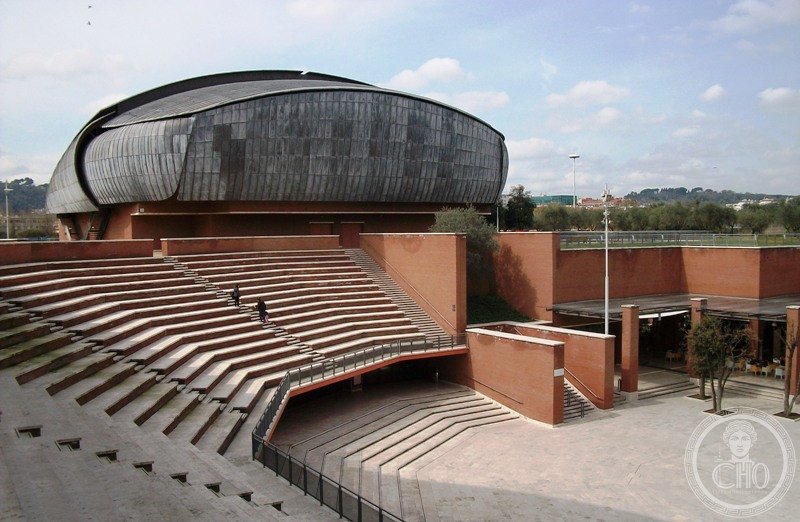
The Music Park Auditorium
Renzo Piano’s landmark multifunctional complex unites concert halls, performance spaces, and archaeological displays in a singular architectural vision dedicated to the arts.
At a glance
The Music Park Auditorium is a comprehensive cultural venue designed by Renzo Piano and his Building Workshop. It comprises four principal performance spaces—three concert halls and an open-air amphitheater—alongside archaeological and musical instrument museums. The Musica per Roma Foundation oversees its programming of concerts, exhibitions, international festivals, and theatrical performances.
History
The project originated in 1993 when Rome’s Municipality launched an international competition to design a major cultural venue on publicly owned land between the Olympic village and the Flaminio stadium. Renzo Piano’s proposal was selected as winner on 27 July 1994, and the project formally transferred to the Municipality on 15 January 1995.
Construction encountered an unexpected interruption when excavation revealed the remains of an ancient Roman villa. Rather than demolish these findings, Piano revised his design in June 1996 to integrate the archaeological site into the overall complex. The phased opening began on 21 April 2002 with the Petrassi and Sinopoli halls, followed by the large Santa Cecilia room on 21 December 2002. By early 2003, the entire complex reached full operational capacity.
What you see
The auditorium comprises four distinct performance spaces. The Petrassi room seats 673; the Sinopoli room accommodates 1,133; the Santa Cecilia room holds 2,744. The Cavea, dedicated to Maestro Luciano Berio, functions as both an open-air theater and gathering place, positioned centrally among the three halls.
Archaeological and curatorial spaces integrate seamlessly: a museum housing the excavated Roman villa, the Aristaios Museum, and the Museum of Musical Instruments of the National Academy of Santa Cecilia overlook the large foyer. This integration of performance, exhibition, and archaeological discovery defines Piano’s conception of the building.
Cultural significance
The Music Park Auditorium represents a defining moment in contemporary Italian cultural infrastructure—a venue that honors both living artistic practice and historical preservation. Its design demonstrates how archaeological discovery can enhance rather than impede modern development, and how a single architectural vision can unite disparate cultural institutions under one roof.
Key facts
- Architect: Renzo Piano and Renzo Piano Building Workshop
- Address: Via Pietro de Coubertin, 30, 00196 Rome
- Coordinates: 41.9290859, 12.4752454
- Main halls: Petrassi (673 seats), Sinopoli (1,133 seats), Santa Cecilia (2,744 seats), Cavea open-air theater
- Opening: April–December 2002
- Phone: +39 06 80241281
- Website: https://www.auditorium.com/
Practical information
The auditorium operates as a ticketed venue for concerts, performances, and exhibitions. Visit the official website for current programming, prices, and reservation details.
Getting there
The Music Park Auditorium is located in northern Rome near the Flaminio stadium and the former Olympic village. Public transport and driving directions are available via the venue’s website.
Sources & resources
Find it on the map
See this place and what’s around it →📷 Diventa un fotografo di Cultural Heritage Online
Condividi le tue foto dei luoghi: restano pubblicate con la tua firma come autore. Più vengono viste, più ti fai conoscere — e presto un concorso premierà le foto più apprezzate.
Accedi o registrati gratis per aggiungere una foto