
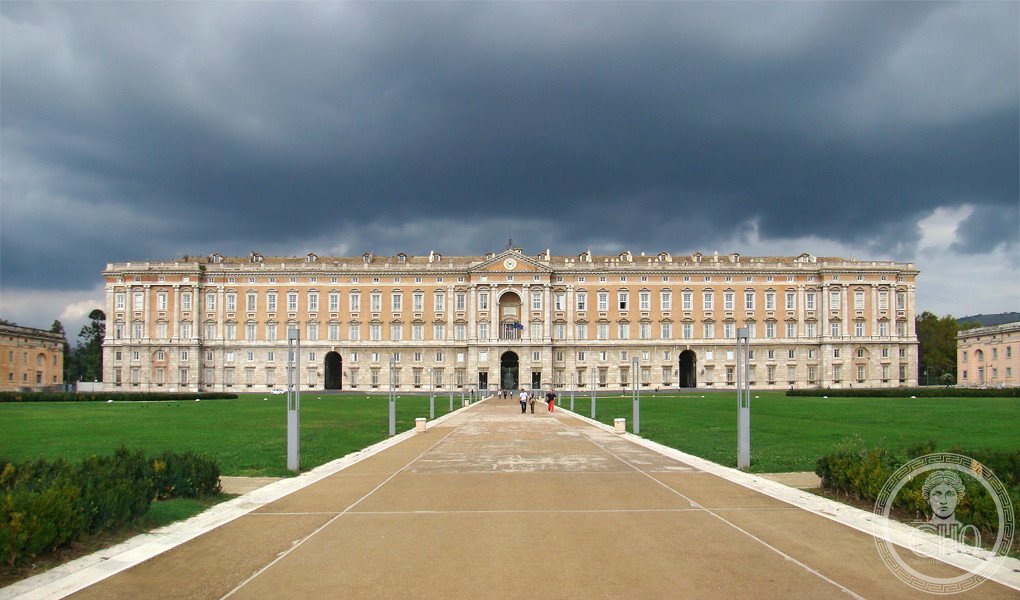
Reggia di Caserta (Palazzo Reale)
La Reggia di Caserta (UNESCO 1997) è l’apice del Barocco europeo in Italia meridionale — commissionata da Carlo di Borbone nel 1752 CE come risposta borbonica ai palazzi di Versailles e del Buen Retiro, progettata da Luigi Vanvitelli come esercizio di scala assoluta (249 m di facciata, 1.200 stanze, giardino di 120 ettari con una cascata artificiale di 78 m alimentata da un acquedotto di 40 km) e trasformata in uno dei set cinematografici più frequentati del XX secolo (da Star Wars a Mission: Impossible a Avengers).
At a glance
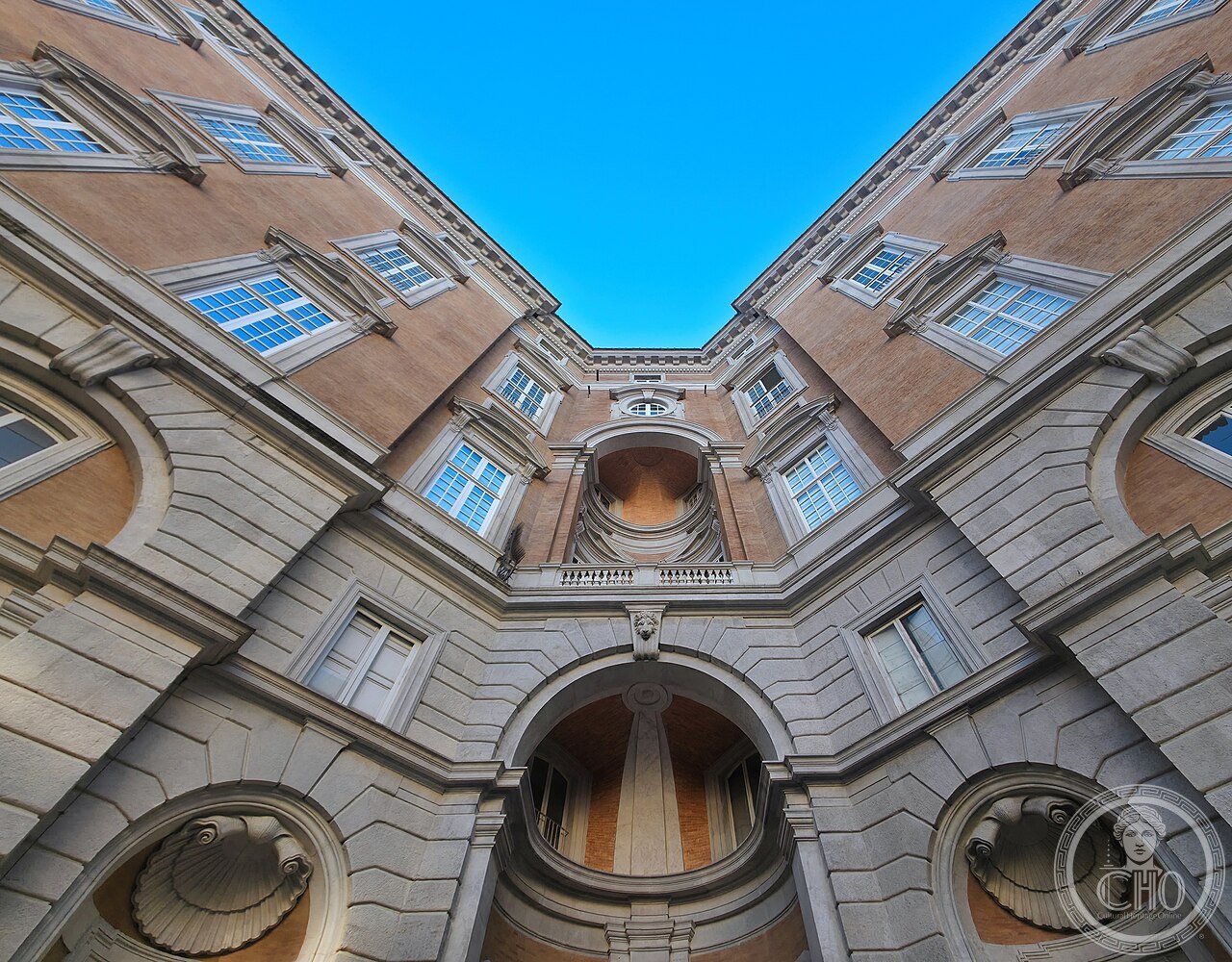
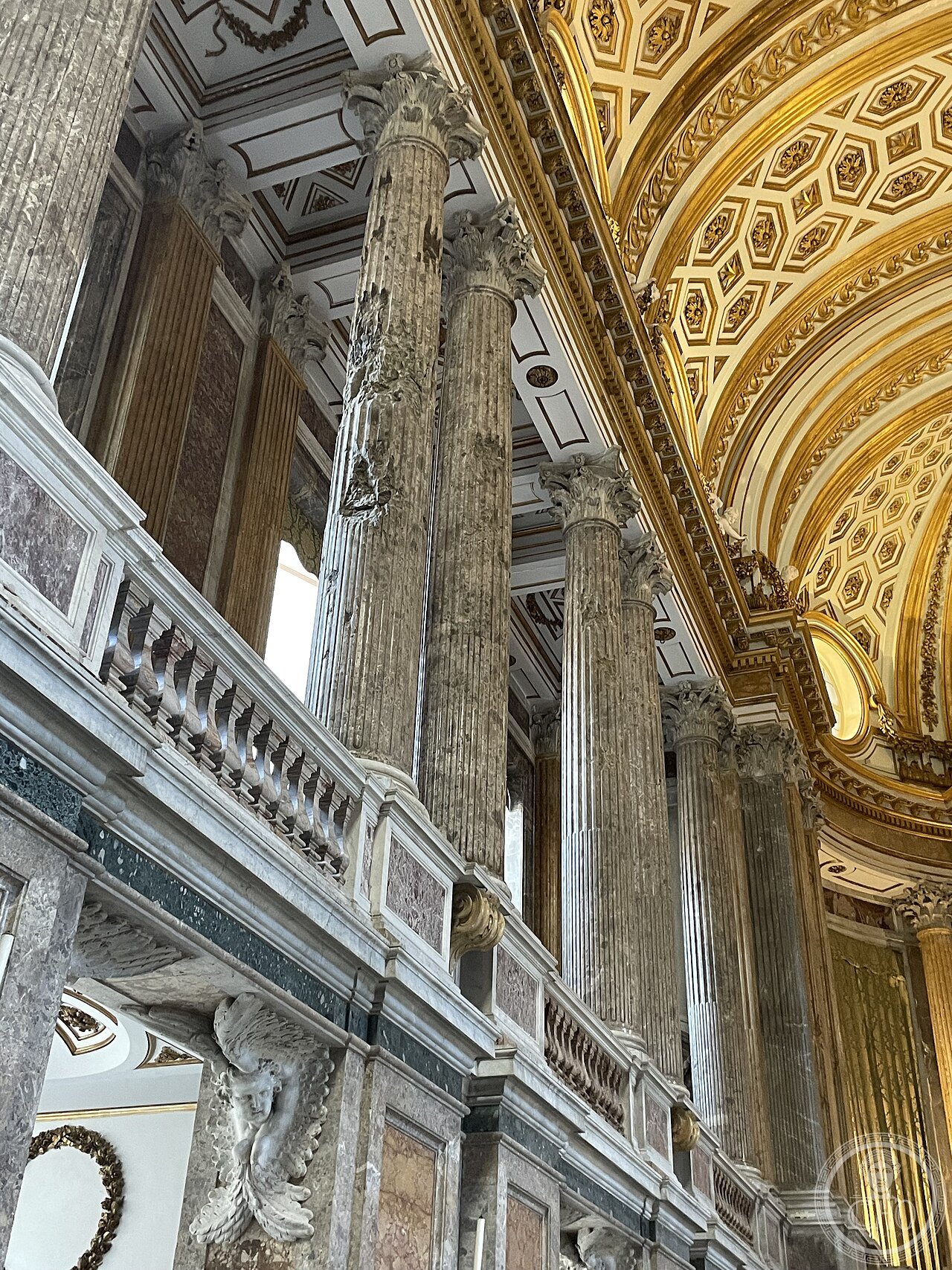
Reggia di Caserta (the most precisely Caserta zone Caserta Campania Italy 41.0737 N 14.3262 E UNESCO WHS 1997 reference 549: the dimensions (the Reggia di Caserta: the numbers: 249 m facade length; 41 m height; 4 internal courts; 1,200 rooms; 1,742 windows; 34 staircases; 120 hectares of gardens; 3 km garden axis from the main door to the Grande Cascata; 78 m height of the Grande Cascata; the construction (Luigi Vanvitelli began 20 January 1752 CE (the first stone); he died in 1773 CE before the palace was completed; his son Carlo Vanvitelli completed the major interior decoration (1773–1845 CE)); the Versailles comparison (Carlo di Borbone’s explicit programme: the Palace of Caserta should be larger than Versailles and more impressive than the Royal Palace of Madrid; the dimensions: Versailles main facade (576 m; the total palace complex including wings); Caserta main facade (249 m; excluding wings); Madrid (490 m); the specific Caserta advantage: Caserta has a longer uninterrupted garden axis (3 km) than Versailles (1.7 km from the palace to the Grand Canal))); the Scalone d’Onore (the Grand Staircase: the single most impressive interior space of 18th-century European Baroque architecture: the staircase starts as a single flight (19.3 m wide; 18 m long) rising from the central vestibule (the “edicola”: the circular space under the dome immediately inside the main entrance) and then divides into 2 flights at the first landing (the “pianerottolo degli scudi”: the landing of shields; 4 lions of marble flank the bifurcation; the entire upper structure is coffered with a single barrel vault decorated with painted stucco grotesques); the ceiling painting (Domenico Mondo, 1789 CE: “The Apotheosis of Carlo di Borbone and Maria Amalia of Saxony”: the allegorical programme (the programme: Carlo and Maria Amalia ascend to Olympus; the 12 Olympian gods surround them; the Genius of Architecture (a figure with a compass) represents Vanvitelli)); the cinema use (the specific film productions at the Reggia: (1) Star Wars: Episode I — The Phantom Menace (1999 CE): the exterior facade was used as the palace of the Queen of Naboo (Padmé Amidala); the courtyard was the hangar of the Royal Starship; (2) Mission: Impossible III (2006 CE): the gardens were used for the Rome street chase sequences; (3) Avengers: Age of Ultron (2015 CE): the royal apartments were Baron Strucker’s Sokovia fortress; (4) The Two Popes (2019 CE; Fernando Meirelles): the grand staircase was used as the Vatican interior)).
Key facts
- Il Giardino Inglese di Caserta (Jacob Philipp Hackert 1785–95) e perché è il giardino romantico più importante dell’Italia meridionale: the English Garden (the Giardino Inglese (the Bosco dei Cervi “English Garden”): the informal landscape garden within the formal Baroque gardens of the Reggia; the location (the northeast area of the 120-hectare park; accessible by walking past the Cascata Grande and turning right (east) on the cross-axis path; 20 min walk from the palace or 5 min by bike rental at the entrance)); the commissioning (Maria Carolina of Austria (1752–1814 CE; the wife of Ferdinando IV of Naples; the sister of Marie Antoinette): she commissioned the English Garden in 1785 CE from the landscape architect John Andrew Graefer (a British-born landscape designer working in Italy); the artistic element (Jacob Philipp Hackert (1737–1807 CE; the German painter; the court painter of Ferdinando IV from 1786 CE): he designed the plantings of the English Garden (not just illustrated them) and painted the landscape paintings of the garden that were used as the programme document for the planting; Hackert was also the teacher of Johann Wolfgang von Goethe in landscape technique (Goethe visited the garden in 1787 CE during his Italian Journey (Italienische Reise, published 1816 CE) and wrote: “the garden is full of a thousand plants from all parts of the world; the air is full of their fragrance”)); the features (the artificial ruins (a ruined aqueduct arch; a miniature Roman bath; a collapsed temple pediment): the first use of artificial ruins as landscape elements in a Southern Italian garden; the specific “fabriqued” ruins distinguish the Caserta English Garden from the purely plant-based English gardens of Florence (Boboli) and Rome (Villa Borghese))
- GPS (ingresso principale): 41.0737° N, 14.3262° E
History
Da Carlo di Borbone a Vanvitelli a Maria Carolina a Mussolini (Aeronautica) all’UNESCO 1997 (the most precisely Caserta zone history: the commissioning (Carlo di Borbone (1716–1788 CE; King of Naples as Charles VII 1734–59 CE; subsequently King of Spain as Charles III 1759–88 CE): the decision to build the Palace of Caserta was made in 1750 CE; Carlo chose Caserta over the earlier Bourbon palaces at Naples (Palazzo Reale di Napoli, 1600 CE) and Portici (Palazzo Reale di Portici, built 1738 CE at the foot of Vesuvius; abandoned after the 1759 CE earthquake) for 3 reasons: (1) the inland location made it defensible against naval attack (a primary concern after the 1734 CE Bourbon seizure of Naples from Austria); (2) the San Leucio hill behind Caserta could supply the water for the fountains via a dedicated aqueduct (the Acquedotto Carolino (1753–62 CE; 40 km from the Campanian springs; the largest hydraulic engineering project in 18th-century Europe); (3) the flat plain allowed an unrestricted garden axis of unlimited length)); the Vanvitelli selection (Luigi Vanvitelli (1700–1773 CE; born Naples; trained in Rome under his father Gaspare Van Wittel (the Dutch-born vedutista whose Italian name “Vanvitelli” Italianized “Van Wittel”)): the selection was based on his design for the Santa Maria degli Angeli in Rome (the conversion of the Baths of Diocletian; 1749 CE)); the Bourbon-French period (the palace was used by the Bourbon and then French administrations until the Unification of Italy (1861 CE); Napoleon’s stepson Joachim Murat (King of Naples 1808–15 CE) used the palace as his primary residence; the Allied Command (1943–45 CE: the Allied Control Commission established its Italian headquarters in the Palace of Caserta (Operation Husky aftermath); the German Instrument of Surrender for Italy was signed in the Throne Room of the Reggia on 2 May 1945 CE)); 1997 CE UNESCO inscription reference 549.
What you see
Lo Scalone d’Onore, gli Appartamenti Reali, il Giardino Formale (3 km), la Cascata Grande, e il Giardino Inglese (the most precisely Caserta zone visit (minimum 4–5 hours for the full site): the palace interior (open daily 8:30 AM–7:30 PM (last entry 6:30 PM); €20 combo palazzo+parco+giardino inglese; the Scalone d’Onore (the must-see: 15 min; the Grand Staircase of 18th-century European Baroque architecture); the Appartamento Borbonico (the royal apartments; the most elaborate: the Sala del Trono (Throne Room), the Sala di Astrea (the justice hall: the fresco of Astrea (the goddess of justice) weighing souls was painted by Fedele Fischetti (1782 CE); the Biblioteca Palatina (the palace library: 12,000 volumes; the bookcases of walnut; the fresco ceiling of the Apotheosis of Literature)); the park (the formal garden axis: 3 km on foot from the palace main door to the Grande Cascata; bicycle hire at the entrance (€5/3 hours; the distance is too long to walk in the heat of summer); the Fontane intermedie (4 fountains at equal intervals along the main axis: Diana e Atteone (the most photographed: the transformation of Acteon into a stag; the 2 facing fountain groups (Diana bathing + Actaeon and his 16 hounds in various stages of transformation)); the Grande Cascata (the 78-m waterfall fed by the Acquedotto Carolino (40 km from the Campanian Apennines); the specific sound (the combined noise of the 1.8 m³/second water flow and the echo from the limestone escarpment is audible from 1.5 km away at the fountain of Aeolus)); the Giardino Inglese (the English Garden; 30 min from the Grande Cascata on foot (1 km east); the artificial ruins; the greenhouse (the Cryptoporticus: 1800s CE glasshouse with subtropical plants including the original camellia japonica specimens; the oldest camellias in Europe in continuous cultivation)).
Practical information
- Come raggiungere la Reggia da Napoli e come organizzare la visita completa in una giornata: transport (Trenitalia da Napoli Centrale: 40 min (€5.10; frequency: every 20–30 min; the station “Caserta” is directly in front of the Reggia main entrance (200 m)); Flixbus da Roma: 2h40; the combo Naples + Caserta (Napoli Centrale → Caserta: 40 min → Caserta → Napoli Centrale: possible in 1 day from Naples; leave Napoli 9 AM; arrive Caserta 9:40 AM; palace + park: 9:40–3 PM; Caserta → Napoli 3:30 PM; full Naples afternoon)); the bike hire (the garden axis is 3 km × 2 (return trip) = 6 km total; the park temperature in summer (July–August) exceeds 35°C on the garden axis (no shade for 2.5 km); bike hire is recommended (€5/3h); the rental shop is immediately inside the palace main gate on the right)); the dining (the cafeteria inside the palace (Officina del Gusto, open palace hours; the “mozzarella di bufala campana DOP” from the San Leucio dairy (the only commercial dairy currently using water buffalo from the original Bourbon royal herd (the Bourbon Bourbon-Parma family introduced the water buffalo to Caserta in 1760 CE from Sicily; the DOP certification covers the Caserta province area)))))
Getting there
Trenitalia da Napoli Centrale (40 min, €5.10, ogni 20-30 min). Stazione di Caserta a 200 m dall’ingresso principale. Noleggio bici all’ingresso (€5/3h). GPS ingresso: 41.0737, 14.3262.
Nearby
- San Leucio: Borgo della Seta Borbonico — 3 km nord-est (incluso nella WHS UNESCO rif. 549; la fabbrica serica di Ferdinando IV (1789 CE); la Vaccheria reale; il borgo utopico (la “Legge sul Felicità: i beni in comune, matrimoni per merito, istruzione obbligatoria); bus locale da Caserta Stazione 15 min €1)
- Pompei ed Ercolano — 40 km sud (Trenitalia da Caserta a Napoli 40 min poi Circumvesuviana a Pompei Scavi 35 min; UNESCO WHS 1997 rif. 829)
Gallery
Sources
- Wikipedia, Palace of Caserta; Luigi Vanvitelli; Garden of Caserta; Jacob Philipp Hackert, accessed June 2026
- UNESCO, 18th-Century Royal Palace at Caserta, WHS reference 549, inscribed 1997
- Chiarini, Marco (ed.). Hackert e la corte di Napoli. Rome: De Luca, 2001 (the study of Hackert’s role in the Caserta English Garden)
Find it on the map
See this place and what’s around it →📷 Diventa un fotografo di Cultural Heritage Online
Condividi le tue foto dei luoghi: restano pubblicate con la tua firma come autore. Più vengono viste, più ti fai conoscere — e presto un concorso premierà le foto più apprezzate.
Accedi o registrati gratis per aggiungere una foto