
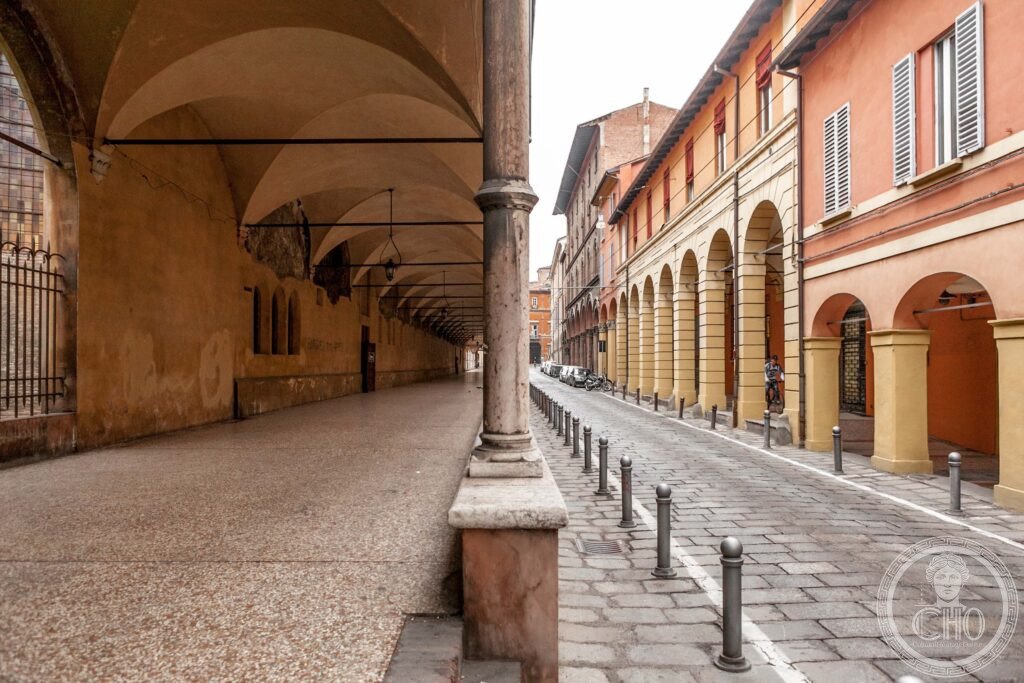
Bologna’s porticoes form a continuous network of arcaded walkways running for tens of kilometres through the city, built up over nearly a thousand years to shelter the students, traders and pilgrims of the oldest university city in the Western world.
At a glance
Bologna is threaded by covered walkways that line its main streets and climb to a hilltop sanctuary outside the city. The porticoes began as a municipal requirement in the 11th century, tied to the growth of the University of Bologna, and grew into one of the largest continuous covered pedestrian networks anywhere. The system was inscribed on the UNESCO World Heritage List in 2021.
Key facts
- Location: Via dell’Indipendenza and the historic centre of Bologna, Emilia-Romagna
- Total extent: around 62 km of porticoed streets across the municipality, with roughly 45 km forming a continuous network in the city centre
- Oldest reference: a city statute of 1041 requiring new buildings on central streets to include a covered ground-floor walkway
- Longest single stretch: the portico linking the Arco del Meloncello to the Sanctuary of the Madonna di San Luca, about 3.8 km with 666 arches
- UNESCO status: inscribed in 2021 (reference 1673)
History
The obligation to build porticoes in Bologna is documented as early as 1041, when the city, already governing itself as one of the earliest Italian communes, required property owners on central streets to provide a covered walkway at their own expense while keeping it open to the public. A statute of 1288 extended the requirement across the walled city and set minimum dimensions, including a clear height sufficient for a loaded pack animal to pass beneath. The rule is closely tied to the University of Bologna, founded in 1088 and recognised as the oldest university in the Western world, whose students lodged across the city and needed sheltered routes to lectures held in scattered rented rooms.
The oldest porticoes to survive substantially intact are those of the Palazzo della Mercanzia, dating from 1384. The Archiginnasio, built in 1563, became the university’s first permanent seat and its portico is counted among the finest in the historic centre. Outside the city, the portico leading to the Sanctuary of the Madonna di San Luca was built in stages between 1674 and 1793, a project proposed by the Bolognese senator Angelo Ranuzzi and financed section by section by noble families and guilds, each of which carved its own insignia into the keystones of the arches it funded. The whole porticoed system was inscribed on the UNESCO World Heritage List in 2021.
What you see
In the city centre, the porticoes of Via dell’Indipendenza, Via Zamboni and Via dell’Archiginnasio combine sandstone columns at street level with brick arches above, roofed in terracotta tile laid in a herringbone pattern. The portico floor sits slightly above the street to keep rainwater out of the walkway and the shops behind it. The Archiginnasio itself houses the Anatomical Theatre, a wooden amphitheatre built for public dissections, along with carved wooden figures known as the Spellati. Nearby, Piazza Maggiore holds Giambologna’s Fountain of Neptune, known locally as El Zigant, and the Basilica di San Petronio, whose upper facade was left unfinished in brick when funds ran out in the 16th century.
Outside the centre, the portico to San Luca runs for around 3.8 km and 666 arches from the Arco del Meloncello, a triumphal arch designed by Carlo Francesco Dotti, up to the Sanctuary of the Madonna di San Luca on the Colle della Guardia. The sanctuary holds a Byzantine icon of the Madonna traditionally attributed to Saint Luke, which is carried down the full length of the portico each year on Ascension Day in a procession recorded since 1433 and back again a week later. Visitors can walk the route or take the cable car from the Meloncello arch.
Practical information
- Access: the porticoes are open public walkways at all times; the Anatomical Theatre and other interiors keep their own visiting hours, best checked with the relevant institution before travelling
- San Luca portico: can be walked in full or reached partway by the Funivia San Luca cable car from the Meloncello arch; check current timetables locally
- Sanctuary of San Luca: open daily, entry free
- Local dishes to try: tagliatelle al ragù, tortellini in brodo and Mortadella Bologna, all closely associated with the city
Getting there
Bologna is served by high-speed rail from Milan, Rome and Florence, with the historic centre and Via dell’Indipendenza a short walk from the central station. The San Luca portico begins at the Arco del Meloncello on the edge of the city, reachable on foot or by local transport.
Nearby
- Piazza Maggiore — the city’s main square, with the Fountain of Neptune and the Basilica di San Petronio
- Palazzo dell’Archiginnasio — former seat of the university, in the historic centre, with its Anatomical Theatre
- Arco del Meloncello — triumphal arch marking the start of the long portico climb to San Luca
- Sanctuary of the Madonna di San Luca — hilltop sanctuary at the end of the 3.8 km portico, holding the Byzantine icon of the Madonna
Sources
- UNESCO
Find it on the map
See this place and what’s around it →Historical events at this place (18)
- 2017 Tamara de Lempicka – Successo e Depressione
- 2018 Istinti razionali
- 2018 Pranzo, Musica e Balli Tradizionali Popolari dell'Appennino
- 2018 Invito di Arpa Terapia, a seguire Pranzo
- 2018 Treno a vapore da Bologna per la Sagra del Tartufo a Brisighella
- 2018 Le Antenate - Cerchio di Donne in Yurta
- 2018 Leader Training di Yoga della Risata
- 2019 Vibrazioni di Scoperta
- 2019 TABLEAUX VIVANTS - Visite Guidate Spettacolo
- 2020 ISIT.opencall#002 / Contemporary Art Magazine
- 2020 SKETCH YOUR DECK: Scatena la Tua CREATIVITÀ!
- 2022 MOSTRA SCAMBIO DI AUTO, MOTO, BICI E RICAMBI D'EPOCA
- 2023 La Fondazione Carlo Gajani presenta: #BLACK&WHITE di AUDREY COÏANIZ (BASMATI VIDEO)
- 2023 Luci della Città, spazio alla cultura con Enel Energia
- 2023 Respice Finem - 520° Anniversario dalla Nascita del Parmigianino
- 2024 A Bologna nasce Galleria Leòn diretta da Leonardo Iuffrida
- Nascita di Angiolo Mazzoni
- 2026 Art Nouveau Week 2026 in Bologna
📷 Become a Cultural Heritage Online photographer
Share your photos of places: they stay published under your name as the author. The more they're seen, the more you get noticed — and soon a contest will reward the most appreciated photos.
Log in or sign up free to add a photo