
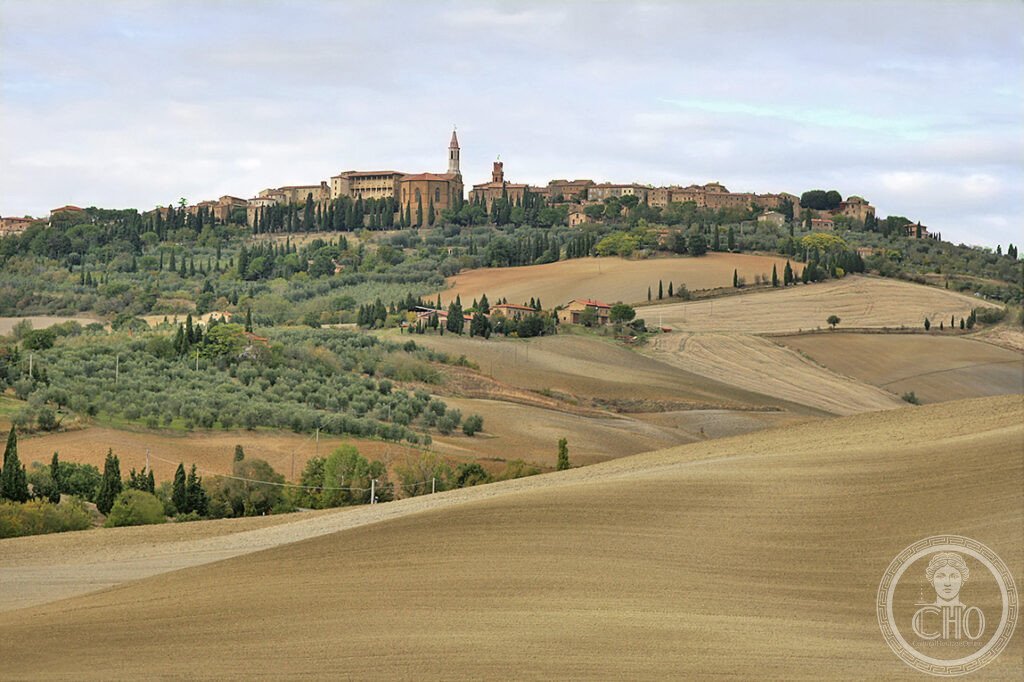
Pienza: Città Ideale del Rinascimento

Pienza centro storico Rossellino Duomo Palazzo Piccolomini ideal Renaissance city Val d'Orcia UNESCO 1996
Piazza Pio II, Pienza, Province of Siena, Toscana, Italy. The cathedral (Duomo di Pienza; 1459–1462 CE; architect Bernardo Rossellino (c.1409–1464 CE); the facade: a triumphal arch composition (3 arched bays with Corinthian pilasters; the keystones of the arches carry the Piccolomini crescent moon insignia; the facade travertine is from the local quarry, 8 km from Pienza); the Palazzo Piccolomini (right; 1459–1462 CE; Rossellino; modeled on Alberti’s Palazzo Rucellai, Florence, which Rossellino had helped build 1446–1451 CE; the 3-story ashlar facade with superimposed pilasters; the loggia on the garden side facing the Val d’Orcia); the Via Rossellino between them (6 m wide; the primary axis of the ideal city plan); total distance from west gate to east gate: 230 m. UNESCO World Heritage Site 1996 (reference 789). Photo via Wikimedia Commons.
Pienza, Province of Siena, Toscana, Italy · Birthplace of Pope Pius II (Enea Silvio Piccolomini; born 1405 CE; pope 1458–1464 CE); Rossellino redesign 1459–1462 CE; Duomo + Palazzo Piccolomini + Palazzo Borgia in 3 years; UNESCO WHS 1996 (ref 789)

Pienza: Città Ideale del Rinascimento

Pienza (UNESCO 1996) is the only city in the world built entirely to a single Renaissance vision in a single building campaign — Pope Pius II hired Bernardo Rossellino in 1459 CE to transform his birthplace of Corsignano into the ideal Albertian city within 3 years, producing the first planned Renaissance urban core in European history and the most complete surviving demonstration of Alberti’s “De Re Aedificatoria.”

At a glance

Pienza centro storico (the most precisely Pienza zone Pienza Siena Toscana Italy 43.0769 N 11.6778 E UNESCO WHS 1996 reference 789: the specific historical context (why Pienza was possible: the specific biography of Pius II (Enea Silvio Piccolomini; born in Corsignano on October 18, 1405 CE; the specific trajectory: humanist scholar (he wrote the first geography of Europe, the first erotic novel in Latin of the Renaissance, and the first personal autobiography of a pope); diplomat (he represented the Council of Basel in Scotland and Germany); poet laureate (crowned by Emperor Frederick III in 1442 CE); bishop (1450 CE); cardinal (1456 CE); Pope Pius II (1458–1464 CE)); the specific idea (Pius II commissioned the redesign of Corsignano (renamed Pienza after himself: Pius → Pienza, “Pio’s city”) as an implementation of Leon Battista Alberti’s De Re Aedificatoria (1452 CE: the first modern architectural treatise; the text lays out principles for the ideal city: orthogonal street plan, proportioned buildings, monumental civic spaces)); the building campaign (1459–1462 CE: 3 years of construction; the specific achievement: Rossellino completed the core of the project (Duomo, Palazzo Piccolomini, Palazzo Borgia, Palazzo Ammannati (later Palazzo Comunale)) in exactly the timeline requested; the cost: approximately 50,000 florins (the exact amount is known from the papal account books) — approximately 3× the original estimate; Pius wrote in his autobiography (Commentarii; the most detailed personal record of a Renaissance architectural patron) that he “was angry” at the cost overrun but “decided to say nothing” because the buildings were beautiful)).

Key facts

  • The Duomo di Pienza and the structural problem that began to appear within 30 years of its construction: the Duomo (Cattedrale di Santa Maria Assunta; 1459–1462 CE; the specific design (Rossellino designed a “hall church” (German: Hallenkirche) for the interior: a nave and 2 side aisles of equal height — the light from all 3 sides fills the interior equally; the specific reason: Pius II had traveled extensively in Germany and Austria as a diplomat and had admired the hall-church interior (the Gothic late-medieval form); he specifically requested a church “di proporzione e non di grandezza” — of proportion, not of size; the interior light (the south wall has 3 very large Gothic windows (the largest surviving Renaissance Gothic windows in Italy): the stained glass (the original Sienese stained glass of 1462 CE survives in the lunettes above the main windows; the small panes (each approximately 15 × 20 cm) are in excellent condition because the church was not heavily used after the 15th century CE))); the structural problem (the south wall of the Duomo was built on a steep slope (the Val d’Orcia drop: the terrain falls 30 m in 100 m behind the Duomo south wall); the south wall of the apse and transept began to tilt outward within 30 years of completion (first noted in the 1480s CE); today, the south wall has a visible lean of approximately 5 degrees; the specific concern: if the wall continues to lean, it could eventually pull the apse vaulting apart; the current stabilization (the south wall has been braced with external buttresses added in the 17th, 18th, and 20th centuries CE; the leaning has been slowed but not stopped)); the Pecorino di Pienza DOP (the local cheese (Pecorino di Pienza: a sheep’s milk cheese made from the sheep that graze the Crete Senesi and Val d’Orcia pastures; the specific varieties: fresh (fresco: 20–30 days aged; white rind; delicate); semi-aged (semistagionato: 60–90 days; firmer; more pronounced); aged (stagionato: 4+ months; dark rind from olive oil and wine marc rubbing; intense)); the Cortona food shops on the Via Rossellino sell all 3 varieties cut to order)
  • GPS (Piazza Pio II): 43.0769° N, 11.6778° E

History

From the medieval village of Corsignano to the ideal city of Pienza to the architectural influence on subsequent Renaissance urbanism (the most precisely Pienza zone history: the pre-Rossellino history (Corsignano: a small village on a hilltop spur above the Val d’Orcia; a Lombard-period settlement (6th–7th century CE); the Piccolomini family (the Sienese noble family owning the local estates); the Romanesque Pieve di Corsignano (still standing outside the walls of Pienza; 11th century CE; the baptismal church in which Enea Silvio Piccolomini was baptized in 1405 CE; today the best-preserved Romanesque church in the Val d’Orcia region); the specific pre-Rossellino structure: Corsignano had the typical medieval Tuscan hilltop plan — irregular streets, a Palazzo del Podestà, a church, and approximately 200–300 inhabitants)); the Rossellino building campaign (1459–1462 CE: 3 years; the Rossellino interventions: (a) the Piazza Pio II (a trapezoidal square designed to accommodate the perspective view from the Via Rossellino entrance axis; the wider end is the cathedral end, making the piazza appear more regular than it is when viewed from the entrance); (b) the Via Rossellino (the main street widened to 6 m with a uniform cornice line for the first 100 m from the gate to the piazza); (c) the 4 principal buildings (Duomo, Palazzo Piccolomini, Palazzo Borgia (later Palazzo Vescovile), Palazzo Ammannati)); the papal decree (1462 CE: Pius II issued the papal bull “Pius papa Secundus” which formally renamed Corsignano as Pienza, elevated it to a bishopric, and prohibited any future alteration of the new buildings under pain of excommunication — the earliest heritage protection law in Italian history); 1996 CE UNESCO inscription reference 789.

What you see

Piazza Pio II (the 4 buildings), the Duomo south wall lean, the Palazzo Piccolomini garden loggia, and the Via Rossellino pecorino shops (the most precisely Pienza zone visit (2–3 hours): 1) Piazza Pio II (the trapezoidal square; note the slight divergence of the side walls when viewed from the entrance axis (the Palazzo Piccolomini side and the Palazzo Borgia side are not parallel — the piazza widens toward the cathedral to exaggerate perspective depth; the effect is best visible from the entrance to the piazza on the Via Rossellino)); 2) Duomo interno (the hall-church interior; the Gothic windows; the 5 altarpieces commissioned by Pius II in 1461 CE from 5 different Sienese painters (Sano di Pietro, Giovanni di Paolo, Vecchietta (Lorenzo di Pietro), Matteo di Giovanni, and Pellegrino di Mariano) — the specific instruction: each altarpiece should be “of the same size and gold ground” to create a uniform effect along both side aisles; this is the earliest documented uniform decorative programme for a Renaissance interior)); 3) Palazzo Piccolomini (Via Rossellino entrance; €7; the piano nobile with the original 15th-century CE furniture; the hanging garden (giardino pensile) on the loggia terrace; the view of the Val d’Orcia from the 3-arch loggia; the well-head in the courtyard (1462 CE; the Piccolomini crescent moon carved into the well-head cap)); 4) Via Rossellino (the main street; the pecorino cheese shops start immediately after the gate and continue for 100 m into the village)).

Practical information

  • Getting to Pienza from Siena and combining with the Val d’Orcia and Montalcino: transport (no direct bus from Siena to Pienza in all seasons; Tiemme bus (line 112) from Siena to Pienza: 1h20; 4–6 buses per day (more in summer; check tiemmespa.it for current timetable); or car (SS2 Via Cassia south from Siena to San Quirico d’Orcia, then SP146 east to Pienza; 52 km total; 50 min; the last 10 km on the SP146 is the most beautiful road in the Val d’Orcia — cypress-lined, curving through the crete senesi landscape; the famous “cappella di Vitaleta” photograph viewpoint (the cypress-flanked hilltop chapel visible from the SP146) is between San Quirico d’Orcia and Pienza on the left; the recommended visit order from Siena: Montalcino (DOCG Brunello wine, Fortezza, Sant’Antimo Abbey 10 km south) → Pienza (2–3 hours) → Montepulciano (Piazza Grande, Palazzo Comunale, Cantina Contucci DOCG Nobile wine))

Getting there

Tiemme bus line 112 from Siena (1h20, 4-6/day). Car: SS2 then SP146, 52km from Siena (50 min). Palazzo Piccolomini: €7. GPS Piazza Pio II: 43.0769, 11.6778.

Nearby

  • Val d’Orcia — 5 km away (UNESCO WHS 2004 — the Crete Senesi landscape; the SP146 cypress road; Cappella di Vitaleta photographic viewpoint; Montalcino (Brunello DOCG) and Montepulciano (Nobile DOCG))
  • Bagno Vignoni — 10 km west (the medieval thermal bath square (Piazza delle Sorgenti) filled with 52°C sulfurous water — the most unusual public space in Tuscany; Lorenzo de’ Medici bathed here; Andrei Tarkovsky filmed “Nostalghia” (1983) in the square)

Sources

  • Wikipedia, Pienza; Bernardo Rossellino; Pope Pius II; De Re Aedificatoria, accessed June 2026
  • UNESCO, Historic Centre of Pienza, WHS reference 789, inscribed 1996
  • Pius II (Enea Silvio Piccolomini). Commentarii. 1462–1464 CE (posthumously published; modern ed.: Florence: Olschki, 1984)

Hero image: Piazza Pio II, Pienza, Toscana, Italy, Wikimedia Commons. Editorial text © Cultural Heritage Online, 2026.

📷 Diventa un fotografo di Cultural Heritage Online

Condividi le tue foto dei luoghi: restano pubblicate con la tua firma come autore. Più vengono viste, più ti fai conoscere — e presto un concorso premierà le foto più apprezzate.

Accedi o registrati gratis per aggiungere una foto
📋 Copy & share on social
Scroll to Top