
Ferrara, Città del Rinascimento

Ferrara Castello Estense Este dynasty Renaissance city Ariosto Addizione Erculea Palazzo dei Diamanti Emilia-Romagna UNESCO 1995
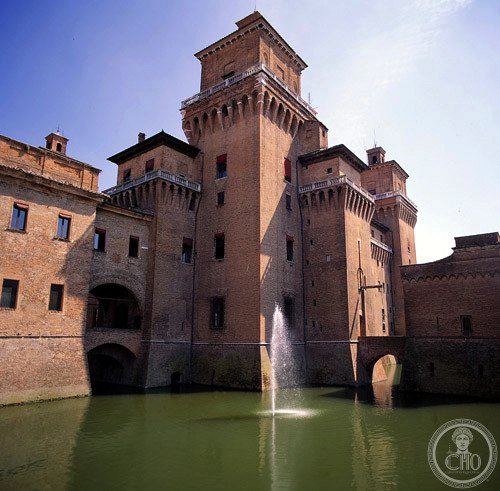
Ferrara, Province of Ferrara, Emilia-Romagna, Italy. The Castello Estense (the moated Este family castle: begun 1385 CE by Niccolò II d’Este after the execution of his nephew Niccolò III’s wife Parisina Malatesta and the marquis’s illegitimate son Ugo (who had conducted an affair with Parisina) in 1425 CE — the castle’s history is intertwined with the Este family’s most violent episode; the moat water is still raised from the Po river by a 1920s CE pump station); the Renaissance façade visible here is the result of the 15th–16th century additions by Ercole I and Alfonso I d’Este. UNESCO World Heritage Site 1995 (reference 733). Photo via Wikimedia Commons.
Ferrara, Province of Ferrara, Emilia-Romagna, Italy · Este dynasty (1240–1598 CE); Castello Estense (1385 CE); Addizione Erculea (Biagio Rossetti, 1492 CE); Ariosto (1516 CE “Orlando Furioso”); UNESCO WHS 1995 (ref 733)

Ferrara, Città del Rinascimento

Ferrara (UNESCO 1995) is the best-preserved planned Renaissance city in Italy — the Addizione Erculea (the 1492 CE urban extension designed by Biagio Rossetti for Duke Ercole I d’Este) doubled the city area overnight with straight wide boulevards and palace-lined streets laid out geometrically before any buildings were constructed, making Ferrara the first city in history to be designed on a grid plan rather than growing organically around medieval lanes.

At a glance

Ferrara (the most precisely Ferrara single Ferrara EmiliaRomagna Italy 44.8358 N 11.6198 E UNESCO WHS 1995 reference 733: the historical context: the Este dynasty (the family name: d’Este (the title comes from Este, a village in the Veneto; the Este lords of Ferrara from 1240 CE to 1598 CE were one of the most culturally productive dynasties in Italian history; their court was the patron of: Ludovico Ariosto (1474–1533 CE; author of “Orlando Furioso” (1516 CE, 38,736 lines; the most widely read poem in 16th-century Europe after Dante’s Commedia; the poem combines Arthurian romance, chivalric epic, Carolingian history, and Italian Renaissance poetry; Ariosto worked as a court secretary for Cardinal Ippolito d’Este from 1503 CE and received permission to write the poem in his spare time — the poem took 18 years to write); Matteo Boiardo (1441–1494 CE; author of “Orlando Innamorato” (1483 CE), the predecessor to Ariosto’s poem; the two poems together define the Renaissance chivalric epic tradition); Giovanni Battista Guarini (1538–1612 CE; author of “Il Pastor Fido” (1590 CE), the most influential pastoral drama of the Renaissance); Girolamo Savonarola (1452–1498 CE; born in Ferrara; the Dominican friar who organized the Bonfire of the Vanities in Florence (1497 CE) and was himself burned at the stake in the Piazza della Signoria in 1498 CE; a theological reactionary, not an Este court figure, but born and educated in Ferrara)); the Addizione Erculea (the 1492 CE urban extension: the specific event: Duke Ercole I d’Este (reigned 1471–1505 CE) commissioned the Ferrarese architect Biagio Rossetti (c.1447–1516 CE) to design a northward extension of the city that would double its area; the specific design (the Addizione uses a rectangular grid of straight boulevards — the Corso Ercole I d’Este (the main north-south axis, 30m wide), the Corso Biagio Rossetti, and the Corso Porta Po — the widest streets built in any Italian city before the 19th century); the population the Addizione was designed for (Ercole I wanted to attract wealthy families from the Veneto and Lombardy to increase the population of Ferrara from 20,000 to 50,000; he offered building lots on the new streets at nominal cost if the buyer committed to building a palace within 5 years; the Palazzo dei Diamanti (1493–1503 CE; built for Sigismondo d’Este, the duke’s brother; the facade: 8,500 diamond-pointed rusticated stone blocks that produce a shimmering effect in changing light — the most discussed Renaissance palace facade in Italy after the Palazzo Medici-Riccardi in Florence)).

Key facts

  • The Palazzo dei Diamanti (1493–1503 CE) and why the 8,500 diamond-pointed blocks create a visual effect impossible to reproduce in photographs: the Palazzo dei Diamanti (Via Corso Ercole I d’Este 21; the museum entrance for the Pinacoteca Nazionale and the exhibition spaces; €8 admission to permanent collection; free to view the exterior); the facade (the two facades — on the Corso Ercole I and on Via Corso Biagio Rossetti — have different diamond-point orientations: the Corso Ercole I facade has the diamonds oriented vertically (pointing in and out of the wall plane); the corner blocks (at the building’s angle) are rotated so the diamond points spiral around the corner — a technically demanding stone-cutting feat accomplished without precedent in the 15th century); the specific visual effect (the diamonds are cut from pink Verona marble at angles that vary by up to 5° from each other; the result is that the facade catches and reflects light differently from every angle and at every time of day — at noon, the facade is flat and pale; at 4 PM in summer, the diamonds cast shadows that make the facade appear to vibrate; at dawn on a clear day, the reflected light reaches the opposite side of the Corso Ercole I, warming the facades of the buildings across the street); the architect controversy (the building is attributed to Biagio Rossetti in all tourist and academic literature, but the primary documentary evidence (a 1492 building permit) names Sigismondo d’Este as the commissioner and does not name the architect; the attribution to Rossetti is based on stylistic comparison with other documented Rossetti buildings)
  • GPS (Castello Estense): 44.8358° N, 11.6198° E

History

From Niccolò II’s 1385 castle to the Este expulsion to 1995 UNESCO (the most precisely Ferrara single Este history: the castle (1385 CE: Niccolò II d’Este commissioned the Castello as a response to the 1385 popular revolt (the ferrarioli: the citizens of Ferrara had risen against the heavy tax burden imposed by Niccolò II; the revolt lasted 3 days before being suppressed; Niccolò II began the castle immediately after the suppression as a permanent fortified residence that could withstand a civic revolt — the moat, the drawbridges (originally 4; now 1), and the 4 corner towers are all designed for protection against an internal revolt, not against an external military attack)); the 1425 scandal (the most famous event in Este family history: Niccolò III d’Este ordered the execution of his wife Parisina Malatesta and his illegitimate son Ugo d’Este after discovering their affair; the execution was by beheading in the castle dungeons (the dungeon rooms are still visible on the guided tour; the specific room: the Camerina di Parisina); the event was the inspiration for Byron’s poem “Parisina” (1816 CE) and Donizetti’s opera “Parisina” (1833 CE))); the expulsion of the Este (1598 CE: Alfonso II d’Este died without a legitimate heir; Pope Clement VIII (the Farnese Pope; the Este had been papal vassals) refused to recognize Alfonso II’s illegitimate cousin Cesare d’Este as the new Duke; the Este moved to Modena (which they held as an imperial fief, not a papal fief); the city of Ferrara was directly administered by the Papal States from 1598 CE to 1796 CE (the Napoleonic conquest)); 1995 CE UNESCO inscription reference 733.

What you see

Castello Estense, Palazzo dei Diamanti, Cathedral facade, and Addizione Erculea boulevards (the most precisely Ferrara single visit (full day; the historic center is walkable or by bicycle (Ferrara has the highest per-capita cycling rate of any Italian city — approximately 30% of trips by bicycle; the city has 50 km of dedicated cycle lanes in the historic center); the Castello Estense (Piazza Castello; open Tue–Sun 9:30 AM–5:30 PM (last entry 5 PM); admission €9; the guided tour (€3 supplement) includes the private Este rooms (the Sala dell’Aurora: the ceiling frescoes by Camillo Filippi (1561 CE); the Camerina di Parisina (the dungeon where Parisina and Ugo were executed)); the Cathedral (Cattedrale di San Giorgio; Piazza Cattedrale; the Romanesque-Gothic facade (1135–1175 CE): one of the most complete examples of Po Valley Romanesque in northern Italy; the specific detail: the triple-loggia facade (the Wiligelmo di Modena tradition; the same workshop that carved the Modena Cathedral reliefs (1099–1106 CE)); the Palazzo dei Diamanti (free exterior view; the Pinacoteca Nazionale and the rotating exhibition spaces (the most visited cultural venue in Ferrara, with 200,000 visitors per year; the permanent collection includes the Ferrara School (Cosimo Tura, Francesco del Cossa, Ercole de’ Roberti — the three painters who defined 15th-century Ferrarese Renaissance style)); the Addizione Erculea walk (the Corso Ercole I d’Este: 800m north from the Castello to the northern city walls; the widest Renaissance boulevard in Italy; at the north end: the Porta degli Angeli (the northern gateway of the Addizione, 1494 CE; the Renaissance arch with Este heraldic devices); the Via delle Volte (the medieval street of covered porticoes (volte: barrel-vaulted bridges connecting merchant houses across the street; 600m of covered street in the oldest part of Ferrara; the specific architecture: each volte is a barrel vault of hand-made brick, typically 2.5m wide and 3m high, spanning the 3m narrow street at 1st-floor level)).

Practical information

  • Visiting Ferrara by bicycle and eating the traditional Ferrarese cuisine: bicycle rental (the city has 3 municipal bicycle rental stations (Ferrara Card includes bike rental; €10/24 hours for the card; the card includes: Castello Estense + Palazzo dei Diamanti + Cattedrale + 10 city museums; available at the main tourist office (Piazza Municipale 2)); the specific cycling circuit (old city: 2 hours at an easy pace; the Addizione Erculea circuit: 3 km; the city walls circuit (the complete 9 km perimeter of the 16th-century Ferrara city walls can be cycled on a dedicated cycle path on the top of the wall — the most unusual urban cycle route in Italy; the walls were built by Pope Clement VIII after the 1598 Este expulsion to defend the expanded city; they are the most complete preserved Renaissance city walls in Italy (the only walls higher: the Lucca walls)))); the Ferrarese cuisine (the most distinctive local specialties: (1) cappellacci di zucca (the “big hat” pasta with pumpkin and nutmeg filling; the Ferrarese version is larger than the similar tortelloni of Bologna; the best producers: the Osteria Al Brindisi (Via degli Adelardi 11; the oldest taverna in Europe — open since 1435 CE (the claim is supported by a 1435 CE document showing the presence of a taverna in this location); the taverna served Ariosto, Copernicus (who studied at the University of Ferrara 1496–1497 CE), and Cellini)); (2) pampapato (a spiced chocolate-and-pepper dome cake with almonds and orange peel; the Ferrarese Christmas cake; produced year-round by the Pasticceria Orsatti and the Pasticceria Gruneisen in the city center); (3) salama da sugo (a large pork sausage seasoned with red wine, nutmeg, cinnamon, cloves, and pepper, then fermented for 1 year and cooked for 6 hours; the most distinctive meat product of the Ferrara area)

Getting there

Frecciarossa/Intercity from Bologna (30 min, €8-15). From Venice: Intercity (1h20, €12). From Milan: Frecciarossa to Bologna + regional (2h total). Ferrara Card: €10/24h (all museums + bike). GPS: 44.8358, 11.6198.

Nearby

  • Ravenna — 75 km southeast (UNESCO WHS 1996 (ref 788); 8 Byzantine mosaic monuments; the most important: Mausoleo di Galla Placidia (430 CE; the deepest blue in ancient mosaic art) and Basilica di San Vitale (547 CE; Justinian and Theodora mosaics); Trenitalia from Ferrara 1h10)
  • Comacchio — 30 km east (the “little Venice” of the Po Delta; the Trepponti (the 17th-century five-arch bridge over 3 canals); the eel valleys (the valli di Comacchio: the Po Delta lagoons used for eel farming since the Roman period; the most famous product: eel in vinegar (anguilla marinata) — the Comacchio specialty sold at the valley farms in autumn); part of the Ferrara UNESCO inscription (the Po Delta extension, added to the inscription in 1999 CE))

Sources

  • Wikipedia, Ferrara; Castello Estense; Palazzo dei Diamanti; Biagio Rossetti; Ludovico Ariosto, accessed June 2026
  • UNESCO, Ferrara, City of the Renaissance and its Po Delta, WHS reference 733, inscribed 1995 (extension 1999)
  • Gruyer, Gustave. L’art ferrarais à l’époque des princes d’Este. Paris: Plon, 1897 (2 vols; still the primary scholarly survey of Ferrarese Renaissance art)

Hero image: Ferrara, Emilia-Romagna, Italy, Wikimedia Commons. Editorial text © Cultural Heritage Online, 2026.

📷 Diventa un fotografo di Cultural Heritage Online

Condividi le tue foto dei luoghi: restano pubblicate con la tua firma come autore. Più vengono viste, più ti fai conoscere — e presto un concorso premierà le foto più apprezzate.

Accedi o registrati gratis per aggiungere una foto
📋 Copy & share on social
Scroll to Top