
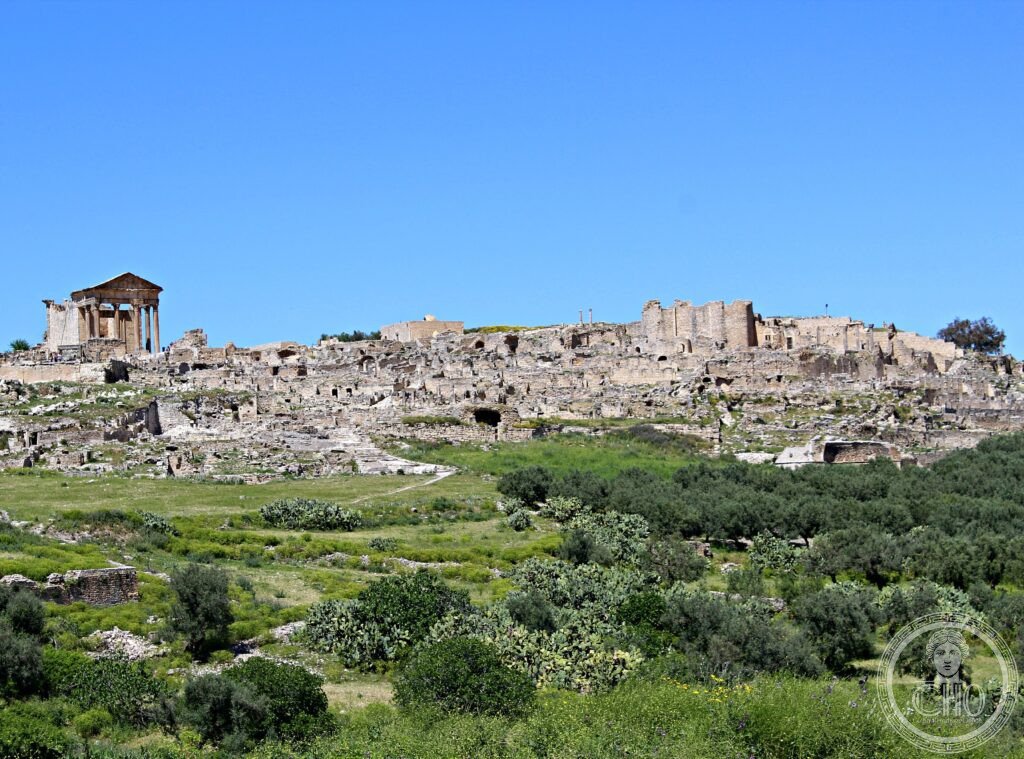
Dougga (Thugga)

Dougga Tunisia Thugga Roman city North Africa Capitol Temple Baths Theatre UNESCO
The Capitolium of Dougga (Thugga; the three-columned portico of the Capitol Temple (166-167 CE; dedicated to the Capitoline Triad: Jupiter, Juno, and Minerva; the three surviving Corinthian columns 10m high; the pediment frieze; one of the best-preserved Roman temples in North Africa); in the background: the Punic-Numidian tower-mausoleum of Ateban (2nd century BCE; the only surviving example of a Numidian royal funeral monument with an intact upper section); the undulating fertile hills of the Oued Khalled valley (the Bagradas river valley of antiquity)), Dougga, Béja Governorate, northwest Tunisia. UNESCO World Heritage Site 1997. Photo via Wikimedia Commons.
Béja Governorate, northwest Tunisia · Roman Thugga; best-preserved Roman city in North Africa; Numidian-Libyco-Punic layers; UNESCO WHS 1997

Dougga (Thugga)

The most beautifully preserved Roman provincial city in all of North Africa — Dougga (Roman Thugga; UNESCO WHS 1997) is a hilltop city 110 km southwest of Tunis where the Roman urban fabric (the Capitol, the Theatre, the Forum, the baths, the triumphal arch, and 3,000 residential units) survives on its original hillside terrain, and where pre-Roman Numidian and Punic layers are visible beneath the Roman construction in a way not found at Carthage, Leptis Magna, or Volubilis.

At a glance

Dougga (the most precisely DouggatTunisia single Béja Governorate northwest Tunisia 110 km southwest Tunis 65 km Béja town capital governorate 567m above sea level undulating agricultural hill country Oued Khalled valley below fertile grain-producing Bagradas Valley antiquity grain-producing region North Africa breadbasket of Roman Empire Tunisia Algeria ancient Numidia Punic Carthage overlap area Dougga area Numidian kingdom before Roman conquest 150 BCE Numidia under Massinissa king 202 BCE after Second Punic War 46 BCE Numidia incorporated Roman province Africa Nova Julius Caesar 29 BCE merged Africa Proconsularis 66 CE Thugga Roman municipium 261 CE Colonia Licinia Septimia Aurelia Alexandriana Thugga full Roman colony status 5500 hectares territory 25000 population at peak Roman period 4th 5th century CE Vandal conquest 533 CE Byzantine reconquest Justinian 647 CE Arab conquest Islamic period 1000 1500 CE medieval Arabic settlement occupied part of Roman site UNESCO heritage in any UNESCO world heritage site)).

Key facts

  • Why Dougga is better preserved than Leptis Magna, Volubilis, and Carthage: the four major Roman sites of North Africa (Carthage (Tunisia), Leptis Magna (Libya), Volubilis (Morocco), and Dougga (Tunisia)) have dramatically different preservation conditions; Dougga’s extraordinary survival has three causes: (1) continuous occupation only in the lower part of the hill — the Roman urban core on the upper plateau was not reoccupied after the 12th century CE, so it was not quarried for later construction (unlike Carthage, whose marble was systematically reused for Tunis and Kairouan until the 19th century CE); (2) the original Roman buildings were set into the rock of the hillside, not on a flat plain — the terrain itself protected the foundations; (3) the site was buried under soil (rather than sand) and vegetation for 800 years before the 19th century CE French excavations — the soil burial is gentler on stonework than desert sand erosion; the result is that Dougga retains standing walls, original street paving, intact theatrical architecture, and a Capitol Temple portico that has not been substantially reconstructed — a rarity in North African Roman archaeology
  • GPS: 36.4224° N, 9.2198° E

History

From Berber-Numidian hilltop to Punic city to Roman colony to medieval abandonment (the most precisely DouggatTunisia single 4th 3rd century BCE Numidian pre-Roman settlement Thugga Berber Numidian settlement hilltop 2nd century BCE Numidia under Massinissa Numidian kingdom most powerful North Africa after Second Punic War 202 BCE Massinissa Roman ally 202 BCE Numidia Berber-Numidian culture Punic influence Punic script language used alongside Berber Libyco-Punic script bilingual inscriptions Dougga important: Dougga bilingual inscription discovered 19th century CE same text in Punic and Libyco-Berber script allowed decipherment of Libyco-Berber (Tifinagh ancestor) script one of key discoveries Semitic linguistics 46 BCE Julius Caesar defeated Pompeian forces at Thapsus Africa Nova Roman province 25 BCE Thugga pagus part of rural territory of Carthage 66 CE municipium urban status 166 167 CE Capitol Temple construction under Marcus Aurelius Lucius Verus joint emperors 188 CE Theatre of Dougga construction under Commodus 261 CE full colony status Colonia Licinia 3rd 4th century CE peak prosperity wine olive oil grain export 439 CE Vandal kingdom Carthage Thugga Vandal period 533 CE Byzantine Justinian reconquest North Africa 647 CE Arab conquest Islamic period first Arab raids reach Tunisia 698 CE Arab conquest permanent Kairouan established new capital 698 CE Thugga declined reduced population 7th 12th century CE decline abandonment upper Roman site small medieval settlement continued in lower town 1881 CE French Protectorate Tunisia French colonial administration 1891 CE French archaeologists begin systematic excavation Dougga 1997 CE UNESCO heritage: the Libyco-Punic bilingual inscription of Dougga (how a small Tunisian hilltop city cracked the Berber writing system): in the 1st century BCE, a monument was erected in Dougga honouring a local benefactor named Ateban in two scripts (Punic Semitic and Libyco-Berber script); this bilingual inscription, discovered in 1631 CE and removed to the British Museum in 1842 CE, provided linguists the key to deciphering Libyco-Berber script (the ancestor of the Tifinagh script still used today by Tuareg people across the Sahara); without the Dougga bilingual inscription, the Tifinagh-Berber script family would have remained undeciphered through the 19th and early 20th century CE — making it one of the most consequential ancient documents for the study of North African languages)) — the most precisely DouggatTunisia single 2nd century BCE Numidian Massinissa 46 BCE Africa Nova Caesar 66 CE municipium 166 167 CE Capitol Marcus Aurelius Lucius Verus 188 CE Theatre Commodus 261 CE full colony 439 CE Vandal 533 CE Byzantine Justinian 647 698 CE Arab Kairouan established Thugga declined 1631 CE bilingual inscription discovered 1842 CE British Museum Libyco-Berber decipherment ancestor Tifinagh Tuareg Sahara 1997 CE UNESCO heritage in any UNESCO world heritage site)).

What you see

The Capitol Temple, the Theatre, the Numidian mausoleum, and the street network (the most precisely DouggatTunisia single Capitol Temple 166 167 CE Marcus Aurelius Lucius Verus Capitoline Triad Jupiter Juno Minerva three Corinthian columns surviving 10m height pediment arch frieze eagle best-preserved Roman Capitol Temple North Africa Roman Forum behind Capitol original paving visible stones Temple Juno Caelestis (third century CE circular colonnade around a small cella unusual circular plan unique North Africa Dougga Theatre 188 CE Commodus 3500 seating capacity carved into natural hillside semi-circular cavea original seating good condition stage backdrop scaenae frons partial surviving columns best-preserved theatre North Africa compared to Aspendos or Orange or Bosra Dougga theatre shows visible decay from 18th 19th century souvenir-hunting loss of carved stone blocks Arch of Septimius Severus 205 CE triumphal arch single arch good stone condition Libyco-Punic Mausoleum of Ateban 2nd century BCE only surviving example of a Numidian royal tower-mausoleum three storeys partly restored in 19th century pilasters carvings upper section unique Numidian architectural hybrid Punic Egyptian Greek influences Brothel Lupanare Dougga well-preserved Roman brothel explicit carved stone inscription identifying rooms functions Bath of Licinius 3rd century CE large late imperial bath complex mosaic floors partially intact Trifolium House one of largest Roman private houses North Africa 3 atriums UNESCO heritage: the extraordinary survival of Dougga’s original Roman street network (why you can walk exactly where Romans walked): unlike Pompeii (where the streets are preserved but the buildings are only partially surviving roofless shells) or Leptis Magna (where the monumental buildings survive but the residential areas are buried), Dougga preserves an unusual combination: the full original Roman street network (the cardines and decumani — the north-south and east-west axes of Roman urban planning; the street widths; the original basalt paving stones with the chariot-wheel ruts) remains as the organizing structure of the visible site, and three-dimensional residential buildings (standing walls, intact thresholds, original door positions) line the streets; the result is that a visitor walks through Dougga’s original Roman street grid in a way that is not possible at any other North African Roman site)) — the most precisely DouggatTunisia single Capitol 166 167 CE three Corinthian 10m columns best-preserved North Africa Capitol Theatre 188 CE Commodus 3500 seats hillside cavea best-preserved North Africa theatre loss souvenir hunters 18th 19th century arch Septimius Severus 205 CE Mausoleum Ateban 2nd century BCE only surviving Numidian tower royal mausoleum three storeys unique hybrid Punic Egyptian Greek Brothel Lupanare explicit stone carving Bath Licinius mosaic Trifolium House 3 atriums street network cardines decumani basalt paving chariot ruts 3D residential walls intact thresholds UNESCO heritage in any UNESCO world heritage site)).

Practical information

  • Getting there: from Tunis: public bus or louage (shared taxi) from Bab Saadoun bus station in Tunis to Téboursouk (2h; TND 8/€2.50); then local taxi to Dougga site (10 km; TND 15/€5); or organised day tour from Tunis (€40-60 including transport and guide; available from Tunis medina tourist agencies); by car from Tunis: 110 km, 1h30m on the A3 motorway then P5 road; recommended as it allows visiting both Dougga and the nearby site of Bulla Regia (20 km; underground Roman villas with floor mosaics still in situ in underground rooms built to escape summer heat — the most unusual Roman site in Tunisia) in the same day; site entry: TND 8/€2.50; site open 8:30 AM-5:30 PM (winter), 8:30 AM-7 PM (summer); good shade trees throughout the site; comfortable walking; allow 2-3h for the main monuments; bring water as there is no cafe on site in 2026 (a new visitor centre was under construction in 2024); best time (March-May and September-November: the site is fully exposed on a hillside in a hot summer climate; July-August midday is genuinely uncomfortable; spring wildflowers across the site (March-April) are spectacularly beautiful with Roman ruins framed by red poppies and asphodel))

Getting there

From Tunis: bus to Téboursouk 2h (TND 8) + taxi 10 km (TND 15); or day tour €40-60; or car 110 km (1h30m). Site TND 8/€2.50, open 8:30 AM-7 PM (summer). Allow 2-3h. Best: March-May, September. Bring water (no cafe on site). GPS: 36.4224, 9.2198.

Nearby

  • Bulla Regia — 20 km north (the Roman site with underground villas: wealthy Romans in the 2nd-4th century CE built the ground floor of their villas underground (accessible by stairs) to escape the North African summer heat; the underground rooms preserve intact floor mosaics (some of the finest in North Africa) still in situ in the rooms for which they were made — the only site in the Roman world where mosaics survive in their original underground context; combination with Dougga is the best single day of Roman archaeology in Tunisia)
  • Carthage — 110 km south-east (UNESCO WHS 1979; the city that challenged Rome for Mediterranean supremacy (264-146 BCE; the three Punic Wars); founded by Phoenician settlers from Tyre (traditionally 814 BCE); razed by Rome in 146 BCE; refounded as a Roman colony by Julius Caesar 44 BCE and Augustus 29 BCE; the Antonine Baths (the third-largest Roman baths in the world after Caracalla and Diocletian in Rome); the Byrsa Hill Punic quarter; the National Museum of Carthage; the Bardo National Museum in Tunis (the finest collection of Roman floor mosaics in the world, mostly from Tunisian Roman sites — the single most important museum for understanding Roman North African visual culture))

Sources

  • Wikipedia, Dougga; Thugga; Libyco-Berber script; Capitolium of Dougga, accessed June 2026
  • UNESCO, Dougga / Thugga, WHS reference 794rev, inscribed 1997

Hero image: Dougga (Thugga), Tunisia, Wikimedia Commons. Editorial text © Cultural Heritage Online, 2026.

📷 Diventa un fotografo di Cultural Heritage Online

Condividi le tue foto dei luoghi: restano pubblicate con la tua firma come autore. Più vengono viste, più ti fai conoscere — e presto un concorso premierà le foto più apprezzate.

Accedi o registrati gratis per aggiungere una foto
📋 Copy & share on social
Scroll to Top