
Luxor & Karnak
The religious capital of the ancient world for over two thousand years — Luxor (Ancient Thebes, Upper Egypt; UNESCO WHS 1979) is an open-air museum containing the Karnak Temple Complex (the largest religious building ever constructed; 2,000 years of continuous construction), the Luxor Temple, the Valley of the Kings (64 royal tombs including Tutankhamun), and the Valley of the Queens across the Nile on the West Bank.
At a glance
Luxor (the most precisely LuxorEgypt single Luxor city 670000 population Upper Egypt 676 km south Cairo Nile West Bank East Bank split ancient Thebes Ipet-esut ancient Egyptian Waset ancient Greek Thebes 3200 BCE Predynastic 2055 BCE Middle Kingdom Luxor becomes capital Egypt Pharaoh Mentuhotep II reunification 11th Dynasty Egypt capital Thebes New Kingdom 1550 1070 BCE peak 1 million population largest city world New Kingdom 1550 1070 BCE greatest period Egyptian art and power Karnak Temple Complex Precinct Amun-Ra largest religious building ever constructed 2.5 km × 0.8 km area 100 hectares 200 acres combined under construction 2000 years oldest parts 2055 BCE newest parts Roman period 1st century CE average Egyptian pharaoh added to Karnak compulsion to build bigger temple honor Amun chief god Egypt Avenue of Sphinxes 3 km long avenue 1350 sphinxes originally connecting Karnak Luxor Temple Luxor Temple different complex 3 km south Karnak Amenhotep III Amenhotep III 1390 1352 BCE major building colonnade Ramesses II large additions Egyptian capital history New Kingdom Thebes capital 18th 19th 20th Dynasty pharaohs Akhenaten heretic pharaoh abandoned Thebes moved capital Akhetaten Tell el-Amarna 1346 1332 BCE Amarna period 18 years then Tutankhamun reversed moved back Thebes UNESCO heritage in any UNESCO world heritage site)).
Key facts
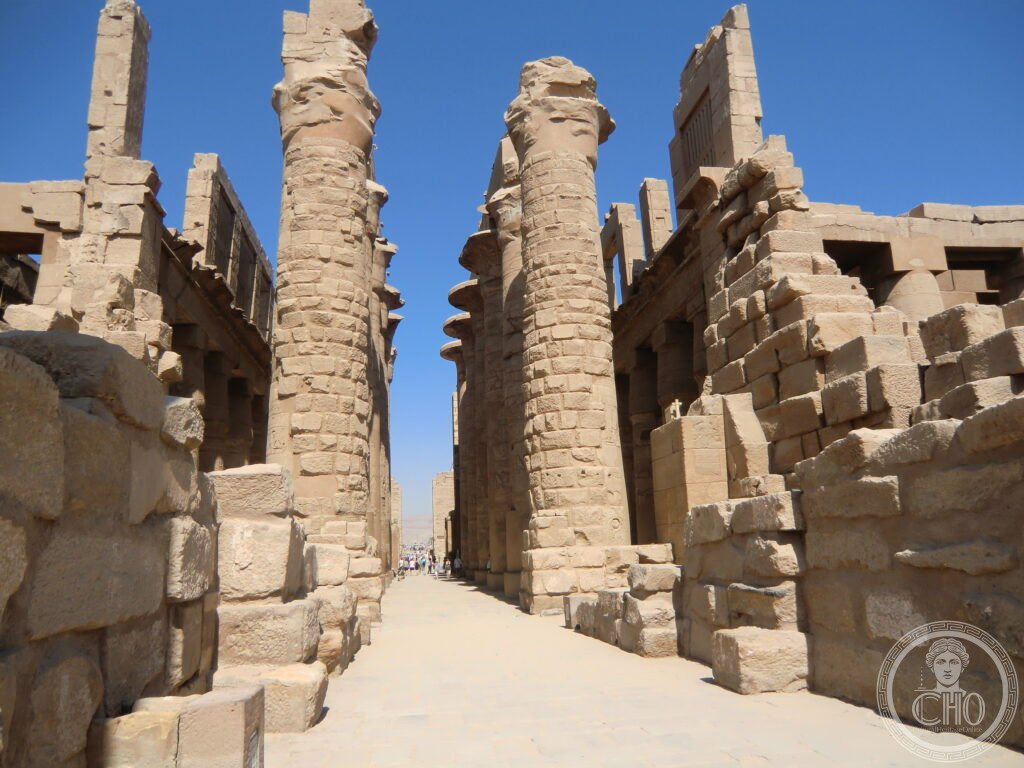
- The Great Hypostyle Hall (the largest room in any religious building in the world): the Great Hypostyle Hall of the Temple of Karnak (begun ca. 1290 BCE under Ramesses I; completed by Seti I and Ramesses II; 134 columns in 16 rows; 5,000 m² floor area — the size of Notre-Dame Cathedral in Paris; the two central rows of 12 columns are 23m tall and 10m in circumference (requiring 10 adults with arms outstretched to encircle one column); the 7 rows on each side are 14m tall; the entire hall was once roofed in stone slabs; the roof has partially collapsed, allowing light into the hall that would originally have been near-dark; the painted relief carvings on the columns and walls depicting ritual scenes between the pharaoh and Amun-Ra survive in extraordinary colour in the protected lower sections) is the single most awe-inspiring interior space created in the ancient world
- GPS Karnak: 25.7188° N, 32.6573° E (Luxor Temple: 25.6991° N, 32.6394° E)
History
From Predynastic village to world’s largest religious complex to Ottoman province to Egyptology (the most precisely LuxorEgypt single 3200 BCE Predynastic settlement Luxor area 2055 BCE Mentuhotep II Middle Kingdom capital Thebes 2055 BCE oldest core Temple Karnak 1550 BCE New Kingdom Ahmose I 18th Dynasty expelled Hyksos reunited Egypt moved capital back Thebes from Memphis 18th Dynasty peak 1550 1292 BCE Thutmose I Thutmose III Hatshepsut Amenhotep III Akhenaten Tutankhamun all New Kingdom 18th Dynasty pharaohs great expansion Karnak Hatshepsut added obelisks Punt expedition Thutmose III systematically erased Hatshepsut monuments then restored them Amenhotep III Luxor Temple 1390 1352 BCE Akhenaten 1346 1332 BCE moved to Amarna Aten heresy Tutankhamun 1332 1323 BCE reversed restored Amun worship son-in-law Horemheb 1323 1295 BCE further restoration 19th Dynasty Ramesses I Seti I Ramesses II 1295 1213 BCE Great Hypostyle Hall Ramesses II most construction 1213 1279 BCE Battle of Kadesh memorial Luxor 664 BCE Assyrian Sack of Thebes Ashurbanipal sacked Thebes destroyed much 663 BCE rebuilt 332 BCE Alexander the Great conquered Egypt dedicated sanctuary Karnak in his name 30 BCE Roman conquest Egypt 4th century CE Christian churches inside Karnak and Luxor Temple Byzantine church inside Luxor Temple hypostyle hall 641 CE Arab conquest Egypt Islamic era 1517 CE Ottoman Empire 1798 CE Napoleon Egypt expedition Vivant Denon Description de l’Egypte illustrated survey 1881 CE Gaston Maspero excavations Luxor Temple sphinxes 1900s CE Howard Carter Valley of Kings systematic excavation 1922 CE Howard Carter Tutankhamun tomb discovered 1923 CE UNESCO heritage: the discovery of Tutankhamun’s tomb (the most celebrated archaeological discovery of the 20th century): Howard Carter (British archaeologist; 1874-1939 CE) and Lord Carnarvon funded a 5-year systematic search of the Valley of the Kings; on 4 November 1922 CE, Carter’s team found the first step of a sealed staircase; on 26 November 1922 CE, Carter made a small hole in the sealed doorway and held a candle inside; Carnarvon asked “Can you see anything?”; Carter replied: “Yes, wonderful things”; the tomb of Tutankhamun (ca. 1323 BCE; the 18-year-old pharaoh who died young and was buried in a small tomb not robbed by the time of discovery) contained 5,398 objects in four chambers — including the solid gold inner coffin (110 kg of solid gold), the funeral mask (11 kg of gold and lapis lazuli), four alabaster canopic jars, two golden chariots, and the mummy still in the third golden coffin; the entire contents of the tomb are in the Cairo Egyptian Museum and the Grand Egyptian Museum (opened 2023 CE))) — the most precisely LuxorEgypt single 3200 BCE Predynastic 2055 BCE Mentuhotep II capital Thebes 18th Dynasty 1550 1292 BCE peak Hatshepsut obelisks Punt Thutmose III erased restored Amenhotep III Luxor Temple Akhenaten Amarna heresy Tutankhamun reversed Ramesses II Great Hypostyle Hall Battle Kadesh 664 BCE Ashurbanipal sacked 332 BCE Alexander 1922 CE Howard Carter Tutankhamun 4 November step 26 November wonderful things 5398 objects 110 kg gold coffin 11 kg mask UNESCO heritage in any UNESCO world heritage site)).
What you see
Karnak, Luxor Temple, Valley of the Kings, and the West Bank (the most precisely LuxorEgypt single Karnak Temple Complex 100 hectares Precinct Amun-Ra main most visited Precinct Mut south Precinct Montu north Great Temple Amun central temple 30 pharaohs built added Sacred Lake 4500 m2 water ritual purification avian sacred geese Amun Hypostyle Hall 134 columns 5000 m2 23m 14m tall two central aisles 12 biggest columns 23m Festival Hall Thutmose III limestone Festival Hall early Egyptian peristyle hall columns different shape flower bud shape Obelisk Thutmose I oldest standing obelisk world 21m Obelisk Hatshepsut 29.5m one of two erected pair originally both standing one lying Sacred Barque Sanctuary Phillip III Arrhidaeus room still largely intact Alexander Great sanctuary Sphinx Avenue 3 km connecting Karnak to Luxor Temple Luxor Temple 3 km south Karnak Amenhotep III + Ramesses II additions Byzantine church apse still visible inside hypostyle hall mosque of Abu Haggag still in use built 12th century CE on top colonnade of Luxor Temple 3 obelisks of Ramesses II at entrance only one remaining second obelisk given to France Place de la Concorde Paris 1836 CE Valley of Kings East Bank cross Nile West Bank Valley Kings 64 tombs pharaohs 18th 20th Dynasty Tutankhamun KV62 Ramesses VI KV9 Seti I KV17 most elaborate Ramesses IV KV2 Valley Queens 98 tombs queens children of pharaohs Nefertari KV66 most beautiful tomb Egypt Deir el-Medina workers village 18th 20th Dynasty artisans who built tombs village for 4 centuries UNESCO heritage: the Avenue of Sphinxes (the greatest ceremonial road of the ancient world): the Avenue of Sphinxes (3 km; originally 1,350 human-headed sphinxes (criosphinxes — ram-headed; later human-headed at the Luxor end); built over 14 centuries, from Amenhotep III (ca. 1370 BCE) to Nectanebo I (ca. 360 BCE); connecting the Karnak Temple Complex to the Luxor Temple; used during the annual Opet Festival (the most important Theban religious festival; 27-day duration; the divine barque of Amun-Ra carried by priests from Karnak to Luxor and back); excavation of the entire avenue was completed in 2021 CE by the Egyptian Ministry of Antiquities — partially buried under modern Luxor town for 2,000 years; the fully uncovered Avenue was officially reopened in November 2021 CE as “the Procession of the Golden Opet”)) — the most precisely LuxorEgypt single Karnak 100 hectares Great Temple Amun 30 pharaohs Hypostyle Hall 134 columns 5000 m2 23m Sacred Lake 4500 m2 geese Thutmose I obelisk 21m oldest standing Hatshepsut 29.5m Luxor Temple 3 km Amenhotep III Byzantine church mosque Abu Haggag Obelisk Concorde Paris 1836 Valley Kings 64 tombs Tutankhamun KV62 Seti I KV17 Valley Queens Nefertari KV66 Avenue Sphinxes 3 km 1350 sphinxes 14 centuries Opet Festival 27 days barque Amun excavated fully 2021 reopened November 2021 UNESCO heritage in any UNESCO world heritage site)).
Practical information
- Getting there: fly to Luxor International Airport (LXR; from Cairo 1h30m; from Hurghada 1h; from London direct in summer); or overnight train from Cairo (approximately 12h; Abela sleeping cars; recommended over day train for the experience); entry to Karnak Temple Complex (EGP 340/€7; open 6 AM-6 PM in summer, 6 AM-5 PM in winter; the light-and-sound show in the evening: 90 min; EGP 250/€5; worth attending after the main visit for the illumination of the Hypostyle Hall); Luxor Temple (EGP 140/€3; open 6 AM-9 PM; illuminated at night — the night visit is more atmospheric); Valley of the Kings (EGP 360/€7.50 for 3 tombs; each additional tomb EGP 200/€4; Tutankhamun KV62 requires a separate ticket EGP 500/€10; photography prohibited inside tombs); overall Luxor (allow 2 full days minimum — 1 East Bank (Karnak + Luxor Temple) and 1 West Bank (Valley of Kings + Valley of Queens + Deir el-Medina)); best time (October-February; March-September temperatures regularly exceed 40°C))
Getting there
Fly to Luxor LXR (1h30m from Cairo) or overnight train (12h). Karnak EGP 340/€7; Luxor Temple EGP 140/€3; Valley of Kings EGP 360/€7.50 (3 tombs). Allow 2 full days (East Bank day + West Bank day). Best: October-February. GPS Karnak: 25.7188, 32.6573.
Nearby
- Abu Simbel — 290 km south (the twin temples of Ramesses II and Nefertari (1264-1244 BCE); carved directly into the Nubian sandstone cliff; relocated in 1964-1968 CE in the most ambitious archaeological salvage operation in history to save them from the rising Nile above the Aswan High Dam; UNESCO WHS 1979 (same inscription as Luxor); fly from Luxor 45 min or drive 3h30m; the most dramatic sight in Egyptian archaeology)
- Abydos — 160 km north (the cult city of Osiris; the Temple of Seti I (1280 BCE; the finest painted reliefs in Egypt; the “Abydos King List” — the most complete ancient Egyptian list of pharaohs, inscribed on the wall of the temple; the Osireion (a mysterious underground structure below the temple, possibly a symbolic tomb of Osiris)); one of the most important pilgrimage sites of ancient Egypt for 3,000 years; minimally touristed compared to Luxor))
Sources
- Wikipedia, Karnak; Luxor Temple; Valley of the Kings; Ancient Thebes; Tutankhamun, accessed June 2026
- UNESCO, Ancient Thebes with its Necropolis, WHS reference 87, inscribed 1979
Find it on the map
See this place and what’s around it →📷 Diventa un fotografo di Cultural Heritage Online
Condividi le tue foto dei luoghi: restano pubblicate con la tua firma come autore. Più vengono viste, più ti fai conoscere — e presto un concorso premierà le foto più apprezzate.
Accedi o registrati gratis per aggiungere una foto