
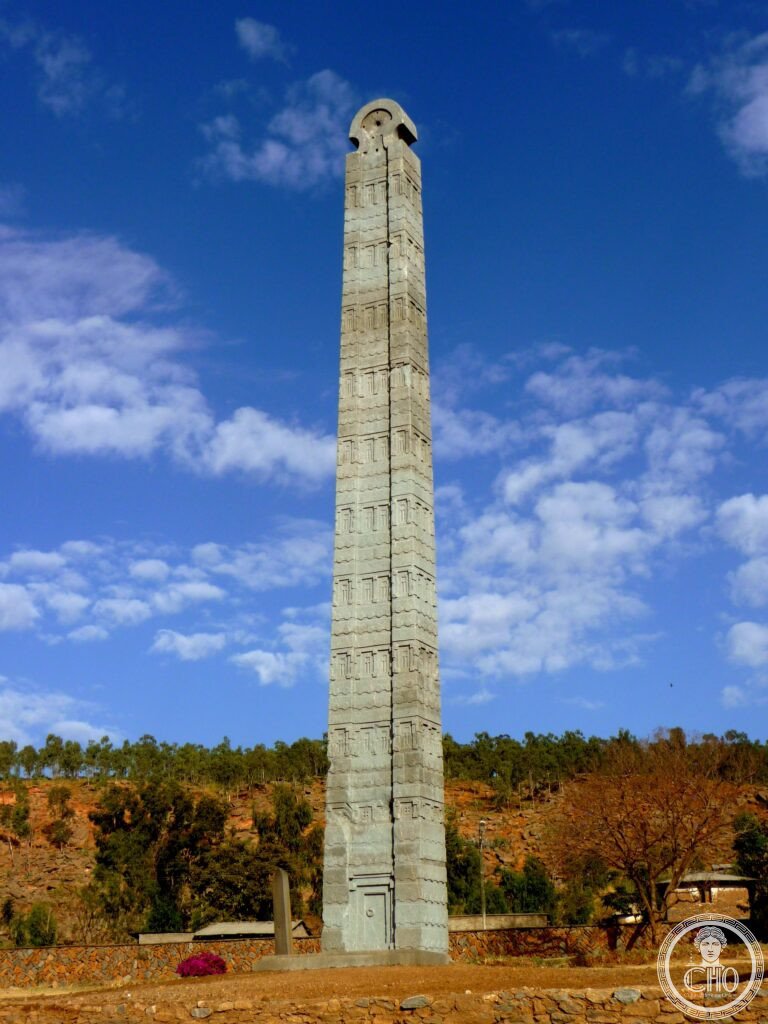
Aksum was the capital of the kingdom UNESCO calls the most powerful state between the Eastern Roman Empire and Persia — an African trading empire that struck its own gold coinage, adopted Christianity in the fourth century, and raised the giant carved stelae that still dominate the town. Ethiopian tradition adds a further claim: that the Ark of the Covenant rests here, in a chapel beside the Church of Our Lady Mary of Zion.
At a glance
From roughly the first century CE, the Kingdom of Aksum grew rich controlling trade between the Roman world, Arabia, India and inner Africa through its Red Sea port of Adulis. The third-century prophet Mani is recorded as counting Aksum among the four great kingdoms of the earth, alongside Rome, Persia and China. Its rulers were among the first anywhere to place the Christian cross on their coins.
The ruins — monolithic stelae, royal tombs, palace foundations — span the first to the thirteenth centuries and were inscribed on the UNESCO World Heritage List in 1980. Aksum remains the holiest city of Ethiopian Christianity.
Key facts
- Kingdom: the Aksumite state flourished from around the 1st century CE, controlling Red Sea trade through the port of Adulis
- Stelae: erected in the 3rd and 4th centuries CE as funerary markers for the kingdom’s elite; the largest standing stele rises over 23 metres, carved as a nine-storey building
- The Great Stele: some 33 metres long and among the largest monoliths ever quarried, it lies where it is believed to have fallen during erection
- Christianity: adopted under King Ezana in the 4th century, with Frumentius as first bishop
- The Obelisk of Aksum: removed to Rome on Mussolini’s orders in 1937, returned in 2005 and re-erected in 2008
- Heritage status: UNESCO World Heritage Site, inscribed 1980 (ref. 15)
History
Aksum rose in the highlands of Tigray as heir to older South Arabian-influenced cultures of the region, and by the early centuries CE had become the hub of a trading empire exporting ivory and gold through Adulis. Its kings struck gold, silver and bronze coinage — the earliest sub-Saharan African coins — and left inscriptions in Ge’ez, Sabaean and Greek, of which the trilingual Ezana Stone is the most famous.
In the fourth century King Ezana adopted Christianity, making Aksum one of the earliest Christian states; the cross replaced older symbols on the coinage. In the sixth century King Kaleb campaigned across the Red Sea in Yemen. With the rise of Islam the kingdom’s maritime trade withered, and power drifted south over the following centuries, eventually to the Zagwe dynasty of Lalibela — but Aksum kept its sacred primacy: Ethiopian emperors down to the twentieth century sought coronation here.
The Ethiopian national epic, the Kebra Nagast, ties the city to the Queen of Sheba and King Solomon, and holds that their son Menelik brought the Ark of the Covenant to Aksum, where the church guards it to this day — a tradition central to Ethiopian identity, upheld by a single guardian monk, and never opened to outside verification.
What you see
The Northern Stelae Field is the heart of the site: a forest of granite monoliths raised over the tombs of Aksumite rulers. The finest, carved with false doors and rows of windows imitating multi-storey palaces, include the returned Obelisk of Aksum and the largest standing stele at over 23 metres. Beside them lies the shattered Great Stele, a reminder of the engineering limit the kingdom finally met.
Beneath and around the field are royal tombs — the Tomb of the Brick Arches and the Tomb of the False Door among them — and further out lie palace ruins and the tombs associated with Kings Kaleb and Gebre Meskel. The Ezana Stone records the kingdom’s conversion in three scripts.
The Church of Our Lady Mary of Zion complex holds both the old church rebuilt in the seventeenth century and the modern cathedral raised beside it in the 1960s; between them stands the Chapel of the Tablet, where the Ark is said to rest.
Practical information
- Visiting: the main monuments are close together in the modern town; a local guide is worthwhile, especially for the tombs
- Season: the dry months from roughly October to March are the most comfortable
- Security: the Tigray Region has seen recent conflict — check your government’s current travel advice before planning a visit
Getting there
Aksum has its own airport, served by domestic flights from Addis Ababa. The town sits in the far north of Ethiopia, and air travel is the practical approach for most visitors. GPS: 14.1280, 38.7227.
Nearby
- Yeha — east of Aksum, the pre-Aksumite temple of the moon god Almaqah, among the oldest standing structures in sub-Saharan Africa
- Adwa — the town and battlefield where Ethiopia defeated the Italian invasion of 1896
- Debre Damo — clifftop monastery of the Aksumite era, reached by rope, traditionally open to men only
- Lalibela — far to the south-east, the rock-hewn churches of Aksum’s spiritual successors, a UNESCO World Heritage Site
Sources
- UNESCO World Heritage Centre — Aksum (ref. 15); Aksum Obelisk return and re-erection project
- Encyclopaedia Britannica — Aksum; Kingdom of Aksum; Ezana
Find it on the map
See this place and what’s around it →📷 Become a Cultural Heritage Online photographer
Share your photos of places: they stay published under your name as the author. The more they're seen, the more you get noticed — and soon a contest will reward the most appreciated photos.
Log in or sign up free to add a photoDo you manage this place?
This page is read by travellers and heritage enthusiasts who find it on Google. Keep it accurate — and make it work for you. Free for non-profit heritage institutions.