
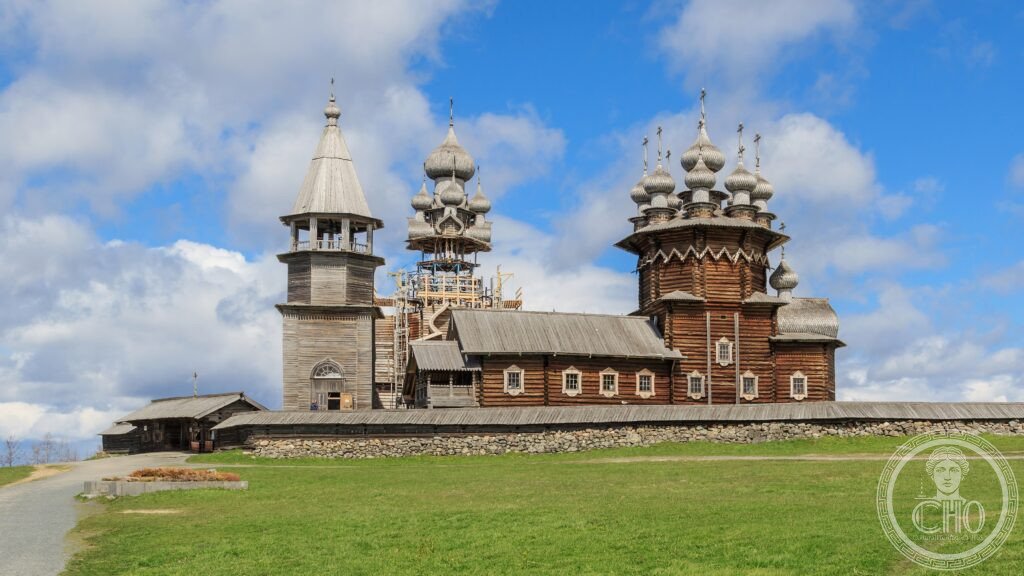
On a narrow island in Lake Onega stands the most accomplished surviving example of Russian Orthodox wooden architecture: the Church of the Transfiguration, raised in 1714 without a single metal nail in its log walls, its twenty-two aspen-shingled domes rising above the water. Together with its sister church and bell tower it forms the walled Kizhi Pogost.
At a glance
Kizhi is an island in the southern part of Lake Onega, the largest lake in Europe, within the Republic of Karelia. Roughly 5km by 1.5km, it can only be reached by water, by ferry from Petrozavodsk. The island is an open-air museum, with around eighty historic timber buildings brought here from across Karelia and the Komi region, alongside the original Kizhi Pogost structures.
At the heart of the pogost stands the Church of the Transfiguration, built in 1714, its twenty-two onion domes rising over six octagonal tiers to a height of 37 metres. It has no heating and is used only in summer. The smaller, nine-domed Church of the Intercession, built in 1764 and heated, served through the winter. A bell tower dating from 1842 stands between them, all enclosed by the white timber fence of the pogost.
Key facts
- Location: Kizhi island, Lake Onega, Republic of Karelia, Russia
- Church of the Transfiguration: built 1714, 37 metres tall, 22 onion domes over six octagonal tiers
- Construction: horizontal log walls joined with the “oblo” corner notch, without metal fasteners; domes covered in hand-cut aspen shingles
- Church of the Intercession: built 1764, nine domes, heated and used in winter
- Status: inscribed on the UNESCO World Heritage List in 1990
- Coordinates: 62.0685° N, 35.2258° E
History
Finno-Ugric Veps and Karelian peoples settled the island from the early medieval period. The name Kizhi may come from a Veps word for games, suggesting the island once hosted pre-Christian midsummer gatherings. A pogost, a walled Orthodox enclosure holding a church, bell tower and cemetery, is recorded on the site from at least the 14th or 15th century; the buildings standing today are the fourth generation to occupy it.
The Church of the Transfiguration carries the date 1714 from an inscription, though no architect is documented. A later legend holds that the master builder threw his axe into the lake once the church was finished, declaring that nothing like it would ever be built again. The Church of the Intercession followed in 1764, and the bell tower was added in 1842.
In 1937 the Soviet authorities closed Kizhi as a place of worship, removed the bell and turned the island into a collective farm. In 1951 the government designated it an open-air museum and began moving other wooden buildings from the region there. The pogost was inscribed on the UNESCO World Heritage List in 1990. Between 2009 and 2021 the Church of the Transfiguration underwent a major restoration in which the structure was raised onto an internal titanium frame and around 600 original logs were replaced with matching old-growth timber before it was lowered back into position.
What you see
The pogost itself is enclosed by a white-painted fence of horizontal logs, with a cemetery inside holding headstones from the 18th to the 20th century. The Church of the Transfiguration, the principal monument, presents its ascending tiers of onion domes most strikingly from the ferry approach on the north side, or from the east in evening light. When open, the interior reveals a four-tier painted iconostasis holding more than a hundred icons dating from the 17th and 18th centuries.
The Church of the Intercession, the so-called warm church, is smaller and more intimate, its nine domes set over a heated interior used through the winter months. The hexagonal bell tower of 1842, topped with a single small onion dome, offers a view back over the pogost from its upper platform.
Beyond the pogost, the open-air museum spreads across the island with around eighty relocated wooden buildings from Karelia and the Komi region. Among them is the Lazarevskaya church, a structure dating from the late 14th century and considered the oldest wooden building in Russia.
Practical information
- Access: Kizhi can only be reached by water. Ferries run seasonally from Petrozavodsk, broadly from May to October, since the lake freezes over in winter; some winter transfers by helicopter are occasionally offered. Check the museum’s official channels for current schedules.
- Best time to visit: June and July bring the longest days, though mosquitoes can be troublesome from late June into August.
- Tickets: entry is managed by the Kizhi State Open-Air Museum; consult its official website for current prices and conditions.
Getting there
Kizhi is reached via Petrozavodsk, the capital of the Republic of Karelia, which has air links to Moscow and St Petersburg. From the pier at Petrozavodsk, hydrofoils cross Lake Onega to the island during the navigable season; there is no road access to Kizhi.
Nearby
- Petrozavodsk — about 30km away, the regional capital and the departure point for ferries to Kizhi
- Lake Onega — the largest lake in Europe, surrounding the island and governing its seasonal access
Sources
- Kizhi State Open-Air Museum
- UNESCO World Heritage List
Find it on the map
See this place and what’s around it →📷 Become a Cultural Heritage Online photographer
Share your photos of places: they stay published under your name as the author. The more they're seen, the more you get noticed — and soon a contest will reward the most appreciated photos.
Log in or sign up free to add a photoIs this page about you?
This page is read by travellers and heritage enthusiasts who find it on Google. Tell us how you are connected to this place and we will take it from there.