
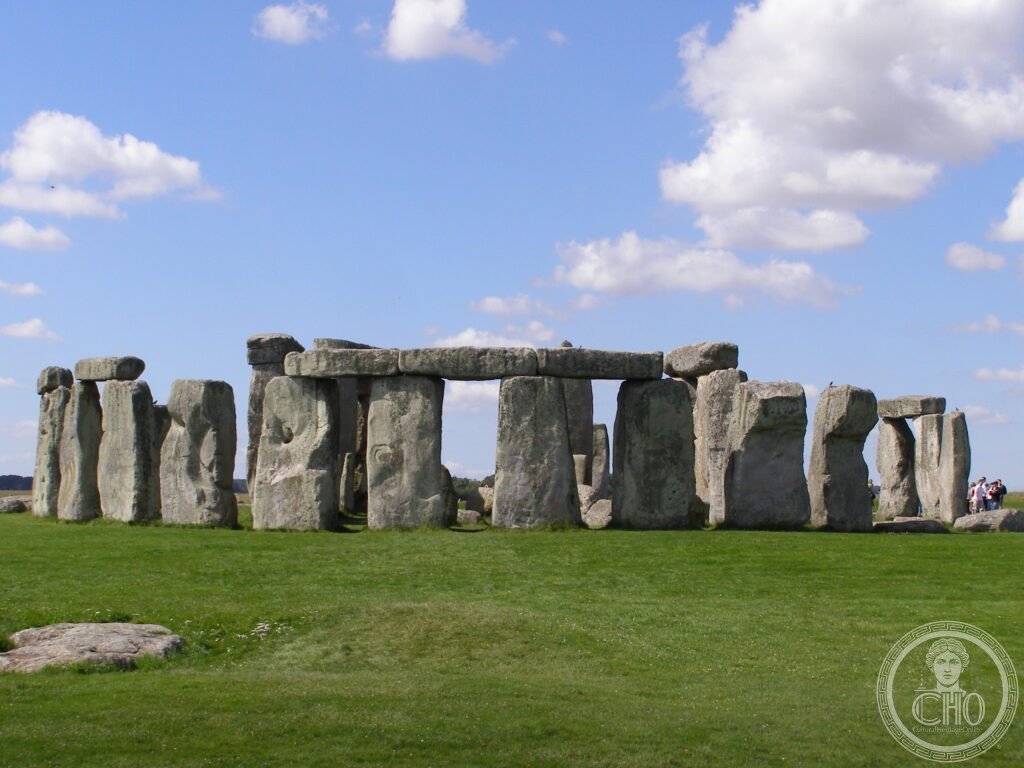
Stonehenge
The most recognized prehistoric monument on Earth and the Neolithic engineering project that moved 25-tonne sarsen stones 25 km from Marlborough Downs — Stonehenge (Wiltshire, England; UNESCO WHS 1986, jointly with Avebury) is a circular stone setting built in stages between approximately 3000 and 1500 BCE, precisely oriented to the summer solstice sunrise, and the most visited heritage site in England.
At a glance
Stonehenge (the most precisely Stonehenge single Neolithic Bronze Age 3000 BCE 1500 BCE Salisbury Plain Wiltshire England outer sarsen circle 2500 BCE 30 uprights 25 tonnes 4m tall lintels 7 tonnes mortise tenon joints inner trilithon horseshoe 5 trilithons 7m tall 50 tonnes Heel Stone summer solstice sunrise alignment Avebury henge 2 miles 11.5 hectares UNESCO heritage: the site (Stonehenge is located on Salisbury Plain in Wiltshire, approximately 130 km west of London; the site is part of a UNESCO-inscribed landscape that includes the Avebury stone circle (28 km north), the West Kennet Long Barrow (a Neolithic burial mound), Silbury Hill (the largest prehistoric human-made earthen mound in Europe), and numerous other Neolithic and Bronze Age earthworks in the wider Stonehenge and Avebury World Heritage Site)); the construction phases (Phase 1 (approximately 3000 BCE): the circular earthwork (ditch and bank) and the Aubrey holes (56 chalk-filled pits inside the bank) were dug; Phase 2 (approximately 2500-2000 BCE): the bluestones (approximately 80 dolerite stones from the Preseli Hills of Wales, 240 km away; weight 2-5 tonnes each) were transported to the site and erected; Phase 3 (approximately 2500 BCE): the sarsen stones (sandstone from Marlborough Downs, 25 km north; weight 25-50 tonnes each) were erected in the current concentric circle and trilithon horseshoe configuration)) — the most precisely Stonehenge single Neolithic Bronze Age 3000 BCE 1500 BCE Salisbury Plain outer sarsen circle 2500 BCE 30 uprights 25 tonnes 4m lintels 7 tonnes mortise tenon inner trilithon horseshoe 5 trilithons 7m 50 tonnes Heel Stone summer solstice Avebury UNESCO heritage in any UNESCO world heritage site)).
Key facts
- The Solstice Alignment: the most precisely Stonehenge single summer solstice sunrise June 21 Heel Stone alignment center monument Avenue earthwork 80m wide 3km NE astronomical orientation winter solstice sunset symmetry also aligned wider Preseli Hills Wales bluestones 240km transport sarsen Marlborough Downs 25km UNESCO heritage — the fundamental astronomical fact: the summer solstice sunrise alignment (on the morning of the summer solstice (June 21 in the Northern Hemisphere), the sun rises at its most northerly point on the horizon; at Stonehenge, the midsummer sunrise aligns precisely with the northeast opening of the monument and over the Heel Stone (the single isolated standing stone outside the entrance); as seen from the center of the circle, the sun rises directly over the top of the Heel Stone at the summer solstice; the Avenue (the earthwork processional approach to Stonehenge, 80m wide and 3 km long in the northeast direction) is aligned to the same northeast axis; the winter solstice sunset (December 21) is aligned in the opposite direction (the southwest axis), giving the monument a dual-solstice astronomical orientation; the fact that both alignments are symmetrical confirms that the astronomical orientation was intentional, not coincidental)
- GPS: 51.1789° N, -1.8262° W
History
From Neolithic earthwork to Bronze Age completion to medieval mystery (the most precisely Stonehenge single Phase 1 3000 BCE circular earthwork Aubrey holes 56 chalk pits Phase 2 2500 2000 BCE bluestones Preseli Wales 240km Phase 3 2500 BCE sarsen Marlborough Downs 25km trilithons lintels mortise tenon Beaker culture 2200 BCE Bell Beaker people Roman Geoffrey of Monmouth 1136 CE “dance of giants” King Arthurian myth Victorian Druid association modern solstice ceremony UNESCO heritage: the Neolithic and Bronze Age construction (Phase 1 (approximately 3000 BCE): the builders were Neolithic (pre-metal-using) farming communities of the British Isles; the circular ditch and bank (approximately 104m outer diameter) and the Aubrey holes (56 chalk-filled pits interpreted as possible cremation deposits or timber posts) were dug using deer antler picks and ox shoulder blade shovels (tools found at the site); Phase 2 (approximately 2500-2000 BCE): the bluestones arrived (80 dolerite stones from the Preseli Hills of Pembrokeshire, Wales, 240 km away; the transport method: raft on Bristol Channel + river + overland on wooden rollers; the average bluestone weighs 2-5 tonnes); Phase 3 (approximately 2500 BCE): the sarsen stones arrived (the sarsen stones are Palaeocene silcrete (silica-cemented sandstone) from Marlborough Downs, 25 km north; the largest sarsens weigh up to 50 tonnes; the transport method: sledges on greased wooden rails or rolling on wooden cylinders; the construction of the lintels used the mortise-and-tenon joint (the only prehistoric example of this carpentry joint transferred to stone construction))); the historical and medieval interpretation (Geoffrey of Monmouth (1136 CE; “Historia Regum Britanniae”) described Stonehenge as the “Dance of the Giants” transported from Ireland by Merlin for King Uther Pendragon; the association with Druids (the 18th century CE Romantic/Druidic revival associated Stonehenge with the Celtic Druid religion; however, the Druids appeared in Britain approximately 1,500 years after Stonehenge was completed)) — the most precisely Stonehenge single Phase 1 3000 BCE earthwork Aubrey holes 56 chalk Phase 2 2500 2000 BCE bluestones Preseli Wales 240km 2-5 tonnes Phase 3 2500 BCE sarsen Marlborough 25km 50 tonnes trilithons lintels mortise tenon Geoffrey Monmouth 1136 CE Dance Giants Merlin medieval UNESCO heritage in any UNESCO world heritage site)).
What you see
The sarsen circle, the trilithon horseshoe, and the Heel Stone (the most precisely Stonehenge single outer sarsen circle 30 uprights 25 tonnes 4m tall lintels 7 tonnes mortise tenon tongue groove inner trilithon horseshoe 5 trilithons 7m tall 50 tonnes Heel Stone summer solstice sunrise alignment Slaughter Stone Altar Stone bluestone circle inner UNESCO heritage: the visitor experience: the monument (visitors at Stonehenge walk around the monument on the path at a distance of approximately 5m; close access to the stones is not permitted in normal visits (the exception: the summer and winter solstice access days, when the public enters the monument for the dawn ceremony); the scale of the stones (the height and weight of the stones are only fully apparent when standing next to them; the 4m height of the sarsen uprights (plus 2m below ground) and the 7-tonne lintels above are not conveyed in photographs)); the key monuments: the Heel Stone (the single isolated standing stone outside the northeast entrance; the summer solstice sunrise aligns over it as seen from the center); the Slaughter Stone (a large prostrate sarsen near the northeast entrance; the name is a Victorian invention (red rain water on the stone in photographs was misidentified as blood)); the Altar Stone (a recumbent bluestone at the center of the monument; the most sacred point of the monument; fallen and now partially buried)); the visitor center (1.5 km from the monument; the museum with Neolithic and Bronze Age objects from excavations at Stonehenge; the 360° immersive video experience of the interior of Stonehenge at solstice)) — the most precisely Stonehenge single outer sarsen circle 30 uprights 4m tall 25 tonnes lintels 7 tonnes mortise tenon inner trilithon horseshoe 5 trilithons 7m 50 tonnes Heel Stone solstice sunrise Slaughter Stone Altar Stone visitor center 1.5km UNESCO heritage in any UNESCO world heritage site)).
Practical information
- Getting there: train from London Waterloo to Salisbury (1h30m; approximately £25-40; SWR trains); the Stonehenge Tour bus from Salisbury rail station (seasonal; approximately £16 adult round trip; runs every 30 minutes in the tourist season (April-October)); the entry ticket (English Heritage managed site; approximately £23 adult (2026 price); must be pre-booked online; timed-entry slots every 30 minutes); the drive from London (approximately 2h via A303; the distinctive A303 roadside view of Stonehenge from the car window is free and iconic); the solstice events (the summer solstice (June 21) and winter solstice (December 21) are the only days when free public access is granted to the stone circle itself (standing within the monument rather than walking the perimeter path); approximately 15,000-30,000 people attend the summer solstice; booking is not required for solstice access (first come, first served)); the Avebury connection (Avebury (28 km north; approximately 40 min drive) is included in the same UNESCO WHS; Avebury has free access (the stone circle is in the village; no ticket required) and is larger than Stonehenge in area)
Getting there
Train London Waterloo→Salisbury (1h30m, ~£25-40) then Stonehenge Tour bus (£16 round trip, seasonal). Entry ~£23, pre-book required. Drive from London ~2h via A303. Free access on summer/winter solstice. GPS: 51.1789, -1.8262.
Nearby
- Avebury — 28 km north (UNESCO WHS 1986 (same inscription as Stonehenge); the largest Neolithic stone circle in Europe (diameter 331m; the village of Avebury sits inside the stone circle); free access (no ticket, no barriers); the Alexander Keiller Museum at Avebury; the Avebury Manor and Garden (National Trust); the West Kennet Long Barrow (2 km south; a Neolithic communal burial chamber of approximately 3500 BCE; accessible and free))
- Salisbury Cathedral — 15 km south (the tallest medieval cathedral in England (123m spire; 1320 CE); the best-preserved original copy of Magna Carta (1215 CE; in the Chapter House of the Cathedral; the only copy of the 1215 original Magna Carta on public display in the world))
Sources
- Wikipedia, Stonehenge; Avebury; Preseli Hills, accessed June 2026
- UNESCO, Stonehenge, Avebury and Associated Sites, WHS reference 373bis, inscribed 1986
Find it on the map
See this place and what’s around it →📷 Diventa un fotografo di Cultural Heritage Online
Condividi le tue foto dei luoghi: restano pubblicate con la tua firma come autore. Più vengono viste, più ti fai conoscere — e presto un concorso premierà le foto più apprezzate.
Accedi o registrati gratis per aggiungere una foto