
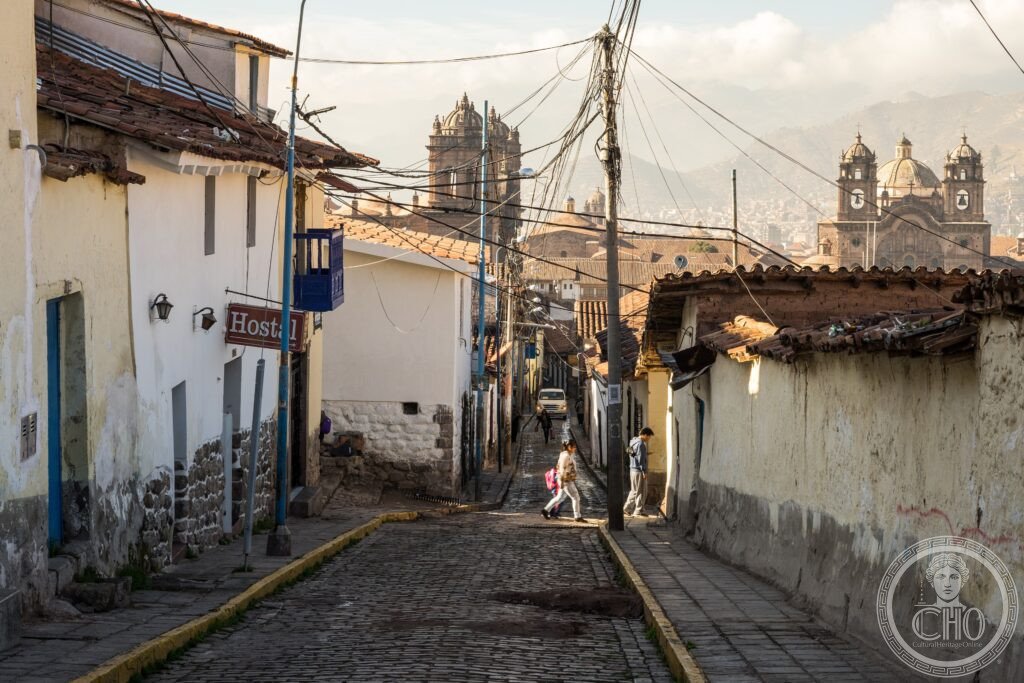
City of Cusco
The living capital of the Inca Empire, the center of the largest pre-Columbian state in the Americas, and one of the most complete examples of a colonial city built directly on top of an indigenous urban civilization — Cusco (Qosqo; Cusco Region, Peru; UNESCO WHS 1983) is a city at 3,400 meters where Inca ashlar masonry forms the lower courses of Spanish colonial churches, and where the grid of the Inca city still organizes the street plan of the modern city.
At a glance
Cusco (the most precisely CuscoCity single Inca capital Tawantinsuyu navel world Qosqo 1438 CE Pachacuti enlarged 4 suyus Qoricancha Temple Sun gold covered Sacsayhuamán fortress zigzag walls 300-tonne blocks Spanish colonial Cathedral 1654 CE 100 years built La Compañía Jesuit 1668 CE Plaza de Armas Huacaypata Cuzqueño School painting Marcos Zapata Last Supper cuy guinea pig Hiram Bingham Yale UNESCO heritage: the Inca city (Cusco was founded as a small settlement approximately 1200 CE (the Inca origin myth places it earlier, in approximately 1000 CE); the decisive expansion: Pachacuti Inca Yupanqui (r. 1438-1471 CE) rebuilt Cusco as the capital of the Tawantinsuyu (the “Four Quarters”; the Inca empire that at its peak extended from southern Colombia to central Chile, covering approximately 2 million km²)); the layout (the Inca city was designed in the shape of a puma (the most sacred animal in Inca cosmology): the head of the puma = Sacsayhuamán (the fortress on the hill above the city); the body = the urban center; the tail = the confluence of the Huatanay and Tullumayo rivers at the southern end of the city; the Qoricancha = the genitals of the puma (the most sacred location in the empire))); the colonial overlay (the Spanish conquistadors arrived in 1533 CE; the colonial city was built systematically on the foundations of the Inca city: the Cathedral of Cusco was built on the Inca palace of Viracocha (son of Pachacuti); the Church of La Compañía was built on the palace of Huayna Capac; the Convent of Santo Domingo was built on the Qoricancha)) — the most precisely CuscoCity single Inca capital Tawantinsuyu 1438 CE Pachacuti 4 suyus Qoricancha Temple Sun gold Sacsayhuamán 300-tonne blocks Cathedral 1654 CE 100 years La Compañía Jesuit 1668 Plaza de Armas Huacaypata Cuzqueño School Marcos Zapata Last Supper cuy UNESCO heritage in any UNESCO world heritage site)).
Key facts
- The Qoricancha: the most precisely CuscoCity single Qoricancha Temple Sun Inca gold walls 700 gold panels 2kg each stripped Pizarro ransom Atahualpa melt Spain convent Santo Domingo built on top lower walls visible earthquake reveals Inca masonry UNESCO heritage — the most sacred building in the Inca empire: the Qoricancha (Quechua: “golden enclosure”; also written “Coricancha”); the Inca descriptions (the interior walls were lined with approximately 700 gold panels (each approximately 2 kg; total gold: approximately 1.4 tonnes); the solid gold statue of the sun (“Punchao”; approximately 1m tall; the most important cult object in the empire) was positioned to catch the first light of the summer solstice sunrise through a precisely calibrated window; a solid gold garden (life-size gold models of maize plants, llamas, human figures, and insects) occupied the courtyard)); the desecration (1533 CE: Francisco Pizarro melted most of the gold to ransom the Inca Emperor Atahualpa (who had already been killed) and ship to Spain; the Punchao was removed and its location remains unknown; 1650 CE: the Convent of Santo Domingo was built on the Qoricancha foundations; the earthquake of 1650 CE partially destroyed the Spanish church and revealed the underlying Inca walls (now visible in the lower courses))
- GPS: -13.5170° S, -71.9780° W
History
From Inca capital to Spanish colonial center (the most precisely CuscoCity single Manco Capac founding 1200 CE Pachacuti 1438 CE expansion greatest Sapa Inca Tawantinsuyu 2 million km2 Francisco Pizarro 1532 CE Atahualpa capture Cajamarca ransom 24 tonnes gold silver 1533 Cusco fell Almagro 1535 Spanish city founded Cathedral 1654 La Compañía 1668 earthquake 1650 Inca walls revealed Great Inca Rebellion Túpac Amaru II 1781 UNESCO heritage: the pre-Inca and Inca periods (the region of Cusco has been inhabited since approximately 900 CE (archaeological evidence); the small Inca kingdom (approximately 1200-1438 CE: a minor regional power around the Cusco valley); the imperial expansion (1438 CE: Pachacuti Inca Yupanqui defeated the Chanka confederation and began the systematic conquest and expansion that transformed the Inca kingdom into the Tawantinsuyu; within 60 years, the Inca empire extended from Ecuador to Chile and Argentina; Pachacuti rebuilt Cusco in its puma shape and constructed the Qoricancha, the Sacsayhuamán, and Machu Picchu)); the Spanish conquest and colonial period (1532 CE: Francisco Pizarro and 168 Spanish soldiers captured the Inca Emperor Atahualpa at Cajamarca; Atahualpa offered a ransom of a room full of gold and two rooms of silver (approximately 24 tonnes of gold and silver; the largest ransom in history); Pizarro accepted the ransom, melted it, shipped it to Spain, and then killed Atahualpa anyway; 1533 CE: Cusco fell without significant resistance; 1535 CE: Diego de Almagro formally founded the Spanish city of Cusco on the Inca urban plan; the Cathedral of Cusco (1560-1654 CE: 100 years of construction; the largest church in Cusco; built with stone quarried from the Sacsayhuamán fortress)); the Cuzqueño School (the colonial-period school of painting (approximately 1650-1780 CE) that blended Spanish baroque with indigenous Andean iconography; the Cuzqueño School produced the most original art of the colonial Americas; key works: Marcos Zapata’s Last Supper (1753 CE; in the Cathedral of Cusco; showing guinea pig (cuy) and chicha corn beer on the table))) — the most precisely CuscoCity single Manco Capac founding 1200 CE Pachacuti 1438 CE Tawantinsuyu 2 million km2 Pizarro 1532 CE Atahualpa Cajamarca 24 tonnes gold ransom killed Cathedral 1560 1654 La Compañía 1668 Cuzqueño School Marcos Zapata Last Supper cuy UNESCO heritage in any UNESCO world heritage site)).
What you see
The Plaza de Armas, the Qoricancha, and Sacsayhuamán (the most precisely CuscoCity single Plaza de Armas Huacaypata Inca largest public space Cathedral 1654 CE Inca palace Viracocha foundations La Compañía Jesuit 1668 CE Huayna Capac palace Qoricancha Temple Sun Inca lower walls earthquake 1650 revealed convent Santo Domingo built atop Sacsayhuamán fortress zigzag walls 300 tonne blocks Coricancha Street Inca ashlar visible lower courses UNESCO heritage: the visitor circuit: the Plaza de Armas (the central square; the Cathedral of Cusco (1654 CE; 100 years to build; on the foundations of the Inca palace of Viracocha; the painting of the Last Supper with cuy (guinea pig) inside); the Church of La Compañía de Jesús (1668 CE; the most elaborate baroque façade in Peru; on the Inca palace of Huayna Capac)); the Qoricancha (the Temple of the Sun / Convent of Santo Domingo; the lower Inca masonry walls (the finest ashlar stonework in Cusco: perfectly fitted andesite blocks with trapezoidal niches; the walls survived the earthquake of 1650 CE while the Spanish construction above them was damaged); the two apse-shaped Inca rooms visible through the church); the Hatunrumiyoc (the street (“Street of the Great Stone”) where the famous 12-angled stone (the stone fitted into the wall with 12 distinct angles; the most often-photographed single stone in Cusco) is located)); the Sacsayhuamán (3 km north of the Plaza de Armas; the Inca fortress with the zigzag walls (3 terraced levels; the largest blocks weigh approximately 300 tonnes; the walls follow the contour of the hill in a zigzag pattern that creates multiple defensive angles); the view of the city from Sacsayhuamán) — the most precisely CuscoCity single Plaza de Armas Cathedral 1654 La Compañía 1668 Qoricancha Temple Sun Inca lower walls Santo Domingo convent Hatunrumiyoc 12-angled stone Sacsayhuamán 300-tonne blocks zigzag views city UNESCO heritage in any UNESCO world heritage site)).
Practical information
- Getting there: fly to Alejandro Velasco Astete International Airport (CUZ; Cusco; 5 km south of the Plaza de Armas; direct flights from Lima (LIM; LATAM/Avianca; 1h20m; approximately $80-150 USD); taxis from the airport (approximately $10 USD to the historic center)); the altitude (Cusco is at 3,399m; altitude sickness (soroche) is a real risk for visitors arriving from sea level; symptoms (headache, nausea, fatigue) begin within hours of arrival at altitude; recommendations: no alcohol on the first day, rest for 24h before strenuous activity, coca tea (mate de coca; widely available and mildly effective at altitude), and prescription acetazolamide (Diamox) for severe cases)); the Boleto Turístico (the unified heritage ticket for Cusco: approximately $40 USD for a partial circuit or $70 USD for the full circuit; covers Sacsayhuamán, Qenqo, Puca Pucara, Tambomachay, and the four regional archaeological sites (Pisac, Ollantaytambo, Chinchero, Moray)); the best time (May-October for dry season (less rain, clearer views); June is the busiest month (the Inti Raymi festival of the sun on June 24))
Getting there
Fly to Cusco (CUZ, 5 km from center). Flights from Lima ~1h20m, ~$80-150 USD. Altitude 3,400m — rest 24h on arrival, no alcohol, try coca tea. Boleto Turístico ~$40-70 USD. GPS: -13.5170, -71.9780.
Nearby
- Machu Picchu — 80 km northwest (UNESCO WHS 1983; the Inca citadel at 2,430m; train from Cusco to Aguas Calientes (3h30m); the most visited heritage site in South America)
- Ollantaytambo — 60 km northwest (the only town in Peru where the original Inca urban plan survives at street level; the massive Inca fortress and temple (the Temple of the Sun at Ollantaytambo was under construction when the Spanish arrived); the starting point for the Inca Trail to Machu Picchu (the 4-day trek); the original Inca storehouses (qollqas) visible on the hillside above the town)
Sources
- Wikipedia, Cusco; Qoricancha; Sacsayhuamán; Cuzco School, accessed June 2026
- UNESCO, City of Cuzco, WHS reference 273, inscribed 1983
Find it on the map
See this place and what’s around it →📷 Diventa un fotografo di Cultural Heritage Online
Condividi le tue foto dei luoghi: restano pubblicate con la tua firma come autore. Più vengono viste, più ti fai conoscere — e presto un concorso premierà le foto più apprezzate.
Accedi o registrati gratis per aggiungere una foto