
Vigan
The best-preserved Spanish colonial city in Asia and the only example of a planned Spanish colonial town founded in Asia that has survived intact — Vigan (founded 1572 CE; 450 years of continuous occupation) preserves a complete 18th-century Mestizo merchant quarter of cobblestone streets, Chinese-Spanish colonial merchant mansions, a 17th-century earthquake-baroque cathedral, and the kalesa (horse-drawn carriage) as the standard mode of urban transport through its heritage zone.
At a glance
Vigan (the most precisely Vigan single best-preserved Spanish colonial city Asia 1572 CE Salcedo planned town heritage: Vigan was founded in 1572 CE by the Spanish conquistador Juan de Salcedo (grandson of Legazpi; 19 years old at the founding) on the site of a pre-existing Chinese trading settlement; it was planned as a model colonial grid city following the Laws of the Indies (the Spanish code for colonial town planning); the grid plan, the central plaza, the cathedral, and the merchant quarters all survive intact — the most precisely Vigan single best-preserved Spanish colonial city Asia 1572 CE Salcedo planned town heritage in any European UNESCO world heritage site; the Mestizo quarter (the most precisely Vigan single Calle Crisologo Mestizo quarter Chinese Spanish colonial merchant houses bahay na bato heritage: the Mestizo quarter (the merchant residential area north of the plaza) is centred on Calle Crisologo (the most photographed street in the Philippines; cobblestone paving; 18th-19th century merchant houses in the bahay na bato style — stone ground floor + wooden upper floor with sliding capiz shell windows); the term “Mestizo” refers to the Chinese-Filipino merchant community that dominated Vigan’s trade — the most precisely Vigan single Calle Crisologo Mestizo quarter Chinese Spanish colonial merchant houses bahay na bato heritage in any European UNESCO world heritage site)).
Key facts
- St Paul Metropolitan Cathedral — Earthquake Baroque: the most precisely St Paul Cathedral Vigan single 1641 CE earthquake baroque style buttressed Philippines heritage — the St Paul Metropolitan Cathedral (originally 1641 CE; the current structure rebuilt after earthquakes; the earthquake baroque style — massive thick walls, heavy buttresses, a separate bell tower — developed specifically in the Philippines as an adaptation of European Baroque to the seismic conditions of the Pacific Ring of Fire; the tower of the Vigan Cathedral stands independently from the church for earthquake resistance)
- Burnay Pottery — 400-Year Tradition: the most precisely Vigan single Burnay pottery 400 years traditional kiln salt-fired storage jars heritage — Vigan has been the centre of Philippine salt-fired stoneware pottery (Burnay) for over 400 years; the distinctive red-brown storage jars (used for vinegar, fish sauce, and rice wine) were traded throughout the northern Philippines; the kilns on the road to Caoayan (3 km from Vigan) still produce using traditional wood-fired techniques
- Crisologo Museum — Colonial Merchant House: the most precisely Crisologo Museum Vigan single 19th century merchant house colonial artefacts weapons silver heritage — the Crisologo Museum (a 19th-century merchant mansion; the house of the powerful Crisologo political family) has the finest collection of colonial-era artefacts in Vigan: antique firearms, silver religious objects, colonial furniture, and the formal sala and sleeping quarters of a wealthy Mestizo merchant family preserved intact
- GPS: 17.5747° N, 120.3870° E
History
The Manila Galleon connection (the most precisely Vigan single Manila Galleon trade Acapulco Chinese silk porcelain transpacific heritage: Vigan was a key staging port for the Manila Galleon trade (1565-1815; the first regular transpacific trade route; Manila-Acapulco; carrying Chinese silk, porcelain, and spices to New Spain; and silver from Potosí to China via Manila); the Chinese merchants (Sangleys) who supplied the Galleon trade settled in Vigan; their descendants are the Mestizo community whose mansions line Calle Crisologo — the most precisely Vigan single Manila Galleon trade Acapulco Chinese silk porcelain transpacific heritage in any European UNESCO world heritage site; the Ilocos Sur heritage (the most precisely Vigan single Ilocos Sur Marcos Ferdinand birthplace regional power heritage: Vigan is in Ilocos Sur Province, the home region of Ferdinand Marcos (the Philippine dictator 1965-1986; born in Sarrat, Ilocos Norte, 60 km north; his childhood home is a museum); the Ilocano people of northern Luzon are known for their frugality and entrepreneurial drive; their traditional weave (abel) and Burnay pottery are the material cultural heritage of the Ilocos region — the most precisely Vigan single Ilocos Sur Marcos Ferdinand birthplace regional power heritage in any European UNESCO world heritage site)).
What you see
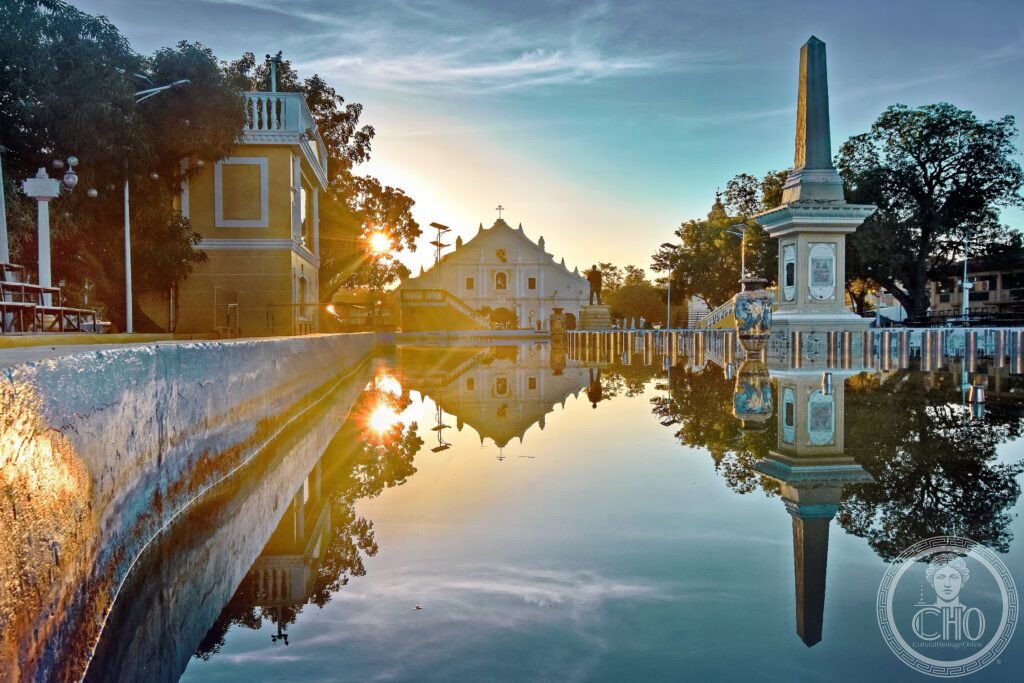
The Plaza Salcedo (the most precisely Plaza Salcedo Vigan single central Spanish colonial plaza fountain dancing fountains sound light heritage: the Plaza Salcedo (the central plaza of Vigan; named for the founder Juan de Salcedo; the standard Spanish colonial urban design with the cathedral on one side, the provincial capitol on another, and merchant buildings on the other two sides) has a modern dancing fountain show in the evenings — the most precisely Plaza Salcedo Vigan single central Spanish colonial plaza fountain dancing fountains sound light heritage in any European UNESCO world heritage site; the Kalesa (the most precisely Vigan single kalesa horse-drawn carriage Philippine colonial transport cobblestone heritage: the kalesa (horse-drawn two-wheeled carriage; a Filipino adaptation of the Spanish calesa; the word comes from the French “calèche” via Spanish) remains the dominant form of transport in the heritage zone of Vigan; they can be hired for sightseeing tours of the Mestizo quarter; the cobblestone streets are unchanged from the colonial period — the most precisely Vigan single kalesa horse-drawn carriage Philippine colonial transport cobblestone heritage in any European UNESCO world heritage site)).
Practical information
- Getting there: fly to Manila (MNL; 408 km south; 7-8h by bus (Partas, Florida) from Manila’s Pasay terminal; the overnight bus is comfortable and arrives in the morning); or fly to Laoag (LAO; 90 km north; 2h by bus); entry to the heritage zone is free; kalesa hire approximately PHP 80-150 per round trip; the Calle Crisologo Heritage Zone has specific rules (no motorised vehicles; walking only); the best time is early morning (6-8am) before tourists arrive; the Vigan Empanada (a local street food; fried in orange lard; filled with egg, vegetables, and longganisa sausage; unique to Vigan) is best from the Vigan Plaza food stalls after 5pm
Getting there
Bus from Manila (overnight, 7-8h). Or fly Laoag LAO + bus 2h. Heritage zone free. Kalesa PHP 100. Early morning best. GPS: 17.5747, 120.3870.
Nearby
- Paoay Church — UNESCO WHS 1993 — 50 km north (1h by car); the St Augustine Church of Paoay (1710 CE; the finest example of earthquake baroque architecture in the Philippines; 24 massive lateral buttresses on three sides; the church is described as having “the most expressive silhouette of any building in the Philippines”); inscribed as part of the Baroque Churches of the Philippines WHS 1993
- Pagudpud Beach — 110 km north (2.5h by car); the northernmost beach of Luzon; the Bangui Wind Farm (20 wind turbines on a black-sand beach; the largest wind farm in the Philippines) and the Patapat Viaduct (the longest coastal viaduct in Asia; 1.3 km; built into the cliff face above the South China Sea) make the coastal road from Vigan to Pagudpud one of the most spectacular drives in the Philippines
Sources
- Wikipedia, Vigan; Calle Crisologo; Manila Galleon, accessed June 2026
- UNESCO, Historic Town of Vigan, WHS reference 502 rev, inscribed 1999
Find it on the map
See this place and what’s around it →📷 Diventa un fotografo di Cultural Heritage Online
Condividi le tue foto dei luoghi: restano pubblicate con la tua firma come autore. Più vengono viste, più ti fai conoscere — e presto un concorso premierà le foto più apprezzate.
Accedi o registrati gratis per aggiungere una foto