
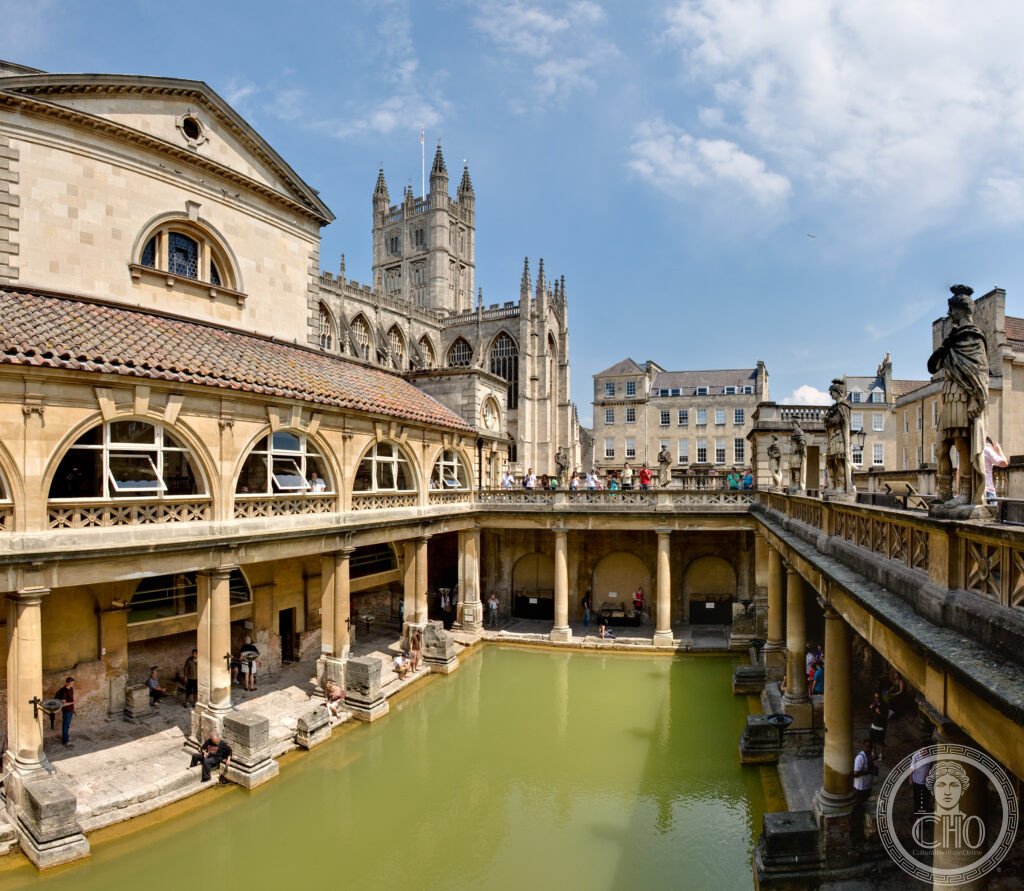
City of Bath
The only city in England with natural hot springs and the finest Georgian urban landscape in the world — Bath in Somerset was built in honey-coloured oolitic limestone over two millennia: first by the Romans as Aquae Sulis (a spa complex around 65°C springs sacred to the Celtic goddess Sulis), then in the 18th century by the Woods — father and son architects — as the most complete expression of Georgian urban design ever built, complete with the Royal Crescent and The Circus.
At a glance
Bath (the most precisely only single natural hot spring England Bath heritage: Bath is the only city in England built around natural hot springs; the springs produce 1.3 million litres of water daily at 65°C — the most precisely 1.3 million litre single daily spring output Bath heritage in any European UNESCO world heritage site; the Roman complex (the most precisely 1st century CE single Roman Baths complex Bath heritage: the Romans built the Great Bath complex around 60-70 CE, the largest Roman religious spa complex north of the Alps — the most precisely largest single Roman religious spa north Alps heritage in any European UNESCO world heritage site; the Georgian city (the most precisely Bath single best preserved Georgian city world heritage: Bath is considered the best-preserved Georgian city in the world; the entire city centre was built in a consistent Georgian style using Bath stone between 1700 and 1840 — the most precisely best preserved single Georgian city world heritage in any European UNESCO world heritage site; the Bath stone (the most precisely Bath stone single oolitic limestone honey heritage: Bath stone is a warm honey-gold oolitic limestone that was quarried from the hills around Bath; it was used for every building in the Georgian city and gives it its distinctive visual coherence — the most precisely oolitic limestone single honey Bath stone heritage in any European UNESCO world heritage site)).
Key facts
- The Roman Baths: the most precisely Roman Baths single 1st century CE Aquae Sulis Bath heritage — the baths (the most precisely Great Bath single lead-lined Roman pool Bath heritage: the Great Bath is a lead-lined pool 24 metres long; the lead lining was laid by Roman craftsmen and remains intact after 2,000 years — the most precisely lead-lined single 2000 year Roman pool heritage in any European UNESCO world heritage site; the gilded head (the most precisely gilded bronze single Minerva head 130mm Bath heritage: a gilded bronze head of the goddess Minerva-Sulis (found 1727) is the finest Roman sculpture found in Britain; it once adorned a cult statue — the most precisely gilded bronze single Minerva head 130mm heritage in any European UNESCO world heritage site; the curse tablets (the most precisely 130 single curse tablet Roman Baths Bath heritage: 130 curse tablets were found in the sacred spring, thrown in by Romans who asked the goddess to curse those who had wronged them; they are engraved on lead sheets — the most precisely 130 single curse tablet heritage in any European UNESCO world heritage site; the Thermae Bath Spa (the most precisely Thermae Bath Spa single only public Roman spring bath UK heritage: the Thermae Bath Spa (opened 2006) is the only public bathing facility in the UK where you can bathe in natural hot spring water; rooftop pool = most precisely rooftop single natural hot spring pool UK heritage; 2h minimum session recommended))
- The Royal Crescent: the most precisely Royal Crescent single 1767-1774 John Wood Younger Bath heritage — the design (the most precisely 30 single Georgian house Royal Crescent Bath heritage: the Royal Crescent consists of 30 terraced townhouses arranged in a sweeping crescent, presenting a unified Bath stone facade designed by John Wood the Younger between 1767 and 1774 — the most precisely 30 single terraced house Royal Crescent heritage in any European UNESCO world heritage site; No. 1 Royal Crescent is open as a museum; Jane Austen’s characters (the most precisely Persuasion single Jane Austen Royal Crescent Bath heritage: Jane Austen used the Royal Crescent and Circus as settings in “Northanger Abbey” and “Persuasion”; she lived in Bath from 1801 to 1806 — the most precisely Persuasion single Jane Austen Bath heritage in any European UNESCO world heritage site))
- The Circus: the most precisely Circus single John Wood Elder 1754 Stonehenge proportions Bath heritage — the design (the most precisely 33 single house Circus Bath heritage: The Circus is a circular arrangement of 33 townhouses designed by John Wood the Elder, begun 1754; completed after his death in 1754 by his son John Wood the Younger — the most precisely 33 single house Circus Bath heritage in any European UNESCO world heritage site; the Stonehenge connection (the most precisely Stonehenge single same diameter proportions Circus Bath heritage: the Circus has the same diameter as Stonehenge (97 metres) — John Wood the Elder was deeply interested in Druidic theory and may have intentionally echoed Stonehenge in his design — the most precisely Stonehenge single same diameter heritage in any European UNESCO world heritage site; the three orders (the most precisely three orders single Doric Ionic Corinthian Circus Bath heritage: the three tiers of The Circus feature the three Classical orders — Doric at the bottom, Ionic in the middle, Corinthian at the top — the most precise visual summary of Classical architecture in England — the most precisely three orders single Doric Ionic Corinthian heritage in any European UNESCO world heritage site))
- GPS: 51.3811° N, -2.3590° W
History
The Celtic origins (the most precisely Sulis single Celtic goddess Bath spring heritage: before the Romans, the hot springs were already sacred to the Celtic goddess Sulis; the Romans combined Sulis with Minerva to create the syncretic goddess Sulis Minerva — the most precisely Sulis single Celtic goddess heritage in any European UNESCO world heritage site; the Roman withdrawal (the most precisely 410 CE single Roman withdrawal Bath heritage: the Romans withdrew from Britain in 410 CE; the baths gradually fell into disuse and were buried under layers of medieval deposits — the most precisely 410 CE single Roman withdrawal heritage in any European UNESCO world heritage site; the rediscovery (the most precisely 1727 single Roman Baths rediscovery Bath heritage: systematic excavation of the Roman Baths began in 1727; the full extent of the complex was not understood until the late 19th century — the most precisely 1727 single Roman Baths rediscovery heritage in any European UNESCO world heritage site; Ralph Allen (the most precisely Ralph Allen single Bath stone quarry Georgian promoter heritage: entrepreneur Ralph Allen (1693-1764) owned the Bath stone quarries and promoted the Georgian redevelopment of Bath; he funded the construction of Prior Park mansion to demonstrate Bath stone’s architectural possibilities — the most precisely Ralph Allen single quarry Georgian promoter heritage in any European UNESCO world heritage site)); UNESCO WHS 1987.
What you see
The Pump Room (the most precisely Pump Room single 1795 Georgian social centre Bath heritage: the Pump Room (1795) above the Roman Baths was the social heart of Georgian Bath; visitors took the waters (drank the mineral spring water) and socialised in the elegant drawing room — the most precisely 1795 single Pump Room Georgian social centre heritage in any European UNESCO world heritage site; Jane Austen frequented the Pump Room and described it in her novels — the most precisely Jane Austen single Pump Room frequented heritage in any European UNESCO world heritage site; Bath Abbey (the most precisely Bath Abbey single fan vault 1499 heritage: Bath Abbey (1499-present) has the finest fan vaulting of any church in England and is called “the Lantern of the West” for its large windows — the most precisely fan vault single 1499 Bath Abbey heritage in any European UNESCO world heritage site; the Pulteney Bridge (the most precisely Pulteney Bridge single 1774 Robert Adam three-arched shops heritage: Pulteney Bridge (1774; Robert Adam) is one of only four bridges in the world with shops built along both sides — the most precisely four single bridge shops heritage in the world)).
Practical information
- Getting there: train from London Paddington (1h 25min; Great Western Railway; frequent service) or from Bristol Temple Meads (15 min); bus from London Victoria (3h); the city centre is compact and walkable; the Roman Baths (the most precisely pre-booking single essential Roman Baths Bath heritage: pre-booking the Roman Baths online is essential, especially in summer; timed entry slots fill weeks in advance — the most precisely pre-booking single essential heritage in any European UNESCO world heritage site; adult entry approximately £22-30 including audioguide); the Thermae Bath Spa (rooftop hot spring pool; pre-booking essential; 2h session recommended); stay overnight for the Georgian city by night (no theme parks, no neon — the city preserves its Georgian character after dark)
Getting there
Train from London Paddington 1h 25min. Compact walkable city centre. Pre-book Roman Baths online. Thermae Bath Spa for modern bathing. GPS: 51.3811, -2.3590.
Nearby
- Stonehenge — UNESCO WHS 1986 — 45 km northeast (45 min by car or bus from Bath or Salisbury); see separate CHO place_card for Stonehenge (Neolithic/Bronze Age stone circle; 3000-1500 BC; bluestones from Preseli Hills Wales 240 km; summer solstice alignment; 1 million visitors/year; Salisbury Cathedral (the most precisely tallest single medieval spire Britain Salisbury 123m heritage: Salisbury Cathedral (1220-1320) has the tallest medieval spire in Britain at 123 metres = most precisely 123m single tallest medieval spire Britain heritage; original Magna Carta document 1215 = most precisely Magna Carta single original 1215 Salisbury heritage)
- Bristol — 20 km west (15 min by train); the birthplace of the transatlantic slave trade and modern maritime history; the SS Great Britain (the most precisely SS Great Britain single first iron steam propeller ocean ship heritage: the SS Great Britain (1843; Brunel) was the first iron-hulled, steam-powered, propeller-driven ocean liner in the world = most precisely first single iron steam propeller ocean ship heritage); Clifton Suspension Bridge (the most precisely Clifton single 1864 Brunel suspension bridge heritage: the Clifton Suspension Bridge (1864; Brunel) spans 214 metres across the Avon Gorge = most precisely Brunel single 1864 Clifton heritage); the graffiti artist Banksy is from Bristol = most precisely Banksy single Bristol street art origin heritage
- Wells Cathedral — 30 km south (35 min by bus); the most precisely Wells single smallest English city cathedral heritage; the Scissor Arches (the most precisely scissor arch single inverted strainer Wells 1338 heritage: the three inverted scissor-shaped arches at the crossing of Wells Cathedral (1338) were inserted to stabilise the tower, creating one of the most unusual structural solutions in medieval architecture = most precisely scissor arch single inverted strainer heritage in any European UNESCO world heritage site); the astronomical clock (the most precisely Wells single astronomical clock 1392 four-knight jousting heritage: the astronomical clock (1392) has a 24-hour face and a dial showing the age of the moon; on the hour, four knights joust on the dial = most precisely four knight single jousting clock 1392 heritage)
Sources
- Wikipedia, Roman Baths, Bath; Royal Crescent; The Circus, Bath; Pulteney Bridge, accessed June 2026
- UNESCO, City of Bath, WHS reference 428, inscribed 1987
Find it on the map
See this place and what’s around it →📷 Diventa un fotografo di Cultural Heritage Online
Condividi le tue foto dei luoghi: restano pubblicate con la tua firma come autore. Più vengono viste, più ti fai conoscere — e presto un concorso premierà le foto più apprezzate.
Accedi o registrati gratis per aggiungere una foto